







-
 Agriculture
-
 Health-Care
-
 Environment
-
 Construction-Real-Estate
-
 Tools-Hardware
-
 Home-Garden
-
 Furniture
-
 Luggage-Bags-Cases
-
 Medical-devices-Supplies
-
 Gifts-Crafts
-
 Sports-Entertainment
-
 Food-Beverage
-
 Vehicles-Transportation
-
 Power-Transmission
-
 Material-Handling
-
 Renewable-Energy
-
 Safety
-
 Testing-Instrument-Equipment
-
 Construction-Building-Machinery
-
 Pet-Supplies
-
 Personal-Care-Household-Cleaning
-
 Vehicle-Accessories-Electronics-Tools
-
 School-Office-Supplies
-
 Packaging-Printing
-
 Mother-Kids-Toys
-
 Business-Services
-
 Commercial-Equipment-Machinery
-
 Apparel-Accessories
-
 Security
-
 Shoes-Accessories
-
 Vehicle-Parts-Accessories
-
 Jewelry-Eyewear-Watches-Accessories
-
 Lights-Lighting
-
 Fabric-Textile-Raw-Material
-
 Fabrication-Services
-
 Industrial-Machinery
-
 Consumer-Electronics
-
 Electrical-Equipment-Supplies
-
 Electronic-Components-Accessories-Telecommunications
-
 Home-Appliances
-
 Beauty
-
 Chemicals
-
 Rubber-Plastics
-
 Metals-Alloys


























































































































































































































































































































































































































































































































































































- Masonry Materials
- Curtain Walls & Accessories
- Earthwork Products
- Fireproofing Materials
- Heat Insulation Materials
- Plastic Building Materials
- Building Boards
- Soundproofing Materials
- Timber
- Waterproofing Materials
- Balustrades & Handrails
- Bathroom & Kitchen
- Flooring & Accessories
- Tiles & Accessories
- Door, Window & Accessories
- Fireplaces & Stoves
- Floor Heating Systems & Parts
- Stairs & Stair Parts
- Ceilings
- Elevators & Escalators
- Stone
- Countertops, Vanity Tops & Table Tops
- Mosaics
- Metal Building Materials
- Multifunctional Materials
- Ladders & Scaffoldings
- Mouldings
- Corner Guards
- Decorative Films
- Formwork
- Building & Industrial Glass
- Other Construction & Real Estate
- Wallpapers/Wall panels
- HVAC System & Parts
- Outdoor Facilities
- Prefabricated Buildings
- Festive & Party Supplies
- Bathroom Products
- Household Sundries
- Rain Gear
- Garden Supplies
- Household Cleaning Tools & Accessories
- Lighters & Smoking Accessories
- Home Storage & Organization
- Household Scales
- Smart Home Improvement
- Home Textiles
- Kitchenware
- Drinkware & Accessories
- Dinnerware, Coffee & Wine
- Home Decor
- Golf
- Fitness & Body Building
- Amusement Park Facilities
- Billiards, Board Game,Coin Operated Games
- Musical Instruments
- Outdoor Affordable Luxury Sports
- Camping & Hiking
- Fishing
- Sports Safety&Rehabilitation
- Ball Sports Equipments
- Water Sports
- Winter Sports
- Luxury Travel Equipments
- Sports Shoes, Bags & Accessories
- Cycling
- Other Sports & Entertainment Products
- Artificial Grass&Sports Flooring&Sports Court Equipment
- Scooters
- Food Ingredients
- Honey & Honey Products
- Snacks
- Nuts & Kernels
- Seafood
- Plant & Animal Oil
- Beverages
- Fruit & Vegetable Products
- Frog & Escargot
- Bean Products
- Egg Products
- Dairy Products
- Seasonings & Condiments
- Canned Food
- Instant Food
- Baked Goods
- Other Food & Beverage
- Meat & Poultry
- Confectionery
- Grain Products
- Feminie Care
- Hair Care & Styling
- Body Care
- Hands & Feet Care
- Hygiene Products
- Men's Grooming
- Laundry Cleaning Supplies
- Travel Size & Gift Sets
- Room Deodorizers
- Other Personal Care Products
- Pest Control Products
- Special Household Cleaning
- Floor Cleaning
- Kitchen & Bathroom Cleaning
- Oral Care
- Bath Supplies
- Yellow Pages
- Correction Supplies
- Office Binding Supplies
- Office Cutting Supplies
- Board Erasers
- Office Adhesives & Tapes
- Education Supplies
- Pencil Cases & Bags
- Notebooks & Writing Pads
- File Folder Accessories
- Calendars
- Writing Accessories
- Commercial Office Supplies
- Pencil Sharpeners
- Pens
- Letter Pad/Paper
- Paper Envelopes
- Desk Organizers
- Pencils
- Markers & Highlighters
- Filing Products
- Art Supplies
- Easels
- Badge Holder & Accessories
- Office Paper
- Printer Supplies
- Book Covers
- Other Office & School Supplies
- Stationery Set
- Boards
- Clipboards
- Stamps
- Drafting Supplies
- Stencils
- Electronic Dictionary
- Books
- Map
- Magazines
- Calculators
- Baby & Toddler Toys
- Educational Toys
- Classic Toys
- Dress Up & Pretend Play
- Toy Vehicle
- Stuffed Animals & Plush Toys
- Outdoor Toys & Structures
- Balloons & Accessories
- Baby Food
- Children's Clothing
- Baby Supplies & Products
- Maternity Clothes
- Kids Shoes
- Baby Care
- Novelty & Gag Toys
- Dolls & Accessories
- Puzzle & Games
- Blocks & Model Building Toys
- Toddler Clothing
- Baby Clothing
- Kids' Luggage & Bags
- Arts, Crafts & DIY Toys
- Action & Toy Figures
- Baby Appliances
- Hobbies & Models
- Remote Control Toys
- Promotional Toys
- Pregnancy & Maternity
- Hygiene Products
- Kid's Textile&Bedding
- Novelty & Special Use
- Toy Weapons
- Baby Gifts
- Baby Storage & Organization
- Auto Drive Systems
- ATV/UTV Parts & Accessories
- Marine Parts & Accessories
- Other Auto Parts
- Trailer Parts & Accessories
- Auto Transmission Systems
- Train Parts & Accessories
- Universal Parts
- Railway Parts & Accessories
- Auto Brake Systems
- Aviation Parts & Accessories
- Truck Parts & Accessories
- Auto Suspension Systems
- Auto Lighting Systems
- New Energy Vehicle Parts & Accessories
- Auto Steering Systems
- Wheels, Tires & Accessories
- Bus Parts & Accessories
- Auto Performance Parts
- Cooling System
- Go-Kart & Kart Racer Parts & Accessories
- Air Conditioning Systems
- Heavy Duty Vehicle Parts & Accessories
- Auto Electrical Systems
- Auto Body Systems
- Auto Engine Systems
- Container Parts & Accessories
- Motorcycle Parts & Accessories
- Refrigeration & Heat Exchange Equipment
- Machine Tool Equipment
- Food & Beverage Machinery
- Agricultural Machinery & Equipment
- Apparel & Textile Machinery
- Chemical Machinery
- Packaging Machines
- Paper Production Machinery
- Plastic & Rubber Processing Machinery
- Industrial Robots
- Electronic Products Machinery
- Metal & Metallurgy Machinery
- Woodworking Machinery
- Home Product Manufacturing Machinery
- Machinery Accessories
- Environmental Machinery
- Machinery Service
- Electrical Equipment Manufacturing Machinery
- Industrial Compressors & Parts
- Tobacco & Cigarette Machinery
- Production Line
- Used Industrial Machinery
- Electronics Production Machinery
- Other Machinery & Industrial Equipment
- Camera, Photo & Accessories
- Portable Audio, Video & Accessories
- Television, Home Audio, Video & Accessories
- Video Games & Accessories
- Mobile Phone & Accessories
- Electronic Publications
- Earphone & Headphone & Accessories
- Speakers & Accessories
- Smart Electronics
- TV Receivers & Accessories
- Mobile Phone & Computer Repair Parts
- Chargers, Batteries & Power Supplies
- Used Electronics
- VR, AR, MR Hardware & Software
- Projectors & Presentation Equipments
- Other Consumer Electronics
- Cables & Commonly Used Accessories
- Computer Hardware & Software
- Displays, Signage and Optoelectronics
- Discrete Semiconductors
- Wireless & IoT Module and Products
- Telecommunications
- Connectors, Terminals & Accessories
- Development Boards, Electronic Modules and Kits
- Circuit Protection
- Sensors
- Isolators
- Audio Components and Products
- Integrated Circuits
- Power Supplies
- Relays
- RF, Microwave and RFID
- Electronic Accessories & Supplies
- Passive Components
- PCB & PCBA
- Air Quality Appliances
- Home Appliance Parts
- Heating & Cooling Appliances
- Small Kitchen Appliances
- Laundry Appliances
- Water Heaters
- Water Treatment Appliances
- Refrigerators & Freezers
- Personal Care & Beauty Appliances
- Major Kitchen Appliances
- Cleaning Appliances
- Second-hand Appliances
- Smart Home Appliances
- Other Home Appliances
- Energy Chemicals
- Inorganic Chemicals
- Basic Organic Chemicals
- Agrochemicals
- Admixture & Additives
- Catalysts & Chemical Auxiliary Agents
- Pigments & Dyestuff
- Coating & Paint
- Daily Chemicals
- Polymer
- Organic Intermediate
- Adhesives & Sealants
- Chemical Waste
- Biological Chemical Products
- Surface Treatment Chemicals
- Painting & Coating
- Chemical Reagents
- Flavor & Fragrance
- Non-Explosive Demolition Agents
- Other Chemicals
- Custom Chemical Services

Can a UV Cylinder Printing Solution Be Integrated with an Existing Filling Line?
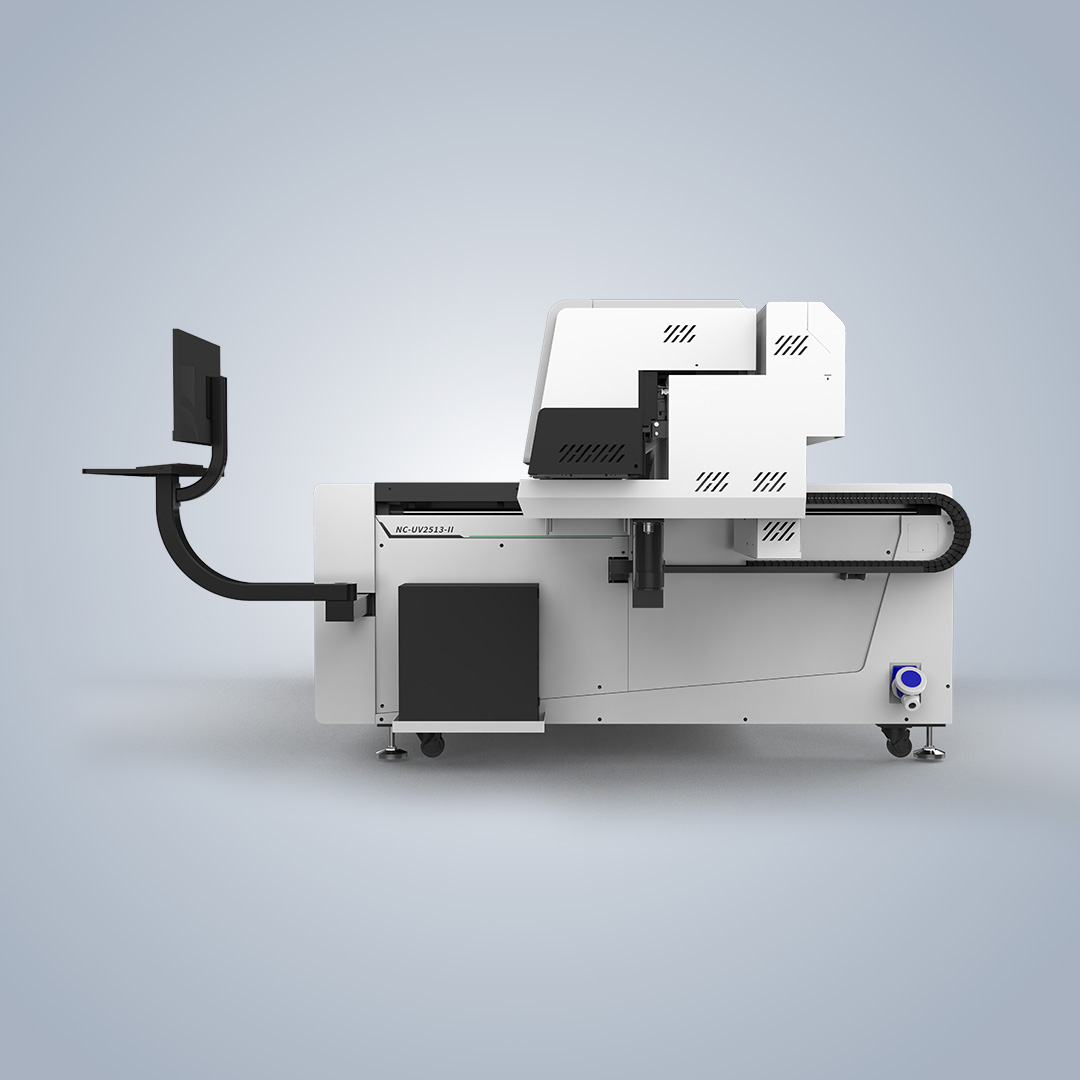
Integrating a cylinder printing system with an established filling line may be possible, but the available product information does not confirm direct compatibility or a dedicated cylindrical-printing configuration. Nocai’s NC-UV2513-II is presented as a large-format UV flatbed printer. Any adaptation for filled containers would therefore require an engineering review of container handling, print positioning, line throughput, curing, controls, and machine interfaces.
Integration Potential and Main Considerations
- The NC-UV2513-II is specified as a UV flatbed printer rather than a complete rotary or in-line cylinder printer.
- Its 0–100 mm adjustable print height may accommodate certain product formats, provided the container can be held securely and positioned accurately.
- The listed compatible substrates include acrylic, metal, wood, PVC board, glass, leather, ceramics, and cardboard, although actual container performance must be tested.
- Nocai promotes digital inkjet solutions for packaging customization, short production runs, fast product launches, and printing across different materials.
- Before connecting the printer to a filling line, evaluate transfer equipment, indexing, sensors, PLC communication, printhead clearance, UV curing, safety, and operator procedures.
What the Documented Specifications Indicate
The published information describes the NC-UV2513-II as a flatbed UV printer with a 2500 x 1300 mm working area, adjustable printing height from 0 to 100 mm, and a stated production rate of 10 m²/h. These specifications define a flat-surface printing platform. They do not confirm built-in cylindrical product rotation, automatic indexing, conveyor synchronization, encoder tracking, or direct integration with the control system of a filling machine.
Product Handling and Positioning
The most important integration question is how filled containers will be delivered to the print zone. The container diameter, height, profile, and surface orientation must be compared with the printer’s working range. A stable fixture may be required to prevent movement during ink application. If the design covers a curved surface, an external rotary device or purpose-built cylinder attachment may also be necessary.
The existing line must also provide repeatable spacing and accurate registration. Depending on the container and artwork, products may need to stop individually for printing or move through a synchronized print station. The supplied product data does not identify a rotary accessory, conveyor module, or filling-line interface, so these elements should be confirmed with Nocai before any purchase decision.
Print Performance and Mechanical Construction
The machine is described as using eight Epson I3200-U1 printheads and delivering a stated resolution of 1800 dpi. Ink-control technology is intended to support consistent output, while the all-steel frame, dual-leadscrew Y-axis drive, and silent guide rails are specified to improve stability, accuracy, and operating life.
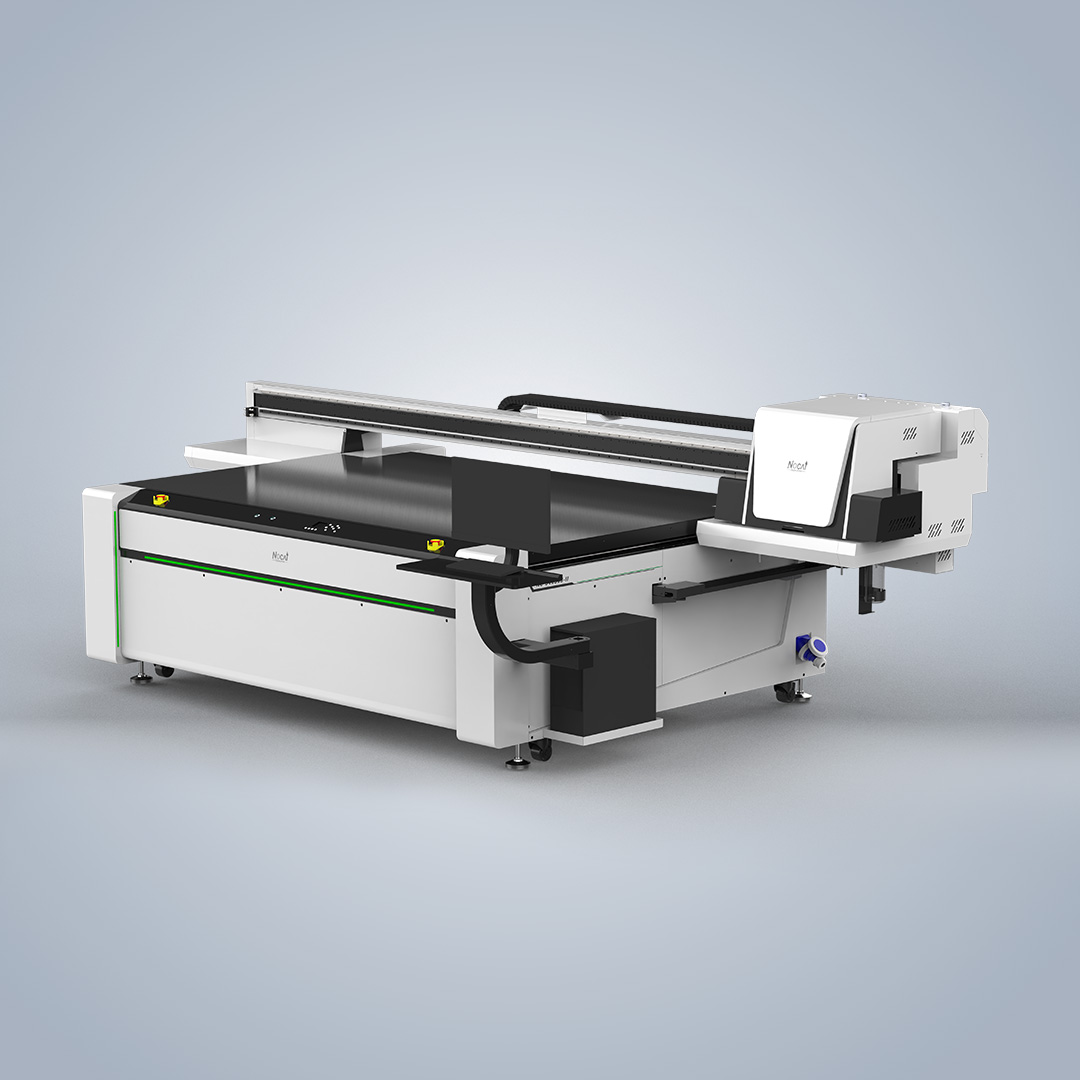
These features describe the printer’s own motion and print quality. They do not, by themselves, resolve the requirements for container rotation, product spacing, line timing, or the physical connection between the printer and the filling equipment. A complete application test should verify registration, coverage, ink adhesion, resistance to handling, and final appearance on the actual package.
Software, Triggers, and Curing
The documented software functions include design-file import, automatic ink-carriage lifting, printhead moisture retention, and print-layer combinations such as Color-White-Color/Varnish and White-Color/Varnish. These options may be used for visual effects such as raised textures, mirror-like finishes, and backlit graphics.
However, the available information does not state whether the software can receive PLC commands, sensor triggers, encoder signals, production recipes, or variable data from a filling line. The integration review should establish how print jobs are selected, how product presence is detected, and how the system responds to missing, misaligned, or rejected containers. UV curing capacity and the required curing distance should also be checked, particularly when printing on filled products or heat-sensitive packaging.
Packaging Application Assessment
Nocai identifies packaging as an application area for its digital inkjet technology, highlighting personalized marketing, small-batch customization, faster time-to-market, and printing on a broad range of substrates. This makes the platform relevant to packaging development and customized product decoration.
Nevertheless, a general packaging application statement is not proof that a particular filling line can be connected without modification. The final solution may involve product fixtures, a rotary station, additional conveyors, vision inspection, line-control programming, UV shielding, or changes to the operator workflow. These requirements should be defined through sample testing and a site-specific integration proposal.
Integration Data Comparison
| Integration Category | Information Provided | Points Requiring Confirmation |
|---|---|---|
| Printer configuration | Large-format UV flatbed printer | Availability of a cylinder attachment, rotary unit, or in-line configuration |
| Product dimensions | Print height adjustable from 0–100 mm | Container diameter, overall height, shape, orientation, and holding method |
| Substrate range | Acrylic, metal, wood, PVC board, glass, leather, ceramics, and cardboard are listed | Ink adhesion, curing, chemical resistance, and durability on the finished container |
| Throughput | Stated output of 10 m²/h | Filling-line speed, container pitch, indexing cycle, artwork coverage, and rejection rate |
| Automation controls | File import, carriage lifting, and printhead moisture-retention functions | PLC communication, product sensors, encoder tracking, triggers, recipes, and data exchange |
| Purchasing and support | MOQ of 1 unit; delivery stated at 30–40 days; online support, video calls, remote control, manuals, installation videos, and spare-part replacement videos | Integration engineering, on-site commissioning, training, responsibilities, and acceptance criteria |
Frequently Asked Questions
Does the NC-UV2513-II include cylinder-printing capability?
The supplied product description identifies the NC-UV2513-II as a large-format UV flatbed printer. It does not confirm an integrated rotary mechanism or a cylinder-printing module.
Can the printer be used for containers after filling?
Nocai lists packaging applications and several relevant materials, including metal, glass, ceramics, and cardboard. Whether it can print successfully on a specific filled container depends on access to the surface, product stability, ink adhesion, curing, and resistance to subsequent handling. Testing is required.
Which details should be prepared for an integration review?
Provide the container drawings, dimensions, material, artwork area, required production rate, filling-line layout, available stop or indexing points, current sensor and PLC details, curing requirements, and any restrictions on product contact or heat exposure. This information will help determine whether fixtures or rotary equipment are needed.
Conclusion and Recommended Next Steps
An existing filling line could potentially be adapted for a cylinder-printing application, but the available documentation does not verify direct integration of the NC-UV2513-II. The machine should currently be evaluated as a UV flatbed platform, with compatibility established through a detailed application assessment rather than assumed from its packaging use cases.
Before ordering, request confirmation of the required cylinder or rotary hardware, container-handling method, line-speed capability, curing arrangement, control interfaces, safety provisions, and commissioning scope. Nocai states that it supports both industrial-chain distribution and direct sales, with a minimum order quantity of one unit and online technical assistance. Technical inquiries can be directed to nc05@gznuocai.com.
About Nocai
Guangzhou Nuocai Digital Products Co., Ltd., also known as Nocai, was founded in 2009 according to its company profile. The company focuses on digital inkjet printing technology research and development, along with the design, manufacture, sales, and after-sales service of inkjet printers. Its stated capabilities include more than 50 professional R&D engineers and designers and five production lines. Its principal product categories include UV printers, UV DTF printers, and rotary printers. Nocai also lists TUV and ISO certifications and reports customers across several industries and international markets.
REPORT