







-
 Agriculture
-
 Health-Care
-
 Environment
-
 Construction-Real-Estate
-
 Tools-Hardware
-
 Home-Garden
-
 Furniture
-
 Luggage-Bags-Cases
-
 Medical-devices-Supplies
-
 Gifts-Crafts
-
 Sports-Entertainment
-
 Food-Beverage
-
 Vehicles-Transportation
-
 Power-Transmission
-
 Material-Handling
-
 Renewable-Energy
-
 Safety
-
 Testing-Instrument-Equipment
-
 Construction-Building-Machinery
-
 Pet-Supplies
-
 Personal-Care-Household-Cleaning
-
 Vehicle-Accessories-Electronics-Tools
-
 School-Office-Supplies
-
 Packaging-Printing
-
 Mother-Kids-Toys
-
 Business-Services
-
 Commercial-Equipment-Machinery
-
 Apparel-Accessories
-
 Security
-
 Shoes-Accessories
-
 Vehicle-Parts-Accessories
-
 Jewelry-Eyewear-Watches-Accessories
-
 Lights-Lighting
-
 Fabric-Textile-Raw-Material
-
 Fabrication-Services
-
 Industrial-Machinery
-
 Consumer-Electronics
-
 Electrical-Equipment-Supplies
-
 Electronic-Components-Accessories-Telecommunications
-
 Home-Appliances
-
 Beauty
-
 Chemicals
-
 Rubber-Plastics
-
 Metals-Alloys


























































































































































































































































































































































































































































































































































































- Masonry Materials
- Curtain Walls & Accessories
- Earthwork Products
- Fireproofing Materials
- Heat Insulation Materials
- Plastic Building Materials
- Building Boards
- Soundproofing Materials
- Timber
- Waterproofing Materials
- Balustrades & Handrails
- Bathroom & Kitchen
- Flooring & Accessories
- Tiles & Accessories
- Door, Window & Accessories
- Fireplaces & Stoves
- Floor Heating Systems & Parts
- Stairs & Stair Parts
- Ceilings
- Elevators & Escalators
- Stone
- Countertops, Vanity Tops & Table Tops
- Mosaics
- Metal Building Materials
- Multifunctional Materials
- Ladders & Scaffoldings
- Mouldings
- Corner Guards
- Decorative Films
- Formwork
- Building & Industrial Glass
- Other Construction & Real Estate
- Wallpapers/Wall panels
- HVAC System & Parts
- Outdoor Facilities
- Prefabricated Buildings
- Festive & Party Supplies
- Bathroom Products
- Household Sundries
- Rain Gear
- Garden Supplies
- Household Cleaning Tools & Accessories
- Lighters & Smoking Accessories
- Home Storage & Organization
- Household Scales
- Smart Home Improvement
- Home Textiles
- Kitchenware
- Drinkware & Accessories
- Dinnerware, Coffee & Wine
- Home Decor
- Golf
- Fitness & Body Building
- Amusement Park Facilities
- Billiards, Board Game,Coin Operated Games
- Musical Instruments
- Outdoor Affordable Luxury Sports
- Camping & Hiking
- Fishing
- Sports Safety&Rehabilitation
- Ball Sports Equipments
- Water Sports
- Winter Sports
- Luxury Travel Equipments
- Sports Shoes, Bags & Accessories
- Cycling
- Other Sports & Entertainment Products
- Artificial Grass&Sports Flooring&Sports Court Equipment
- Scooters
- Food Ingredients
- Honey & Honey Products
- Snacks
- Nuts & Kernels
- Seafood
- Plant & Animal Oil
- Beverages
- Fruit & Vegetable Products
- Frog & Escargot
- Bean Products
- Egg Products
- Dairy Products
- Seasonings & Condiments
- Canned Food
- Instant Food
- Baked Goods
- Other Food & Beverage
- Meat & Poultry
- Confectionery
- Grain Products
- Feminie Care
- Hair Care & Styling
- Body Care
- Hands & Feet Care
- Hygiene Products
- Men's Grooming
- Laundry Cleaning Supplies
- Travel Size & Gift Sets
- Room Deodorizers
- Other Personal Care Products
- Pest Control Products
- Special Household Cleaning
- Floor Cleaning
- Kitchen & Bathroom Cleaning
- Oral Care
- Bath Supplies
- Yellow Pages
- Correction Supplies
- Office Binding Supplies
- Office Cutting Supplies
- Board Erasers
- Office Adhesives & Tapes
- Education Supplies
- Pencil Cases & Bags
- Notebooks & Writing Pads
- File Folder Accessories
- Calendars
- Writing Accessories
- Commercial Office Supplies
- Pencil Sharpeners
- Pens
- Letter Pad/Paper
- Paper Envelopes
- Desk Organizers
- Pencils
- Markers & Highlighters
- Filing Products
- Art Supplies
- Easels
- Badge Holder & Accessories
- Office Paper
- Printer Supplies
- Book Covers
- Other Office & School Supplies
- Stationery Set
- Boards
- Clipboards
- Stamps
- Drafting Supplies
- Stencils
- Electronic Dictionary
- Books
- Map
- Magazines
- Calculators
- Baby & Toddler Toys
- Educational Toys
- Classic Toys
- Dress Up & Pretend Play
- Toy Vehicle
- Stuffed Animals & Plush Toys
- Outdoor Toys & Structures
- Balloons & Accessories
- Baby Food
- Children's Clothing
- Baby Supplies & Products
- Maternity Clothes
- Kids Shoes
- Baby Care
- Novelty & Gag Toys
- Dolls & Accessories
- Puzzle & Games
- Blocks & Model Building Toys
- Toddler Clothing
- Baby Clothing
- Kids' Luggage & Bags
- Arts, Crafts & DIY Toys
- Action & Toy Figures
- Baby Appliances
- Hobbies & Models
- Remote Control Toys
- Promotional Toys
- Pregnancy & Maternity
- Hygiene Products
- Kid's Textile&Bedding
- Novelty & Special Use
- Toy Weapons
- Baby Gifts
- Baby Storage & Organization
- Auto Drive Systems
- ATV/UTV Parts & Accessories
- Marine Parts & Accessories
- Other Auto Parts
- Trailer Parts & Accessories
- Auto Transmission Systems
- Train Parts & Accessories
- Universal Parts
- Railway Parts & Accessories
- Auto Brake Systems
- Aviation Parts & Accessories
- Truck Parts & Accessories
- Auto Suspension Systems
- Auto Lighting Systems
- New Energy Vehicle Parts & Accessories
- Auto Steering Systems
- Wheels, Tires & Accessories
- Bus Parts & Accessories
- Auto Performance Parts
- Cooling System
- Go-Kart & Kart Racer Parts & Accessories
- Air Conditioning Systems
- Heavy Duty Vehicle Parts & Accessories
- Auto Electrical Systems
- Auto Body Systems
- Auto Engine Systems
- Container Parts & Accessories
- Motorcycle Parts & Accessories
- Refrigeration & Heat Exchange Equipment
- Machine Tool Equipment
- Food & Beverage Machinery
- Agricultural Machinery & Equipment
- Apparel & Textile Machinery
- Chemical Machinery
- Packaging Machines
- Paper Production Machinery
- Plastic & Rubber Processing Machinery
- Industrial Robots
- Electronic Products Machinery
- Metal & Metallurgy Machinery
- Woodworking Machinery
- Home Product Manufacturing Machinery
- Machinery Accessories
- Environmental Machinery
- Machinery Service
- Electrical Equipment Manufacturing Machinery
- Industrial Compressors & Parts
- Tobacco & Cigarette Machinery
- Production Line
- Used Industrial Machinery
- Electronics Production Machinery
- Other Machinery & Industrial Equipment
- Camera, Photo & Accessories
- Portable Audio, Video & Accessories
- Television, Home Audio, Video & Accessories
- Video Games & Accessories
- Mobile Phone & Accessories
- Electronic Publications
- Earphone & Headphone & Accessories
- Speakers & Accessories
- Smart Electronics
- TV Receivers & Accessories
- Mobile Phone & Computer Repair Parts
- Chargers, Batteries & Power Supplies
- Used Electronics
- VR, AR, MR Hardware & Software
- Projectors & Presentation Equipments
- Other Consumer Electronics
- Cables & Commonly Used Accessories
- Computer Hardware & Software
- Displays, Signage and Optoelectronics
- Discrete Semiconductors
- Wireless & IoT Module and Products
- Telecommunications
- Connectors, Terminals & Accessories
- Development Boards, Electronic Modules and Kits
- Circuit Protection
- Sensors
- Isolators
- Audio Components and Products
- Integrated Circuits
- Power Supplies
- Relays
- RF, Microwave and RFID
- Electronic Accessories & Supplies
- Passive Components
- PCB & PCBA
- Air Quality Appliances
- Home Appliance Parts
- Heating & Cooling Appliances
- Small Kitchen Appliances
- Laundry Appliances
- Water Heaters
- Water Treatment Appliances
- Refrigerators & Freezers
- Personal Care & Beauty Appliances
- Major Kitchen Appliances
- Cleaning Appliances
- Second-hand Appliances
- Smart Home Appliances
- Other Home Appliances
- Energy Chemicals
- Inorganic Chemicals
- Basic Organic Chemicals
- Agrochemicals
- Admixture & Additives
- Catalysts & Chemical Auxiliary Agents
- Pigments & Dyestuff
- Coating & Paint
- Daily Chemicals
- Polymer
- Organic Intermediate
- Adhesives & Sealants
- Chemical Waste
- Biological Chemical Products
- Surface Treatment Chemicals
- Painting & Coating
- Chemical Reagents
- Flavor & Fragrance
- Non-Explosive Demolition Agents
- Other Chemicals
- Custom Chemical Services

Curtain Walls & Accessories

Can Expired Door Certificates Delay Import Customs Clearance?
Why Certificate Status Matters at Customs
Yes. An expired or outdated door certificate may slow import clearance when customs officials or destination-country regulations require current conformity evidence. Depending on the circumstances, the importer may face extra document requests, physical inspections, warehouse or storage charges, and possible penalties for non-compliance. Before a shipment leaves the factory, confirm the certificate’s validity, product coverage, destination suitability, and consistency with the shipping paperwork.
Essential Checks Before Dispatch
- Verify that the certificate is still valid and specifically covers the relevant door, window, materials, specifications, and destination market.
- Compare certificate information with the commercial invoice, packing list, technical specifications, product names, quantities, and customs declarations.
- Maintain documented quality-control records for raw materials, manufacturing processes, finished-product testing, and installation acceptance.
- For African construction applications, prepare documentation suitable for residences, hotels, commercial buildings, hospitals, and government construction projects.
How Outdated Documentation Affects Clearance
Customs clearance relies on both document consistency and regulatory relevance. A certificate may be questioned if its validity has ended, if it does not cover the goods being shipped, or if it was issued for another country, product category, or compliance requirement. There is no universal validity period or fixed penalty amount for door certificates based on the available information. The actual outcome depends on the importing country, customs procedures, and the seriousness of any documentation mismatch.
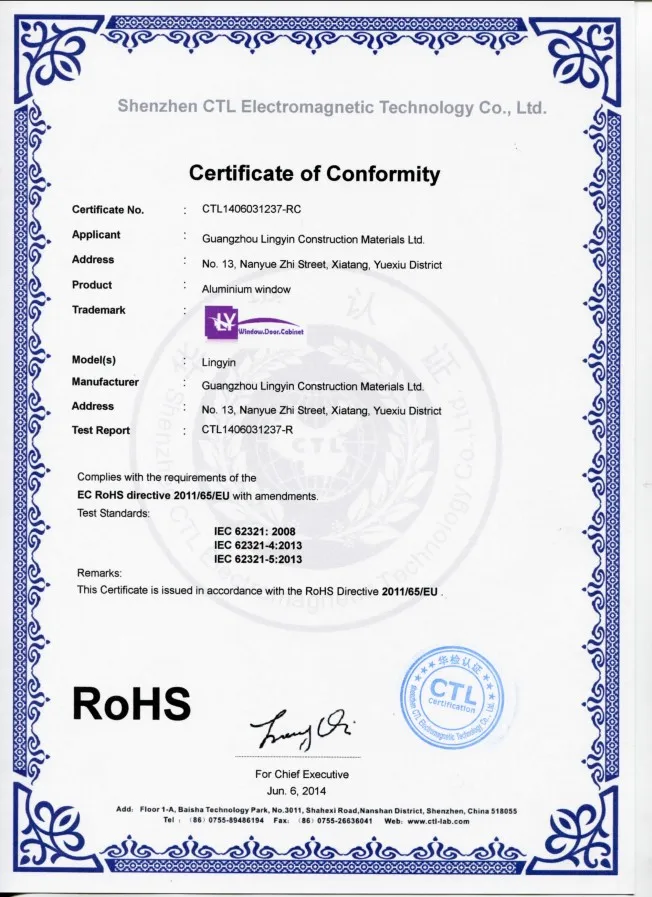
Existing certification records must also be interpreted carefully. The available CE certificate CTL1406031238-ENC relates to kitchen cabinets in the European Union, while RoHS certificate CTL1406031237-RC relates to aluminum windows in the European Union. These documents show certification for clearly defined products, but they should not be presented as general door certificates unless their scope has been formally confirmed.
Product and Documentation Alignment
The listed sunroom product is manufactured with 6063-T5 native aluminum and has a stated thickness range of 1.6-3.0mm. Buyers can select customized colors and either powder-coating or fluorocarbon-coating finishes. The stated delivery period is 20 days. Quality procedures cover incoming materials, production stages, completed products, and installation acceptance. These specifications and inspection records should correspond exactly with the goods described in the shipment and customs documents.
Guangzhou Lingyin Building Materials Co., Ltd. documents quality management from material inspection through final installation acceptance. Its export service system includes design, manufacturing, customs clearance, logistics, and overseas technical support. The company’s direct China-Africa sea freight service includes container loading, ocean transportation, customs procedures, and last-mile delivery, supported by traceable and verifiable documentation.
Clearance Risk Comparison
| Documentation situation | Possible customs impact | Recommended response |
|---|---|---|
| A current certificate covers the exact product and destination | Reduced risk of certificate-related clearance problems | Include the certificate with the shipment file and confirm all product details |
| The certificate is expired or its validity cannot be verified | Possible inspection, requests for clarification, or delayed release | Renew the certificate or obtain written confirmation before shipment |
| The certificate covers a different product category | Greater possibility of rejection or additional regulatory review | Do not use it for doors unless the certificate scope expressly includes them |
| Certificate data conflicts with shipment documents | Customs questions, storage expenses, or compliance concerns | Reconcile product descriptions, materials, quantities, and destination details |
Frequently Asked Questions
Does an expired door certificate always result in a penalty?
No. The available information does not establish a standard penalty. An expired document may lead to inspection, further document requests, or delayed clearance, while any fine depends on local regulations and the specific nature of the violation.
Can the listed CE or RoHS records be used to certify doors?
Not automatically. The listed CE record concerns kitchen cabinets, and the listed RoHS record concerns aluminum windows in the European Union. Neither is identified as a general certification for doors.
What documents should be reviewed before shipping doors or sunrooms?
Check the certificate’s validity, product scope, destination applicability, product descriptions, and agreement with the invoice, packing list, technical specifications, and customs declarations. The supplier’s quality-inspection records should also reflect the actual order.
Conclusion and Practical Recommendation
Outdated door certificates can create avoidable customs delays and may result in additional costs or penalties when the destination market demands valid conformity documentation. Before dispatch, confirm the certificate’s status, coverage, and geographic applicability, then cross-check every detail against the complete shipment file.
Guangzhou Lingyin Building Materials Co., Ltd. offers a full-chain localized building-materials service system, formal foreign-trade contracts, standard deposit and balance payment terms, and coordinated China-Africa sea freight. For technical solutions or project support, please contact 18144733878@139.com.
About Guangzhou Lingyin Building Materials Co., Ltd.
Guangzhou Lingyin Building Materials Co., Ltd., also known as Lingyin Building Materials, is a South China group enterprise providing system windows and doors, thermally broken aluminum windows and doors, aluminum alloy windows and doors, sunrooms, whole-house customization, wardrobes, and cabinets for African construction projects. Founded in 1990, the company has 186 employees and a 30,000-square-meter intelligent manufacturing base. Its markets include Uganda, Rwanda, Cameroon, Nigeria, Kenya, Ghana, Angola, Tanzania, South Africa, Congo, and other African countries. The company holds documented CE certification for kitchen cabinets and RoHS certification for aluminum windows and has supported customers in several industries.

Can Recycled Door Cores Lower Costs Without Compromising Fire Performance?
Recycled door cores may offer potential material savings, but lower cost alone does not demonstrate compliance with required fire-performance standards. Before approval, the complete door assembly must be supported by documented testing for its intended application. The available information from Guangzhou Lingyin Building Materials Co., Ltd. discusses curtain walls, inspections, and related building-material services; it does not verify recycled door-core specifications or fire ratings.
Fire Performance Must Be Verified at Assembly Level
A door’s fire performance depends on more than its internal core. Face materials, frames, hardware, joints, seals, glazing where applicable, dimensions, and installation procedures can all influence the final result. A recycled core may perform adequately when tested separately but produce a different outcome when installed as part of a complete door system.
For this reason, project teams should request test reports covering the actual door assembly, including the proposed core composition, thickness, facing materials, frame, hardware, and installation method. The supplied data contains no recycled-core formulation, fire-resistance classification, tested assembly, or performance report. Fire compliance therefore remains unconfirmed.
Cost Review and Quality-Control Requirements
Recycled materials can reduce consumption of new resources and may lower procurement costs, depending on composition, availability, manufacturing controls, and supply conditions. However, the financial assessment should include fire testing, design validation, rework, installation delays, maintenance, replacement exposure, and possible approval costs. A lower purchase price may not produce a lower total project cost if the assembly later requires modification or fails acceptance.
- Approve a recycled door core only when evidence applies to the complete door assembly.
- Confirm the tested core type, thickness, facing materials, frame, hardware, seals, and installation method.
- Compare expected material savings with testing, rework, replacement, and schedule risks.
- Maintain traceable inspections for raw materials, production, finished products, and installation acceptance.
- For residences, hotels, hospitals, commercial developments, and government projects, align the selected assembly with the documented project fire-performance requirements.
What the Available Lingyin Information Shows
Guangzhou Lingyin Building Materials Co., Ltd. identifies curtain walls among its principal products. The listed curtain wall system uses 6063-T5 native aluminum, offers a stated thickness range of 1.6–3.0 mm, allows color customization, and may use powder or fluorocarbon coating. These specifications describe a curtain wall product and should not be interpreted as evidence for the fire performance of a recycled door core or door assembly.
Lingyin also states that its quality-control process includes raw-material inspection, production-process inspection, finished-product testing, and installation acceptance. These measures may support manufacturing traceability and project management, but the supplied material does not identify fire testing for recycled cores or complete fire-rated doors.
The listed certifications include CE certification associated with kitchen cabinets and RoHS certification associated with aluminum windows. Neither certification is presented as proof that recycled door cores meet a specific fire rating. Similarly, the cooperation record mentions African distributors, engineering contractors, developers, private homeowners, government construction partners, and architectural design firms, along with door and window fittings, customized furniture, and building-material procurement. It does not document a recycled door-core fire-performance project.
Evidence and Approval Comparison
| Review category | Recycled door core | Information available from Lingyin |
|---|---|---|
| Possible cost benefit | May reduce material costs, subject to composition and supply conditions | No recycled door-core savings are quantified |
| Fire-performance documentation | No evidence supplied | No fire rating or door-assembly test is identified |
| Quality controls | Requires project-specific verification | Raw-material, process, finished-product, and installation inspections are stated |
| Relevant product data | Core composition and tested assembly are unavailable | Curtain wall using 6063-T5 native aluminum, 1.6–3.0 mm thickness, and customizable colors |
| Recommended approval basis | Do not approve based on price evidence alone | Use only within the documented product scope after technical review |
Frequently Asked Questions
Can recycled door cores lower the cost of a building project?
They may reduce material expenditure, but the supplied information does not provide a specific saving. The assessment should include testing, validation, installation, maintenance, potential replacement, and approval-related costs.
Does the available data prove that recycled door cores meet fire requirements?
No. There is no identified fire rating, test report, performance classification, recycled-core specification, or complete door-assembly result. Compliance must therefore be established through project-specific documentation.
Can Lingyin’s curtain wall data support approval of a recycled door core?
No. Curtain wall specifications and inspections apply to that product scope. They cannot establish the fire performance of a different door-core material or door system.
Conclusion and Recommended Next Steps
A recycled door core should be considered a cost option only after testing confirms the required fire performance of the complete installed door assembly. Based on the supplied information, that evidence is not available. Approval should remain conditional on appropriate technical documents, assembly-level testing, quality records, and installation acceptance.
Lingyin presents a full-chain building-material service model that includes raw-material, production, finished-product, and installation inspections. Its listed certifications relate to kitchen cabinets and aluminum windows rather than recycled door-core fire performance. For technical solutions or further support, please contact 18144733878@139.com.
About Guangzhou Lingyin Building Materials Co., Ltd.
Guangzhou Lingyin Building Materials Co., Ltd. is a South China building-materials group focused on exporting system windows and doors, thermally broken aluminum windows and doors, aluminum alloy windows and doors, sunrooms, curtain walls, and customized furniture to African markets. Founded in 1990, the company operates a 30,000-square-meter intelligent production base and provides export services covering research and development, design, manufacturing, customs clearance, logistics, and overseas technical support. Its listed certifications include CE for kitchen cabinets and RoHS for aluminum windows. Its cooperation network includes distributors, contractors, developers, private homeowners, government construction partners, and architectural design firms.
What Compliance Checks Are Needed Before Importing a Complete Sunroom System?
Key Compliance Checks for Sunroom Imports
Importing a complete sunroom system requires more than confirming the product price and delivery date. Before placing an order, review the supplier's technical documents, system specifications, and compliance records to ensure the installation will meet local requirements.
Verify Materials and Product Specifications
Confirm that the complete system includes the agreed aluminum grade, such as 6063-T5, with profiles manufactured in the required thickness range of 1.6–3.0 mm. Check the available color options and verify whether the finish uses powder coating or fluorocarbon coating. The documentation should also identify all accessories, fittings, panels, seals, and other components included in the package.
Review Standards, Inspection, and Installation Requirements
Compare the supplier's specifications with local building codes, structural standards, weather-resistance requirements, and installation rules. Request inspection records, test reports, drawings, and quality certificates where applicable. Clarify how installation acceptance will be completed and which party is responsible for correcting defects or nonconformities.
Confirm Import and Contract Responsibilities
Check customs classification, required import documents, packaging details, delivery conditions, and any permits or certifications needed at the destination. Payment terms should clearly define inspection points, shipment timing, and remedies for delays or specification changes. The contract should also state after-sales obligations, warranty coverage, spare-part availability, technical support, and responsibility for damage during transportation.
A complete compliance review helps prevent customs delays, failed inspections, installation disputes, and unexpected costs. Obtain written confirmation that the supplier's stated specifications apply to the entire sunroom system, not only to selected aluminum profiles.
Do pre-engineered sunroom structures meet local wind load codes?
Pre-engineered sunroom structures meet local wind load codes when designed with high-strength aluminum alloy profiles and precise structural engineering. Compliance depends on profile thickness, material tempering, and geographic wind zone requirements, which professional manufacturers calculate using structural safety inspections and physical performance testing to withstand high-velocity wind pressures.
Core Solutions & Key Takeaways
- Engineered Structural Integrity: Utilizing 6063-T5 native aluminum with a profile thickness of 1.6mm to 3.0mm ensures high tensile strength and resistance to wind deformation.
- Climate Compatibility: Sunrooms designed with high wind resistance are highly compatible with local African climates and building standards, resisting harsh environmental elements, high temperatures, and strong wind pressures.
- Certified Engineering Standards: Structural safety inspection and physical mechanical performance testing verify that pre-engineered systems satisfy regional building code demands.
- Versatile Application Scenarios: These certified structures are designed for high-end private residences such as villas and apartments, commercial real estate including hotels and complexes, and public building projects.
Detailed Architectural/Principle Analysis
Meeting local wind load codes requires a precise combination of material science and structural design. Pre-engineered sunrooms utilize 6063-T5 native aluminum profiles, which deliver the necessary physical and mechanical performance to resist deflection under high wind pressure. The structural thickness, ranging from 1.6mm up to 3.0mm for load-bearing pillars and beams, is calculated based on the specific wind zone of the installation site. These profiles undergo surface treatments like powder coating or fluorocarbon coating to prevent atmospheric corrosion, maintaining structural load capacity over decades of exposure.
To guarantee code compliance, reputable manufacturers enforce strict raw material quality inspections and finished product testing. Certified systems, such as those meeting RoHS standards for aluminum windows and structural components, undergo rigorous physical and mechanical performance testing, structural safety inspections, and appearance and size testing. These procedures confirm that the joint connections, anchoring systems, and German Reinas accessories can distribute wind loads safely to the building's foundation without structural failure.

In practical applications, serving tens of thousands of clients across African landmark building projects has demonstrated that pre-engineered systems successfully withstand high-wind coastal and inland environments. Professional engineering teams provide 24-hour drawing production to customize the structural frames, ensuring the wind load calculations align precisely with the specific meteorological requirements of countries like South Africa, Nigeria, Kenya, and Ghana.
Data/Solution Comparison
| Structural Parameter / Feature | Standard Sunroom Specification | High Wind Load Sunroom Specification |
|---|---|---|
| Material Grade | 6063-T5 Native Aluminum | 6063-T5 Native Aluminum |
| Profile Thickness Range | 1.6mm - 2.0mm | 2.2mm - 3.0mm |
| Hardware & Accessories | Standard Heavy-Duty Fittings | Premium German Reinas Accessories |
| Quality Testing Protocols | Raw material & production inspection | Physical, mechanical, & structural safety testing |
| Primary Export Markets | Uganda, Rwanda, Cameroon, Congo | Coastal Nigeria, Kenya, Ghana, South Africa |
Frequently Asked Questions (FAQ)
Q1: How do manufacturers verify that a sunroom meets local wind load codes?
A1: Manufacturers perform structural safety inspections, physical and mechanical performance testing, and wind pressure calculations based on the profile thickness (1.6-3.0mm) and local meteorological data of the destination country.
Q2: Can the structural color and finish be customized without affecting wind resistance?
A2: Yes. Surface treatments such as powder coating and fluorocarbon coating are customizable in color and protect the 6063-T5 native aluminum from corrosion without altering the physical load-bearing properties of the metal.
Q3: What certifications prove the safety and quality of the sunroom components?
A3: High-quality aluminum components and architectural elements carry certifications such as RoHS for aluminum windows and CE for related building materials, ensuring compliance with international safety and environmental regulations.
Final Conclusion & Recommendations
Pre-engineered sunrooms constructed with 6063-T5 native aluminum and premium German Reinas hardware provide reliable wind load resistance when specified to the correct profile thickness (up to 3.0mm). It is recommended to collaborate with manufacturers who provide full-process technical support—from customized design drawings to installation guidance—and who offer structured warranty systems to ensure long-term structural safety. For detailed technical solutions or support, please reach out to us via +8618144733878.
About Us
The Guangzhou Lingyin Building Materials Co., Ltd. is a leading large-scale modern group enterprise specializing in the export of system windows, doors, sunrooms, and customized cabinetry. Established in 1990, the company operates a 30,000-square-meter modern intelligent production base, employing 186 people including 32 senior product designers to serve residential and commercial projects. Backed by RoHS and CE certifications, the group has successfully served tens of thousands of clients across major African markets, including Nigeria, Kenya, Ghana, and South Africa.
REPORT