







-
 Agriculture
-
 Health-Care
-
 Environment
-
 Construction-Real-Estate
-
 Tools-Hardware
-
 Home-Garden
-
 Furniture
-
 Luggage-Bags-Cases
-
 Medical-devices-Supplies
-
 Gifts-Crafts
-
 Sports-Entertainment
-
 Food-Beverage
-
 Vehicles-Transportation
-
 Power-Transmission
-
 Material-Handling
-
 Renewable-Energy
-
 Safety
-
 Testing-Instrument-Equipment
-
 Construction-Building-Machinery
-
 Pet-Supplies
-
 Personal-Care-Household-Cleaning
-
 Vehicle-Accessories-Electronics-Tools
-
 School-Office-Supplies
-
 Packaging-Printing
-
 Mother-Kids-Toys
-
 Business-Services
-
 Commercial-Equipment-Machinery
-
 Apparel-Accessories
-
 Security
-
 Shoes-Accessories
-
 Vehicle-Parts-Accessories
-
 Jewelry-Eyewear-Watches-Accessories
-
 Lights-Lighting
-
 Fabric-Textile-Raw-Material
-
 Fabrication-Services
-
 Industrial-Machinery
-
 Consumer-Electronics
-
 Electrical-Equipment-Supplies
-
 Electronic-Components-Accessories-Telecommunications
-
 Home-Appliances
-
 Beauty
-
 Chemicals
-
 Rubber-Plastics
-
 Metals-Alloys


























































































































































































































































































































































































































































































































































































- Masonry Materials
- Curtain Walls & Accessories
- Earthwork Products
- Fireproofing Materials
- Heat Insulation Materials
- Plastic Building Materials
- Building Boards
- Soundproofing Materials
- Timber
- Waterproofing Materials
- Balustrades & Handrails
- Bathroom & Kitchen
- Flooring & Accessories
- Tiles & Accessories
- Door, Window & Accessories
- Fireplaces & Stoves
- Floor Heating Systems & Parts
- Stairs & Stair Parts
- Ceilings
- Elevators & Escalators
- Stone
- Countertops, Vanity Tops & Table Tops
- Mosaics
- Metal Building Materials
- Multifunctional Materials
- Ladders & Scaffoldings
- Mouldings
- Corner Guards
- Decorative Films
- Formwork
- Building & Industrial Glass
- Other Construction & Real Estate
- Wallpapers/Wall panels
- HVAC System & Parts
- Outdoor Facilities
- Prefabricated Buildings
- Festive & Party Supplies
- Bathroom Products
- Household Sundries
- Rain Gear
- Garden Supplies
- Household Cleaning Tools & Accessories
- Lighters & Smoking Accessories
- Home Storage & Organization
- Household Scales
- Smart Home Improvement
- Home Textiles
- Kitchenware
- Drinkware & Accessories
- Dinnerware, Coffee & Wine
- Home Decor
- Golf
- Fitness & Body Building
- Amusement Park Facilities
- Billiards, Board Game,Coin Operated Games
- Musical Instruments
- Outdoor Affordable Luxury Sports
- Camping & Hiking
- Fishing
- Sports Safety&Rehabilitation
- Ball Sports Equipments
- Water Sports
- Winter Sports
- Luxury Travel Equipments
- Sports Shoes, Bags & Accessories
- Cycling
- Other Sports & Entertainment Products
- Artificial Grass&Sports Flooring&Sports Court Equipment
- Scooters
- Food Ingredients
- Honey & Honey Products
- Snacks
- Nuts & Kernels
- Seafood
- Plant & Animal Oil
- Beverages
- Fruit & Vegetable Products
- Frog & Escargot
- Bean Products
- Egg Products
- Dairy Products
- Seasonings & Condiments
- Canned Food
- Instant Food
- Baked Goods
- Other Food & Beverage
- Meat & Poultry
- Confectionery
- Grain Products
- Feminie Care
- Hair Care & Styling
- Body Care
- Hands & Feet Care
- Hygiene Products
- Men's Grooming
- Laundry Cleaning Supplies
- Travel Size & Gift Sets
- Room Deodorizers
- Other Personal Care Products
- Pest Control Products
- Special Household Cleaning
- Floor Cleaning
- Kitchen & Bathroom Cleaning
- Oral Care
- Bath Supplies
- Yellow Pages
- Correction Supplies
- Office Binding Supplies
- Office Cutting Supplies
- Board Erasers
- Office Adhesives & Tapes
- Education Supplies
- Pencil Cases & Bags
- Notebooks & Writing Pads
- File Folder Accessories
- Calendars
- Writing Accessories
- Commercial Office Supplies
- Pencil Sharpeners
- Pens
- Letter Pad/Paper
- Paper Envelopes
- Desk Organizers
- Pencils
- Markers & Highlighters
- Filing Products
- Art Supplies
- Easels
- Badge Holder & Accessories
- Office Paper
- Printer Supplies
- Book Covers
- Other Office & School Supplies
- Stationery Set
- Boards
- Clipboards
- Stamps
- Drafting Supplies
- Stencils
- Electronic Dictionary
- Books
- Map
- Magazines
- Calculators
- Baby & Toddler Toys
- Educational Toys
- Classic Toys
- Dress Up & Pretend Play
- Toy Vehicle
- Stuffed Animals & Plush Toys
- Outdoor Toys & Structures
- Balloons & Accessories
- Baby Food
- Children's Clothing
- Baby Supplies & Products
- Maternity Clothes
- Kids Shoes
- Baby Care
- Novelty & Gag Toys
- Dolls & Accessories
- Puzzle & Games
- Blocks & Model Building Toys
- Toddler Clothing
- Baby Clothing
- Kids' Luggage & Bags
- Arts, Crafts & DIY Toys
- Action & Toy Figures
- Baby Appliances
- Hobbies & Models
- Remote Control Toys
- Promotional Toys
- Pregnancy & Maternity
- Hygiene Products
- Kid's Textile&Bedding
- Novelty & Special Use
- Toy Weapons
- Baby Gifts
- Baby Storage & Organization
- Auto Drive Systems
- ATV/UTV Parts & Accessories
- Marine Parts & Accessories
- Other Auto Parts
- Trailer Parts & Accessories
- Auto Transmission Systems
- Train Parts & Accessories
- Universal Parts
- Railway Parts & Accessories
- Auto Brake Systems
- Aviation Parts & Accessories
- Truck Parts & Accessories
- Auto Suspension Systems
- Auto Lighting Systems
- New Energy Vehicle Parts & Accessories
- Auto Steering Systems
- Wheels, Tires & Accessories
- Bus Parts & Accessories
- Auto Performance Parts
- Cooling System
- Go-Kart & Kart Racer Parts & Accessories
- Air Conditioning Systems
- Heavy Duty Vehicle Parts & Accessories
- Auto Electrical Systems
- Auto Body Systems
- Auto Engine Systems
- Container Parts & Accessories
- Motorcycle Parts & Accessories
- Refrigeration & Heat Exchange Equipment
- Machine Tool Equipment
- Food & Beverage Machinery
- Agricultural Machinery & Equipment
- Apparel & Textile Machinery
- Chemical Machinery
- Packaging Machines
- Paper Production Machinery
- Plastic & Rubber Processing Machinery
- Industrial Robots
- Electronic Products Machinery
- Metal & Metallurgy Machinery
- Woodworking Machinery
- Home Product Manufacturing Machinery
- Machinery Accessories
- Environmental Machinery
- Machinery Service
- Electrical Equipment Manufacturing Machinery
- Industrial Compressors & Parts
- Tobacco & Cigarette Machinery
- Production Line
- Used Industrial Machinery
- Electronics Production Machinery
- Other Machinery & Industrial Equipment
- Camera, Photo & Accessories
- Portable Audio, Video & Accessories
- Television, Home Audio, Video & Accessories
- Video Games & Accessories
- Mobile Phone & Accessories
- Electronic Publications
- Earphone & Headphone & Accessories
- Speakers & Accessories
- Smart Electronics
- TV Receivers & Accessories
- Mobile Phone & Computer Repair Parts
- Chargers, Batteries & Power Supplies
- Used Electronics
- VR, AR, MR Hardware & Software
- Projectors & Presentation Equipments
- Other Consumer Electronics
- Cables & Commonly Used Accessories
- Computer Hardware & Software
- Displays, Signage and Optoelectronics
- Discrete Semiconductors
- Wireless & IoT Module and Products
- Telecommunications
- Connectors, Terminals & Accessories
- Development Boards, Electronic Modules and Kits
- Circuit Protection
- Sensors
- Isolators
- Audio Components and Products
- Integrated Circuits
- Power Supplies
- Relays
- RF, Microwave and RFID
- Electronic Accessories & Supplies
- Passive Components
- PCB & PCBA
- Air Quality Appliances
- Home Appliance Parts
- Heating & Cooling Appliances
- Small Kitchen Appliances
- Laundry Appliances
- Water Heaters
- Water Treatment Appliances
- Refrigerators & Freezers
- Personal Care & Beauty Appliances
- Major Kitchen Appliances
- Cleaning Appliances
- Second-hand Appliances
- Smart Home Appliances
- Other Home Appliances
- Energy Chemicals
- Inorganic Chemicals
- Basic Organic Chemicals
- Agrochemicals
- Admixture & Additives
- Catalysts & Chemical Auxiliary Agents
- Pigments & Dyestuff
- Coating & Paint
- Daily Chemicals
- Polymer
- Organic Intermediate
- Adhesives & Sealants
- Chemical Waste
- Biological Chemical Products
- Surface Treatment Chemicals
- Painting & Coating
- Chemical Reagents
- Flavor & Fragrance
- Non-Explosive Demolition Agents
- Other Chemicals
- Custom Chemical Services

Can Recycled Plastic Run in an Existing Mold Without Modifications?
In some cases, recycled plastic can be processed in an existing injection mold without altering the tool. However, mold specifications alone cannot confirm compatibility with a specific recycled resin or part design. The safest approach is to conduct a mold trial, inspect the molded samples, and verify their dimensions before deciding whether the mold can be used without changes.
Key Considerations Before Reusing a Mold
- Compatibility must be verified with the actual recycled material and the existing mold; it cannot be determined from a general mold description.
- Trial parts should be checked against drawing tolerances, functional requirements, appearance standards, and application needs.
- For two-shot or overmolding tools, verify that the selected hard-and-soft material combination, injection sequence, and alignment are suitable. The listed mold supports combinations such as ABS+TPU and PP+TPE.
- Because injection molds serve products such as consumer electronics housings and home appliance components, testing should reflect the final part and its operating conditions.
How Recycled Resin Can Affect Mold Performance
Recycled plastic may differ from virgin resin in melt flow, shrinkage, moisture content, contamination level, color consistency, and thermal behavior. These differences can influence filling, cooling, part dimensions, surface quality, and the stability of the molding process. As a result, an existing tool may perform normally, require process optimization, or need targeted modifications after testing.
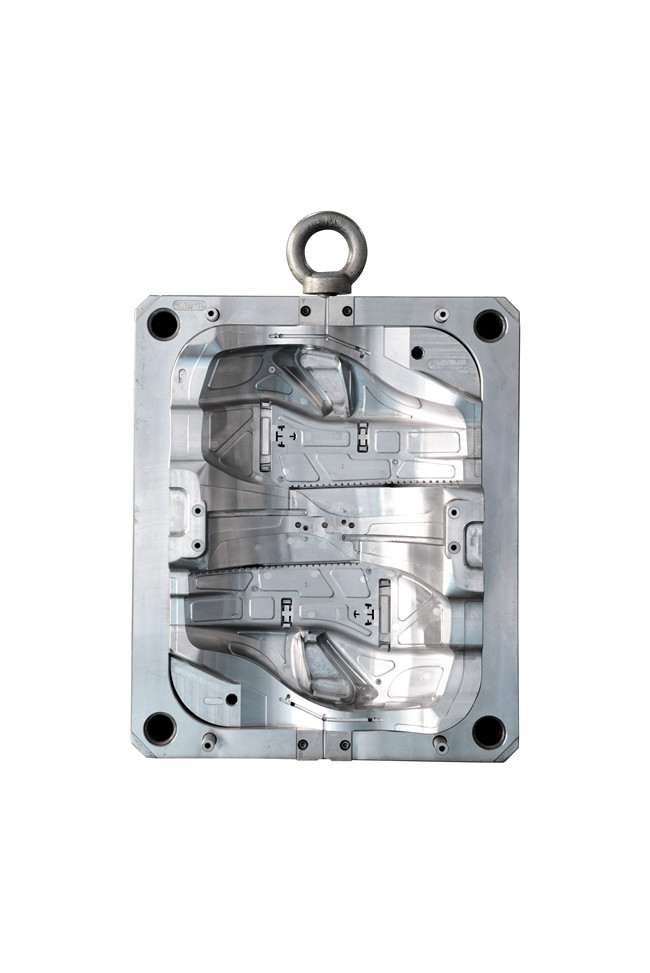
The available product information describes a custom double-shot overmolding mold with a two-color injection structure, optional multi-cavity layouts, and precision alignment features. It identifies several hard-and-soft material combinations, including ABS+TPU and PP+TPE, but does not confirm approval for recycled grades of these materials or guarantee that an existing mold will operate unchanged.
Recommended Validation Process
1. Confirm the Material and Tool Configuration
Identify the exact recycled resin, its grade, percentage of recycled content, processing requirements, and intended material pairing. At the same time, confirm that the existing tool has the correct cavity arrangement, gate design, cooling system, and alignment for the part and molding process.
2. Conduct a Mold Trial
Run the intended recycled material in the existing tool under controlled conditions. Record filling behavior, injection pressure, cycle stability, demolding performance, visible defects, and any variation between cavities. For a double-shot mold, also verify the interface between the hard and soft materials and the accuracy of the second-shot alignment.
3. Inspect the Trial Parts
Evaluate the samples through dimensional testing, visual inspection, and functional checks. Compare the results with the approved drawings, product specifications, and end-use requirements. If the parts meet these standards consistently, the mold may be suitable for continued use without modification. If not, process adjustments or tool changes may be necessary.
Longterm Mold lists CMM inspection, surface checks, and multi-cycle mold trials among its quality activities for double-shot molds. Its product information also refers to mold trials, dimensional testing, and pre-shipment inspection. These steps provide a useful validation framework, although the supplied information does not define a specific recycled-resin acceptance standard.
Compatibility and Modification Comparison
| Evaluation area | Information currently available | Verification required before production |
|---|---|---|
| Recycled material | The mold listing identifies hard-and-soft combinations such as ABS+TPU and PP+TPE. | Confirm that the exact recycled resin, grade, and material pairing are suitable for the tool. |
| Mold construction | The listed design includes two-color injection, precision alignment, and optional multi-cavity configurations. | Check whether the current mold design matches the part, resin behavior, and required production volume. |
| Testing and inspection | Mold trials, dimensional checks, and pre-shipment inspection are included in the stated quality process. | Run the recycled resin and assess dimensions, appearance, function, and process repeatability. |
| Need for tool changes | No general statement confirms that modifications will never be required. | Decide whether to retain, adjust, or repair the mold based on documented trial results. |
Frequently Asked Questions
Is recycled plastic automatically compatible with the listed mold?
No. The product information supports certain hard-and-soft material combinations but does not specifically approve recycled plastic. The exact resin must be tested in the intended tool.
Can I keep using the mold without changing it?
Possibly, but this should not be assumed in advance. A mold trial followed by dimensional, visual, and functional inspection should determine whether the existing tool is suitable as-is.
What should be checked if the trial parts fail?
Review the resin’s processing conditions, shrinkage, moisture, contamination, and flow behavior, along with the mold’s gates, cooling, vents, cavities, and alignment. Depending on the findings, process optimization or mold modification may be required.
What technical assistance is available?
The listing includes online technical support, mold maintenance, and spare parts. The company also describes mold optimization and after-sales engineering assistance for complex precision tooling.
Conclusion and Practical Recommendation
Recycled plastic may work in an existing injection mold, but compatibility must be demonstrated rather than assumed. Test the specified recycled material in the tool, inspect the resulting samples, and compare the data with the product requirements. Only then should you decide whether to keep the mold unchanged or introduce targeted improvements.
Longterm provides custom mold manufacturing and injection molding services, with mold trials and dimensional inspection included among its stated quality checks. For technical support, contact rogerluo@longterm-mold.com.
About Longterm Manufacturing Solutions
Longterm Manufacturing Solutions Limited is a mold manufacturer founded in 2010. The company serves customers in the United States, Europe, Australia, and other international markets, providing mold design, tooling, precision machining, mold production, and plastic parts manufacturing. Its reported five-person R&D team focuses on molds and precision machining. The company holds ISO 9001:2015 certification and supports projects across several industries.

REPORT