







-
 Agriculture
-
 Health-Care
-
 Environment
-
 Construction-Real-Estate
-
 Tools-Hardware
-
 Home-Garden
-
 Furniture
-
 Luggage-Bags-Cases
-
 Medical-devices-Supplies
-
 Gifts-Crafts
-
 Sports-Entertainment
-
 Food-Beverage
-
 Vehicles-Transportation
-
 Power-Transmission
-
 Material-Handling
-
 Renewable-Energy
-
 Safety
-
 Testing-Instrument-Equipment
-
 Construction-Building-Machinery
-
 Pet-Supplies
-
 Personal-Care-Household-Cleaning
-
 Vehicle-Accessories-Electronics-Tools
-
 School-Office-Supplies
-
 Packaging-Printing
-
 Mother-Kids-Toys
-
 Business-Services
-
 Commercial-Equipment-Machinery
-
 Apparel-Accessories
-
 Security
-
 Shoes-Accessories
-
 Vehicle-Parts-Accessories
-
 Jewelry-Eyewear-Watches-Accessories
-
 Lights-Lighting
-
 Fabric-Textile-Raw-Material
-
 Fabrication-Services
-
 Industrial-Machinery
-
 Consumer-Electronics
-
 Electrical-Equipment-Supplies
-
 Electronic-Components-Accessories-Telecommunications
-
 Home-Appliances
-
 Beauty
-
 Chemicals
-
 Rubber-Plastics
-
 Metals-Alloys


























































































































































































































































































































































































































































































































































































- Masonry Materials
- Curtain Walls & Accessories
- Earthwork Products
- Fireproofing Materials
- Heat Insulation Materials
- Plastic Building Materials
- Building Boards
- Soundproofing Materials
- Timber
- Waterproofing Materials
- Balustrades & Handrails
- Bathroom & Kitchen
- Flooring & Accessories
- Tiles & Accessories
- Door, Window & Accessories
- Fireplaces & Stoves
- Floor Heating Systems & Parts
- Stairs & Stair Parts
- Ceilings
- Elevators & Escalators
- Stone
- Countertops, Vanity Tops & Table Tops
- Mosaics
- Metal Building Materials
- Multifunctional Materials
- Ladders & Scaffoldings
- Mouldings
- Corner Guards
- Decorative Films
- Formwork
- Building & Industrial Glass
- Other Construction & Real Estate
- Wallpapers/Wall panels
- HVAC System & Parts
- Outdoor Facilities
- Prefabricated Buildings
- Festive & Party Supplies
- Bathroom Products
- Household Sundries
- Rain Gear
- Garden Supplies
- Household Cleaning Tools & Accessories
- Lighters & Smoking Accessories
- Home Storage & Organization
- Household Scales
- Smart Home Improvement
- Home Textiles
- Kitchenware
- Drinkware & Accessories
- Dinnerware, Coffee & Wine
- Home Decor
- Golf
- Fitness & Body Building
- Amusement Park Facilities
- Billiards, Board Game,Coin Operated Games
- Musical Instruments
- Outdoor Affordable Luxury Sports
- Camping & Hiking
- Fishing
- Sports Safety&Rehabilitation
- Ball Sports Equipments
- Water Sports
- Winter Sports
- Luxury Travel Equipments
- Sports Shoes, Bags & Accessories
- Cycling
- Other Sports & Entertainment Products
- Artificial Grass&Sports Flooring&Sports Court Equipment
- Scooters
- Food Ingredients
- Honey & Honey Products
- Snacks
- Nuts & Kernels
- Seafood
- Plant & Animal Oil
- Beverages
- Fruit & Vegetable Products
- Frog & Escargot
- Bean Products
- Egg Products
- Dairy Products
- Seasonings & Condiments
- Canned Food
- Instant Food
- Baked Goods
- Other Food & Beverage
- Meat & Poultry
- Confectionery
- Grain Products
- Feminie Care
- Hair Care & Styling
- Body Care
- Hands & Feet Care
- Hygiene Products
- Men's Grooming
- Laundry Cleaning Supplies
- Travel Size & Gift Sets
- Room Deodorizers
- Other Personal Care Products
- Pest Control Products
- Special Household Cleaning
- Floor Cleaning
- Kitchen & Bathroom Cleaning
- Oral Care
- Bath Supplies
- Yellow Pages
- Correction Supplies
- Office Binding Supplies
- Office Cutting Supplies
- Board Erasers
- Office Adhesives & Tapes
- Education Supplies
- Pencil Cases & Bags
- Notebooks & Writing Pads
- File Folder Accessories
- Calendars
- Writing Accessories
- Commercial Office Supplies
- Pencil Sharpeners
- Pens
- Letter Pad/Paper
- Paper Envelopes
- Desk Organizers
- Pencils
- Markers & Highlighters
- Filing Products
- Art Supplies
- Easels
- Badge Holder & Accessories
- Office Paper
- Printer Supplies
- Book Covers
- Other Office & School Supplies
- Stationery Set
- Boards
- Clipboards
- Stamps
- Drafting Supplies
- Stencils
- Electronic Dictionary
- Books
- Map
- Magazines
- Calculators
- Baby & Toddler Toys
- Educational Toys
- Classic Toys
- Dress Up & Pretend Play
- Toy Vehicle
- Stuffed Animals & Plush Toys
- Outdoor Toys & Structures
- Balloons & Accessories
- Baby Food
- Children's Clothing
- Baby Supplies & Products
- Maternity Clothes
- Kids Shoes
- Baby Care
- Novelty & Gag Toys
- Dolls & Accessories
- Puzzle & Games
- Blocks & Model Building Toys
- Toddler Clothing
- Baby Clothing
- Kids' Luggage & Bags
- Arts, Crafts & DIY Toys
- Action & Toy Figures
- Baby Appliances
- Hobbies & Models
- Remote Control Toys
- Promotional Toys
- Pregnancy & Maternity
- Hygiene Products
- Kid's Textile&Bedding
- Novelty & Special Use
- Toy Weapons
- Baby Gifts
- Baby Storage & Organization
- Auto Drive Systems
- ATV/UTV Parts & Accessories
- Marine Parts & Accessories
- Other Auto Parts
- Trailer Parts & Accessories
- Auto Transmission Systems
- Train Parts & Accessories
- Universal Parts
- Railway Parts & Accessories
- Auto Brake Systems
- Aviation Parts & Accessories
- Truck Parts & Accessories
- Auto Suspension Systems
- Auto Lighting Systems
- New Energy Vehicle Parts & Accessories
- Auto Steering Systems
- Wheels, Tires & Accessories
- Bus Parts & Accessories
- Auto Performance Parts
- Cooling System
- Go-Kart & Kart Racer Parts & Accessories
- Air Conditioning Systems
- Heavy Duty Vehicle Parts & Accessories
- Auto Electrical Systems
- Auto Body Systems
- Auto Engine Systems
- Container Parts & Accessories
- Motorcycle Parts & Accessories
- Refrigeration & Heat Exchange Equipment
- Machine Tool Equipment
- Food & Beverage Machinery
- Agricultural Machinery & Equipment
- Apparel & Textile Machinery
- Chemical Machinery
- Packaging Machines
- Paper Production Machinery
- Plastic & Rubber Processing Machinery
- Industrial Robots
- Electronic Products Machinery
- Metal & Metallurgy Machinery
- Woodworking Machinery
- Home Product Manufacturing Machinery
- Machinery Accessories
- Environmental Machinery
- Machinery Service
- Electrical Equipment Manufacturing Machinery
- Industrial Compressors & Parts
- Tobacco & Cigarette Machinery
- Production Line
- Used Industrial Machinery
- Electronics Production Machinery
- Other Machinery & Industrial Equipment
- Camera, Photo & Accessories
- Portable Audio, Video & Accessories
- Television, Home Audio, Video & Accessories
- Video Games & Accessories
- Mobile Phone & Accessories
- Electronic Publications
- Earphone & Headphone & Accessories
- Speakers & Accessories
- Smart Electronics
- TV Receivers & Accessories
- Mobile Phone & Computer Repair Parts
- Chargers, Batteries & Power Supplies
- Used Electronics
- VR, AR, MR Hardware & Software
- Projectors & Presentation Equipments
- Other Consumer Electronics
- Cables & Commonly Used Accessories
- Computer Hardware & Software
- Displays, Signage and Optoelectronics
- Discrete Semiconductors
- Wireless & IoT Module and Products
- Telecommunications
- Connectors, Terminals & Accessories
- Development Boards, Electronic Modules and Kits
- Circuit Protection
- Sensors
- Isolators
- Audio Components and Products
- Integrated Circuits
- Power Supplies
- Relays
- RF, Microwave and RFID
- Electronic Accessories & Supplies
- Passive Components
- PCB & PCBA
- Air Quality Appliances
- Home Appliance Parts
- Heating & Cooling Appliances
- Small Kitchen Appliances
- Laundry Appliances
- Water Heaters
- Water Treatment Appliances
- Refrigerators & Freezers
- Personal Care & Beauty Appliances
- Major Kitchen Appliances
- Cleaning Appliances
- Second-hand Appliances
- Smart Home Appliances
- Other Home Appliances
- Energy Chemicals
- Inorganic Chemicals
- Basic Organic Chemicals
- Agrochemicals
- Admixture & Additives
- Catalysts & Chemical Auxiliary Agents
- Pigments & Dyestuff
- Coating & Paint
- Daily Chemicals
- Polymer
- Organic Intermediate
- Adhesives & Sealants
- Chemical Waste
- Biological Chemical Products
- Surface Treatment Chemicals
- Painting & Coating
- Chemical Reagents
- Flavor & Fragrance
- Non-Explosive Demolition Agents
- Other Chemicals
- Custom Chemical Services

Can Sustainable Materials Lower the Cost of Expandable Container Houses?
Sustainable materials may help make expandable container houses more affordable when they extend service life, simplify installation, support relocation, or allow repeated reuse. However, the available information does not include a direct price comparison between greener materials and conventional alternatives. The real affordability of a modular home must therefore be evaluated through its complete lifecycle, including purchase, transport, setup, maintenance, relocation, and reuse.
Key Findings for Buyers
- Reusable and recyclable modular units can reduce the need to purchase new temporary buildings for each project, although the available data does not state the exact savings.
- Factory manufacturing, robotic welding, automated spraying, and prefabricated components can improve production consistency and shorten installation work. The company reports a 60% improvement over the industry average for its relevant enclosure expansion process.
- Prefabricated housing is used for construction camps, worker accommodation, project offices, field facilities, emergency housing, cultural tourism projects, and rural residences.
- The listed space capsule product has a minimum order quantity of one set, a stated delivery period of 30 days, factory self-inspection, and a one-year warranty covering non-human damage.
How Sustainable Design Can Affect Total Cost
The financial effect of greener materials should be considered over the entire service period rather than judged only by the initial purchase price. Materials that can be recycled, reused, or transported several times may create value for developers managing temporary or changing project locations. Nevertheless, the supplied product information does not include a purchase quotation for an expandable container house or a benchmark against traditional buildings.
Prefabrication can reduce the amount of work required at the project site. Guangdong Uni-House states that its manufacturing facilities include more than 10 advanced production lines, automated laser cutting, robotic welding, automated spraying, and full-process CNC control. These systems are designed to standardize production and reduce labor-related manufacturing costs. For the company’s relevant expansion process, a single worker is reported to be able to complete enclosure space expansion in approximately 10 minutes.
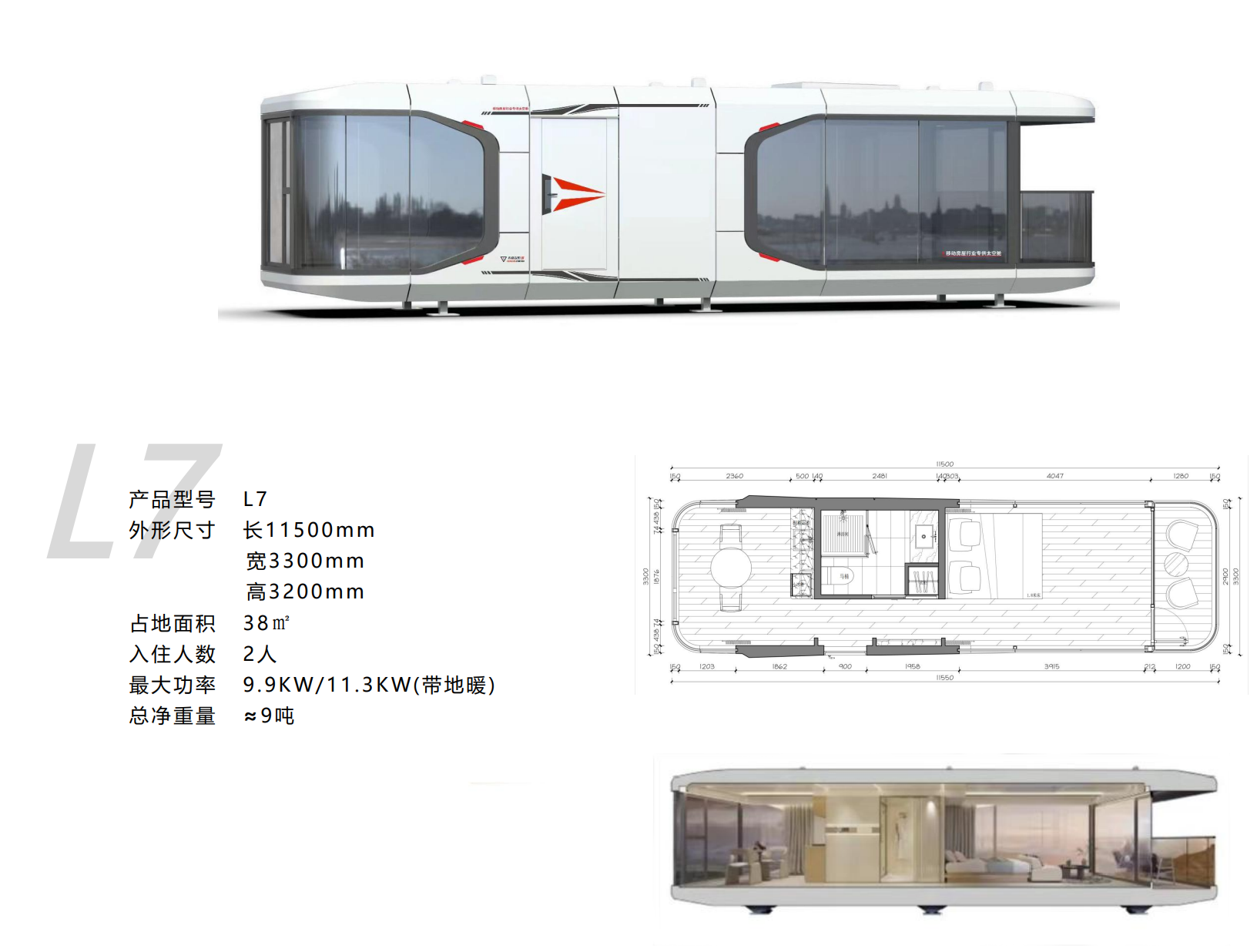
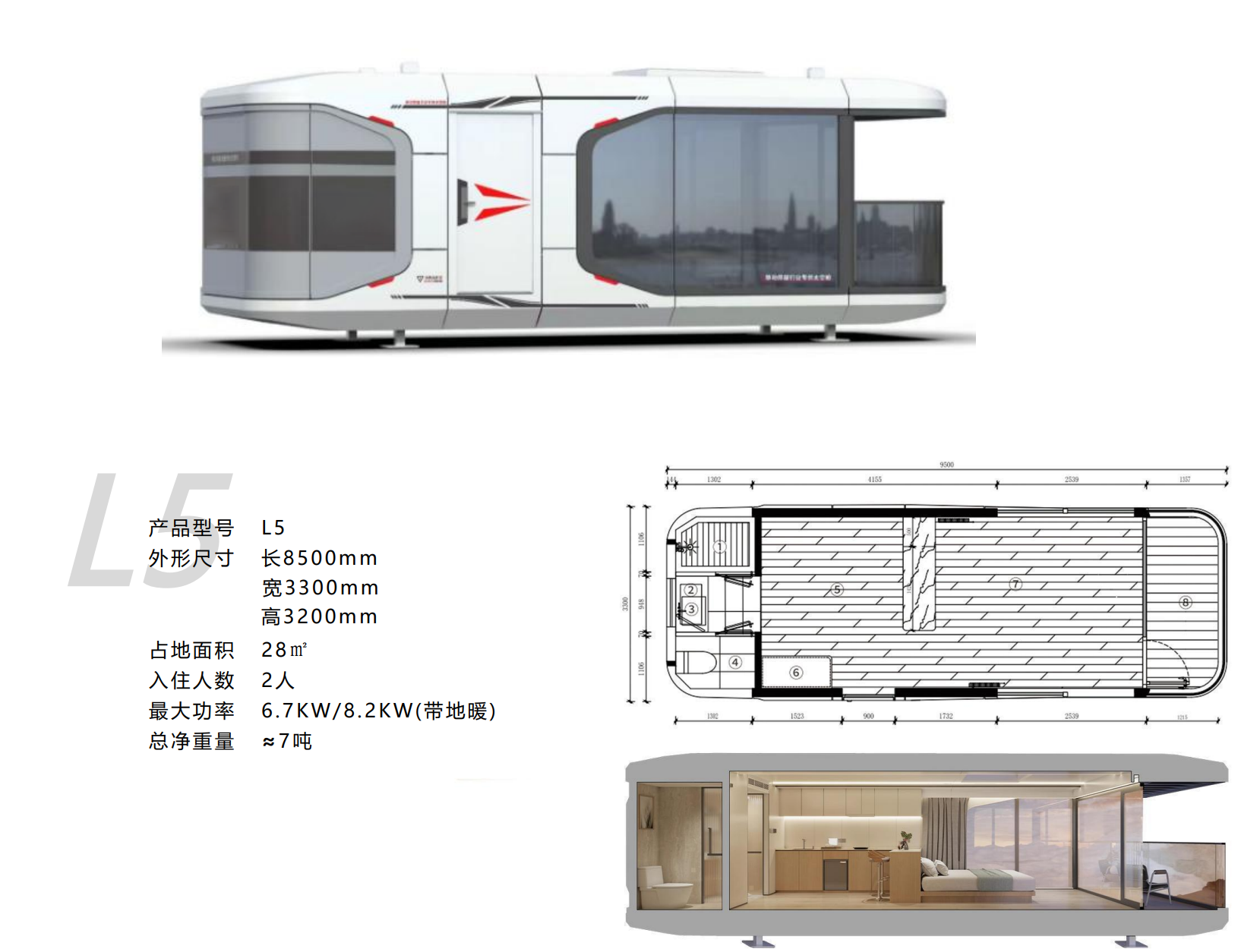
Material specifications also influence maintenance and operating performance. The listed space capsule uses a 70–100 mm closed-cell PU polyurethane sandwich panel, aviation-grade aluminum alloy exterior panels, fluorocarbon coating, and insulated Low-E tempered glass. Its stated performance features include waterproofing, moisture resistance, sound insulation, fire retardance, and operation in temperatures from -40 degrees Celsius to +50 degrees Celsius. These characteristics indicate protection and durability targets, but they do not guarantee a specific reduction in energy or maintenance expenses.
Transport, Placement, and Reuse
The listed space capsule is supplied as a completed one-piece unit with water and electrical systems installed in advance. It can be delivered by truck or container ship and placed on level ground without conventional foundation construction. Multiple units can also be combined or stacked to create scenic resort clusters. The product information describes the unit as 100% recyclable and suitable for repeated relocation projects. These features may improve lifecycle economics where a building must be moved or used at more than one site, although no monetary benefit is specified.
Logistics and production capacity are also important when assessing the cost of sustainable modular housing. Guangdong Uni-House reports a 30,000-square-meter single-plant production base, annual output of up to 10,000 sets, and a workforce of 200 people, including more than 30 research and development personnel. This scale may support standardized manufacturing and repeat purchasing. Final affordability, however, will still depend on material costs, freight, destination taxes, local labor, and site preparation requirements.
Applications and Compliance Information
Prefabricated units are reported in a range of applications, including construction-site dormitories, project offices, field camps, temporary post-disaster accommodation, cultural tourism facilities, community buildings, and rural housing. One recorded cooperation case concerns a worker living area for an Indonesian coal mine. The company also describes project experience in engineering, tourism, and community facility developments, where customers highlighted installation speed, stable quality, and adaptability.
CE certification is listed for the company’s modular container house range, including detachable containers, flat pack containers, folding containers, expandable containers, space capsules, and related units. The stated certification coverage includes the European Union, Australia, North America, South America, Southeast Asia, and the Middle East. Certification provides conformity documentation for the listed product scope, but it should not be interpreted as proof of lower pricing or superior environmental performance.
Cost-Factor Comparison
| Cost consideration | Information provided | Practical implication |
|---|---|---|
| Reuse and recyclability | The listed space capsule is described as 100% recyclable and reusable across multiple relocation projects. | May provide lifecycle value for temporary, mobile, or repeat-use projects; no specific savings are stated. |
| Manufacturing efficiency | Production uses automated laser cutting, robotic welding, automated spraying, more than 10 production lines, and CNC process control. | Can support consistent quality and lower production labor requirements, but does not establish the final selling price. |
| Site installation | The finished space capsule can be placed on flat ground without traditional foundation construction. | May reduce foundation and on-site labor costs where local conditions permit; site preparation remains project-specific. |
| Insulation and weather resistance | PU insulation, Low-E insulated glass, waterproofing, and a stated operating range of -40 degrees Celsius to +50 degrees Celsius are included. | Supports use in varied climates and may reduce maintenance demand, while energy savings are not quantified. |
| Order and delivery terms | The general business model lists a one-set minimum order and 15-day delivery. The space capsule listing specifies 30 days. | Small projects can be ordered directly, but delivery timing should be confirmed for the chosen model. |
| Payment and freight | Payment is 50% deposit with the remaining 50% due before shipment. Ocean transport uses 40HQ or 20FT containers. | These terms assist procurement planning, while the landed cost depends on freight distance and destination conditions. |
Frequently Asked Questions
Can sustainable materials automatically make an expandable container house cheaper?
No. Recyclability, repeated use, factory production, and reduced installation work can all influence total cost. However, the available information does not provide raw material prices, project quotations, energy savings, or a direct comparison with conventional construction.
Which features may reduce lifecycle expenditure?
The listed space capsule includes one-piece delivery, pre-installed utilities, placement on suitable flat ground, repeated relocation capability, and 100% recyclability. These features may reduce repeated construction and setup work when the project is designed around them.
Does the supplied information describe an expandable container house?
The detailed product information describes a space capsule house available in mini, two-person, and four-person models. Expandable container houses are included in the company’s broader product range, but the supplied data does not provide detailed specifications or prices for a particular expandable model.
Conclusion and Purchasing Recommendations
Greener materials can support affordability when they improve durability, allow reuse, simplify transport and installation, or reduce the need to build replacements. The available evidence supports these possible cost mechanisms, but it is not sufficient to conclude that sustainable materials alone make expandable container houses cheaper. Buyers should request a product-specific quotation and confirm whether the applicable delivery period is the general 15 days or the listed 30 days for the space capsule. The full budget should include freight, site preparation, installation, relocation, maintenance, and potential resale or reuse value. The company supports an industry-trade integration model, accepts orders from one set, requires a 50% deposit followed by the balance before shipment, and ships products in 40HQ or 20FT ocean containers. For technical guidance or project support, contact guizugroup@outlook.com.
About the Company
Guangdong Uni-House Technology Co., Ltd. operates as a foreign trade company under the Guizu Group. Its services cover design, research and development, manufacturing, installation, and after-sales support through multiple factories. The product range includes detachable, expandable, folding, prefab K house, flat pack, and space capsule units for offices, dormitories, residences, shops, hospitals, and hotels. The company reports 30 professional research and development engineers and designers, more than 10 advanced production lines, and 150 utility model patents. Its single-plant facility covers 30,000 square meters and has an annual capacity of 10,000 sets.
The company lists CE certification for its modular container house product range and records cooperation experience in engineering, mining, cultural tourism, and community facility projects.

REPORT