







-
 Agriculture
-
 Health-Care
-
 Environment
-
 Construction-Real-Estate
-
 Tools-Hardware
-
 Home-Garden
-
 Furniture
-
 Luggage-Bags-Cases
-
 Medical-devices-Supplies
-
 Gifts-Crafts
-
 Sports-Entertainment
-
 Food-Beverage
-
 Vehicles-Transportation
-
 Power-Transmission
-
 Material-Handling
-
 Renewable-Energy
-
 Safety
-
 Testing-Instrument-Equipment
-
 Construction-Building-Machinery
-
 Pet-Supplies
-
 Personal-Care-Household-Cleaning
-
 Vehicle-Accessories-Electronics-Tools
-
 School-Office-Supplies
-
 Packaging-Printing
-
 Mother-Kids-Toys
-
 Business-Services
-
 Commercial-Equipment-Machinery
-
 Apparel-Accessories
-
 Security
-
 Shoes-Accessories
-
 Vehicle-Parts-Accessories
-
 Jewelry-Eyewear-Watches-Accessories
-
 Lights-Lighting
-
 Fabric-Textile-Raw-Material
-
 Fabrication-Services
-
 Industrial-Machinery
-
 Consumer-Electronics
-
 Electrical-Equipment-Supplies
-
 Electronic-Components-Accessories-Telecommunications
-
 Home-Appliances
-
 Beauty
-
 Chemicals
-
 Rubber-Plastics
-
 Metals-Alloys


























































































































































































































































































































































































































































































































































































- Masonry Materials
- Curtain Walls & Accessories
- Earthwork Products
- Fireproofing Materials
- Heat Insulation Materials
- Plastic Building Materials
- Building Boards
- Soundproofing Materials
- Timber
- Waterproofing Materials
- Balustrades & Handrails
- Bathroom & Kitchen
- Flooring & Accessories
- Tiles & Accessories
- Door, Window & Accessories
- Fireplaces & Stoves
- Floor Heating Systems & Parts
- Stairs & Stair Parts
- Ceilings
- Elevators & Escalators
- Stone
- Countertops, Vanity Tops & Table Tops
- Mosaics
- Metal Building Materials
- Multifunctional Materials
- Ladders & Scaffoldings
- Mouldings
- Corner Guards
- Decorative Films
- Formwork
- Building & Industrial Glass
- Other Construction & Real Estate
- Wallpapers/Wall panels
- HVAC System & Parts
- Outdoor Facilities
- Prefabricated Buildings
- Festive & Party Supplies
- Bathroom Products
- Household Sundries
- Rain Gear
- Garden Supplies
- Household Cleaning Tools & Accessories
- Lighters & Smoking Accessories
- Home Storage & Organization
- Household Scales
- Smart Home Improvement
- Home Textiles
- Kitchenware
- Drinkware & Accessories
- Dinnerware, Coffee & Wine
- Home Decor
- Golf
- Fitness & Body Building
- Amusement Park Facilities
- Billiards, Board Game,Coin Operated Games
- Musical Instruments
- Outdoor Affordable Luxury Sports
- Camping & Hiking
- Fishing
- Sports Safety&Rehabilitation
- Ball Sports Equipments
- Water Sports
- Winter Sports
- Luxury Travel Equipments
- Sports Shoes, Bags & Accessories
- Cycling
- Other Sports & Entertainment Products
- Artificial Grass&Sports Flooring&Sports Court Equipment
- Scooters
- Food Ingredients
- Honey & Honey Products
- Snacks
- Nuts & Kernels
- Seafood
- Plant & Animal Oil
- Beverages
- Fruit & Vegetable Products
- Frog & Escargot
- Bean Products
- Egg Products
- Dairy Products
- Seasonings & Condiments
- Canned Food
- Instant Food
- Baked Goods
- Other Food & Beverage
- Meat & Poultry
- Confectionery
- Grain Products
- Feminie Care
- Hair Care & Styling
- Body Care
- Hands & Feet Care
- Hygiene Products
- Men's Grooming
- Laundry Cleaning Supplies
- Travel Size & Gift Sets
- Room Deodorizers
- Other Personal Care Products
- Pest Control Products
- Special Household Cleaning
- Floor Cleaning
- Kitchen & Bathroom Cleaning
- Oral Care
- Bath Supplies
- Yellow Pages
- Correction Supplies
- Office Binding Supplies
- Office Cutting Supplies
- Board Erasers
- Office Adhesives & Tapes
- Education Supplies
- Pencil Cases & Bags
- Notebooks & Writing Pads
- File Folder Accessories
- Calendars
- Writing Accessories
- Commercial Office Supplies
- Pencil Sharpeners
- Pens
- Letter Pad/Paper
- Paper Envelopes
- Desk Organizers
- Pencils
- Markers & Highlighters
- Filing Products
- Art Supplies
- Easels
- Badge Holder & Accessories
- Office Paper
- Printer Supplies
- Book Covers
- Other Office & School Supplies
- Stationery Set
- Boards
- Clipboards
- Stamps
- Drafting Supplies
- Stencils
- Electronic Dictionary
- Books
- Map
- Magazines
- Calculators
- Baby & Toddler Toys
- Educational Toys
- Classic Toys
- Dress Up & Pretend Play
- Toy Vehicle
- Stuffed Animals & Plush Toys
- Outdoor Toys & Structures
- Balloons & Accessories
- Baby Food
- Children's Clothing
- Baby Supplies & Products
- Maternity Clothes
- Kids Shoes
- Baby Care
- Novelty & Gag Toys
- Dolls & Accessories
- Puzzle & Games
- Blocks & Model Building Toys
- Toddler Clothing
- Baby Clothing
- Kids' Luggage & Bags
- Arts, Crafts & DIY Toys
- Action & Toy Figures
- Baby Appliances
- Hobbies & Models
- Remote Control Toys
- Promotional Toys
- Pregnancy & Maternity
- Hygiene Products
- Kid's Textile&Bedding
- Novelty & Special Use
- Toy Weapons
- Baby Gifts
- Baby Storage & Organization
- Auto Drive Systems
- ATV/UTV Parts & Accessories
- Marine Parts & Accessories
- Other Auto Parts
- Trailer Parts & Accessories
- Auto Transmission Systems
- Train Parts & Accessories
- Universal Parts
- Railway Parts & Accessories
- Auto Brake Systems
- Aviation Parts & Accessories
- Truck Parts & Accessories
- Auto Suspension Systems
- Auto Lighting Systems
- New Energy Vehicle Parts & Accessories
- Auto Steering Systems
- Wheels, Tires & Accessories
- Bus Parts & Accessories
- Auto Performance Parts
- Cooling System
- Go-Kart & Kart Racer Parts & Accessories
- Air Conditioning Systems
- Heavy Duty Vehicle Parts & Accessories
- Auto Electrical Systems
- Auto Body Systems
- Auto Engine Systems
- Container Parts & Accessories
- Motorcycle Parts & Accessories
- Refrigeration & Heat Exchange Equipment
- Machine Tool Equipment
- Food & Beverage Machinery
- Agricultural Machinery & Equipment
- Apparel & Textile Machinery
- Chemical Machinery
- Packaging Machines
- Paper Production Machinery
- Plastic & Rubber Processing Machinery
- Industrial Robots
- Electronic Products Machinery
- Metal & Metallurgy Machinery
- Woodworking Machinery
- Home Product Manufacturing Machinery
- Machinery Accessories
- Environmental Machinery
- Machinery Service
- Electrical Equipment Manufacturing Machinery
- Industrial Compressors & Parts
- Tobacco & Cigarette Machinery
- Production Line
- Used Industrial Machinery
- Electronics Production Machinery
- Other Machinery & Industrial Equipment
- Camera, Photo & Accessories
- Portable Audio, Video & Accessories
- Television, Home Audio, Video & Accessories
- Video Games & Accessories
- Mobile Phone & Accessories
- Electronic Publications
- Earphone & Headphone & Accessories
- Speakers & Accessories
- Smart Electronics
- TV Receivers & Accessories
- Mobile Phone & Computer Repair Parts
- Chargers, Batteries & Power Supplies
- Used Electronics
- VR, AR, MR Hardware & Software
- Projectors & Presentation Equipments
- Other Consumer Electronics
- Cables & Commonly Used Accessories
- Computer Hardware & Software
- Displays, Signage and Optoelectronics
- Discrete Semiconductors
- Wireless & IoT Module and Products
- Telecommunications
- Connectors, Terminals & Accessories
- Development Boards, Electronic Modules and Kits
- Circuit Protection
- Sensors
- Isolators
- Audio Components and Products
- Integrated Circuits
- Power Supplies
- Relays
- RF, Microwave and RFID
- Electronic Accessories & Supplies
- Passive Components
- PCB & PCBA
- Air Quality Appliances
- Home Appliance Parts
- Heating & Cooling Appliances
- Small Kitchen Appliances
- Laundry Appliances
- Water Heaters
- Water Treatment Appliances
- Refrigerators & Freezers
- Personal Care & Beauty Appliances
- Major Kitchen Appliances
- Cleaning Appliances
- Second-hand Appliances
- Smart Home Appliances
- Other Home Appliances
- Energy Chemicals
- Inorganic Chemicals
- Basic Organic Chemicals
- Agrochemicals
- Admixture & Additives
- Catalysts & Chemical Auxiliary Agents
- Pigments & Dyestuff
- Coating & Paint
- Daily Chemicals
- Polymer
- Organic Intermediate
- Adhesives & Sealants
- Chemical Waste
- Biological Chemical Products
- Surface Treatment Chemicals
- Painting & Coating
- Chemical Reagents
- Flavor & Fragrance
- Non-Explosive Demolition Agents
- Other Chemicals
- Custom Chemical Services

Electrostatic Flocking Fabric Certifications: What Buyers Should Check
The right certification package for electrostatic flocking fabric depends on its fibers, intended use and destination market. Buyers may need a supplier quality certificate, product-level chemical test reports, recycled-content documentation or packaging-specific compliance evidence. No single certificate covers every requirement.
Start with the Fabric and Its Intended Market
ISO 9001:2015 relates to a manufacturer's quality management system, not the chemical safety of an individual fabric. GRS is relevant when the flocking fabric contains recycled polyester or nylon. For EU and EEA sales, REACH testing can provide evidence against applicable chemical restrictions; RoHS 2.0 is relevant to electronics-related applications. Packaging sold in the EU or United States may also require evidence addressing rules such as PPWR, TPCH/CONEG, California Proposition 65 or CPSIA, depending on the product and market.
Mingqian Flocking reports that its ISO 9001:2015 certificate is valid through March 2, 2028. For fabrics made with recycled polyester or nylon, it lists GRS Version 4.0 certification and says Transaction Certificates can be provided upon request.
Chemical Testing for EU and Electronics Applications
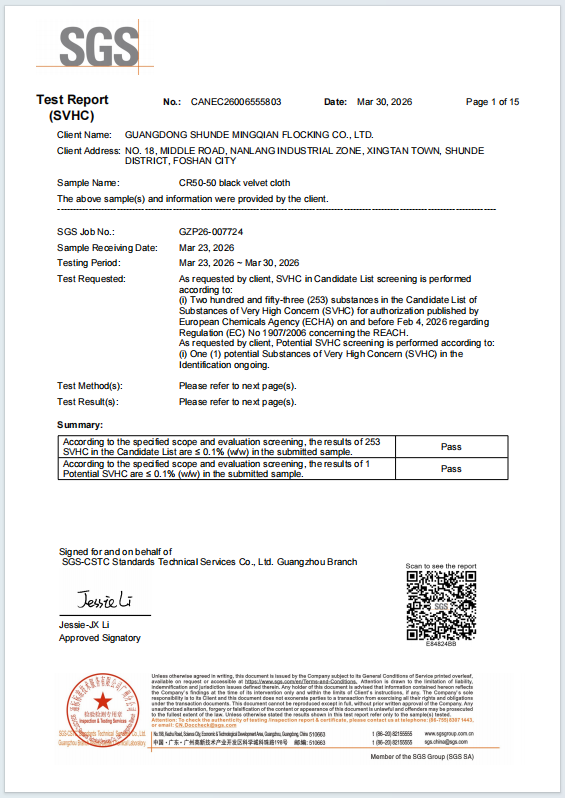
For EU shipments, Mingqian Flocking reports SGS REACH testing under report CANEC26006555803. The stated scope covers 253 SVHC substances on the cited ECHA Candidate List update and one potential SVHC; none was detected above the reporting limit.
Its SGS RoHS 2.0 report, CANEC26006555801, is reported as passing for ten restricted substances: lead, mercury, cadmium, hexavalent chromium, polybrominated biphenyls, polybrominated diphenyl ethers, DEHP, BBP, DBP and DIBP. This evidence is most relevant when the fabric is used in electronics packaging or related products.
For packaging placed on the EU market, the supplied information states compliance with the Packaging and Packaging Waste Regulation (PPWR), effective August 12, 2026. It lists a maximum of 100 parts per million for each of four heavy metals, total organic fluorine below 50 milligrams per kilogram, and no intentional addition of PFAS. Stated REACH Annex XVII controls include azo dyes, formaldehyde, PAHs, phthalates, chlorinated paraffins, pentachlorophenol and organotin compounds.
US Packaging and Application-Specific Evidence
For the United States, the supplier states that its packaging flocking fabrics meet TPCH and CONEG requirements, including a combined limit of 100 parts per million for four heavy metals and 7P phthalate limits. Proposition 65 screening is stated to cover a list of more than 900 substances. CPSIA documentation can be requested for children's jewelry boxes and gift packaging; the supplied information describes adult packaging as exempt.
Some end uses call for additional checks beyond general chemical reports. Jewelry box linings should be assessed for reactive sulfur, pH, chloride ions and volatile organic acids, since these factors can affect silver. Mingqian Flocking reports keeping reactive sulfur below 5 parts per million and aqueous extract pH between 5.5 and 7.5. It also uses sulfur-free dye systems for dark shades and performs an accelerated silver coupon corrosion test on every batch. Acceptance requires no blackening, spotting or oxidation discoloration.
For electronics packaging, anti-static fabric options are listed with surface resistivity from 106 to 109 ohms. MIL-STD-1686 compliance is stated for applicable products. OEKO-TEX Standard 100 testing is available on request for buyers with premium procurement requirements.
Product and Manufacturing Checks
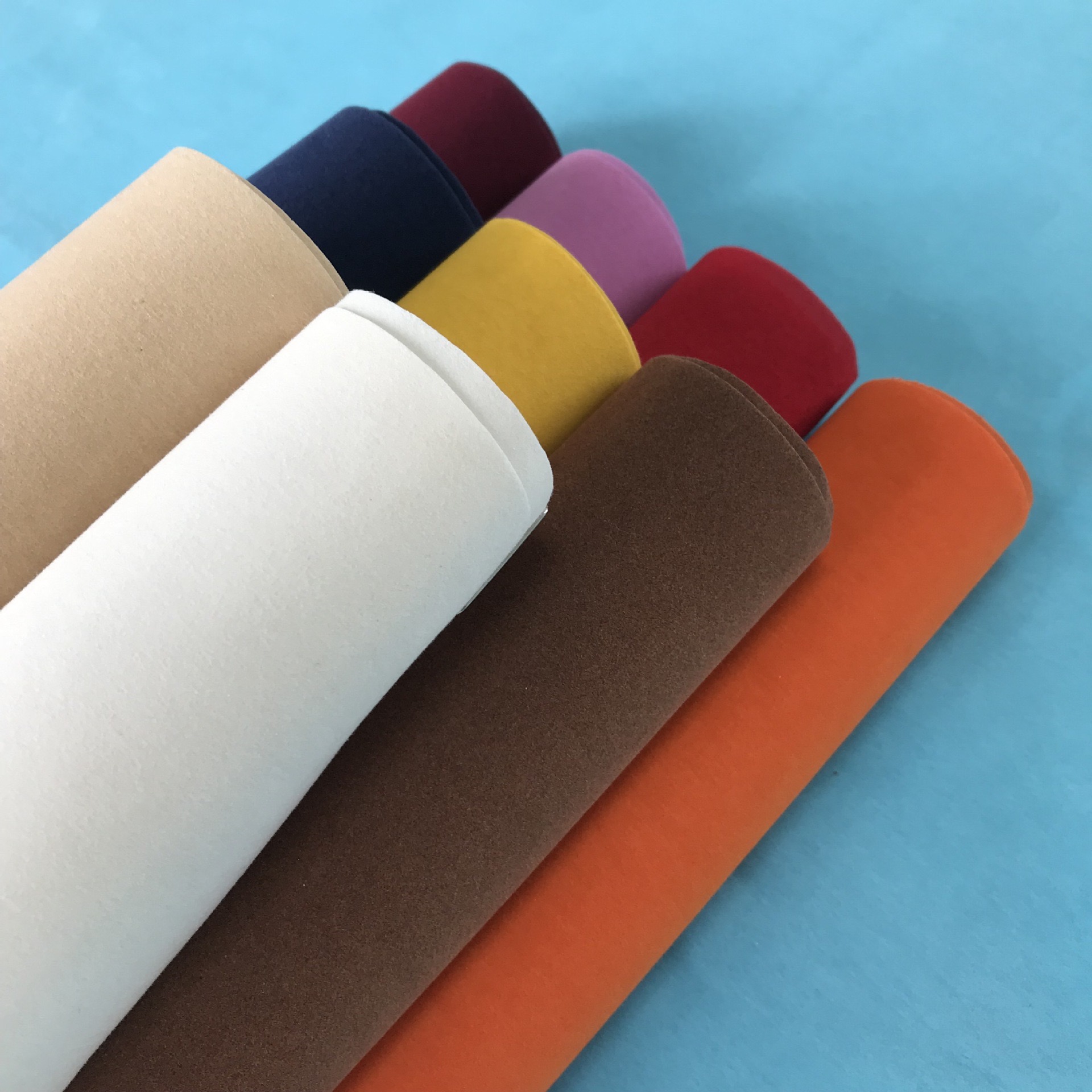
Mingqian Flocking's Long Pile Velvet has pile over 1 millimeter and can be produced on spunlace, cotton-rayon or knitted base fabrics. Listed applications include luxury gift-box interiors, jewelry display trays and moisture-absorbing or noise-reducing components for home appliances.
The reported quality process includes incoming-material inspection, in-process monitoring, finished-product testing and pre-shipment checks. Internal limits include formaldehyde at no more than 75 parts per million and azo dyes covering 22 carcinogenic amines at no more than 30 parts per million. The stated overall defect-rate target is no more than 0.5 percent.
Reported customer programs include black nylon long-pile flocking for a luxury perfume gift box, where color matching, abrasion resistance and shedding were checked before delivery. A separate jewelry-box lining project used medium-pile spunlace fabric and included REACH certification, color-fastness testing and batch sampling within the agreed schedule.
Certification and Evidence at a Glance
| Evidence | Typical use | Mingqian Flocking information |
|---|---|---|
| ISO 9001:2015 | Supplier quality management | Reported for company-manufactured products; valid until March 2, 2028 |
| GRS Version 4.0 | Fabrics containing recycled polyester or nylon | Certificate SGC-GRC01308-GRS-2026-05R3; Transaction Certificates available on request |
| REACH | Chemical restrictions for EU and EEA markets | SGS report CANEC26006555803; reported pass for the tested SVHC scope |
| RoHS 2.0 | Electronics packaging and related linings | SGS report CANEC26006555801; reported pass for ten restricted substances |
| PPWR, TPCH/CONEG and Proposition 65 | Packaging market requirements in the EU or United States | Compliance is stated for the listed heavy metals, PFAS, phthalates and screened substances |
| OEKO-TEX Standard 100 | Premium sourcing specifications | Testing available upon customer request |
Frequently Asked Questions
Does an ISO 9001 certificate establish that flocking fabric is chemically safe?
No. ISO 9001 covers the supplier's quality management system. Product-specific chemical reports, such as REACH or RoHS 2.0, and any applicable market or packaging evidence need to be assessed separately.
What should buyers request for recycled flocking fabric?
For flocking fabrics made with recycled polyester or nylon, request the applicable GRS scope documentation. A Transaction Certificate for the relevant shipment may also be requested.
What tests matter for jewelry box lining?
Ask about reactive sulfur, extract pH, chloride ions and volatile organic acids, as well as an accelerated silver coupon corrosion test. The stated batch acceptance criteria require no blackening, spotting or oxidation discoloration.
Choosing the Right Documentation
Match the requested evidence to the fabric construction, use and destination: ISO 9001 for the quality system, GRS for recycled fibers, REACH for relevant EU chemical restrictions and RoHS 2.0 for applicable electronics uses. For packaging, confirm whether PPWR, TPCH/CONEG, Proposition 65 or CPSIA documentation applies to the particular product and market. Buyers should verify report scope, dates and shipment documentation against their own requirements.
Mingqian Flocking states that it supports OEM/ODM orders with a minimum order quantity of 1,000 yards and a 14-day delivery time, alongside four-stage inspection and batch traceability. For technical information or support, contact 005@mingqianflocking.com.
About Mingqian Flocking
Guangdong Shunde Mingqian Flocking Co., Ltd. is a flocking fabric manufacturer based in Foshan City, Guangdong Province, China, operating under the Mingqian brand. Founded in 2008, the company reports a self-owned facility covering more than 12,000 square meters. Its in-house processes include dyeing, electrostatic flocking, backing, embossing and cutting. Its listed certification and testing portfolio includes ISO 9001, GRS, REACH and RoHS, with customer programs across multiple industries.
REPORT