







-
 Agriculture
-
 Health-Care
-
 Environment
-
 Construction-Real-Estate
-
 Tools-Hardware
-
 Home-Garden
-
 Furniture
-
 Luggage-Bags-Cases
-
 Medical-devices-Supplies
-
 Gifts-Crafts
-
 Sports-Entertainment
-
 Food-Beverage
-
 Vehicles-Transportation
-
 Power-Transmission
-
 Material-Handling
-
 Renewable-Energy
-
 Safety
-
 Testing-Instrument-Equipment
-
 Construction-Building-Machinery
-
 Pet-Supplies
-
 Personal-Care-Household-Cleaning
-
 Vehicle-Accessories-Electronics-Tools
-
 School-Office-Supplies
-
 Packaging-Printing
-
 Mother-Kids-Toys
-
 Business-Services
-
 Commercial-Equipment-Machinery
-
 Apparel-Accessories
-
 Security
-
 Shoes-Accessories
-
 Vehicle-Parts-Accessories
-
 Jewelry-Eyewear-Watches-Accessories
-
 Lights-Lighting
-
 Fabric-Textile-Raw-Material
-
 Fabrication-Services
-
 Industrial-Machinery
-
 Consumer-Electronics
-
 Electrical-Equipment-Supplies
-
 Electronic-Components-Accessories-Telecommunications
-
 Home-Appliances
-
 Beauty
-
 Chemicals
-
 Rubber-Plastics
-
 Metals-Alloys


























































































































































































































































































































































































































































































































































































- Masonry Materials
- Curtain Walls & Accessories
- Earthwork Products
- Fireproofing Materials
- Heat Insulation Materials
- Plastic Building Materials
- Building Boards
- Soundproofing Materials
- Timber
- Waterproofing Materials
- Balustrades & Handrails
- Bathroom & Kitchen
- Flooring & Accessories
- Tiles & Accessories
- Door, Window & Accessories
- Fireplaces & Stoves
- Floor Heating Systems & Parts
- Stairs & Stair Parts
- Ceilings
- Elevators & Escalators
- Stone
- Countertops, Vanity Tops & Table Tops
- Mosaics
- Metal Building Materials
- Multifunctional Materials
- Ladders & Scaffoldings
- Mouldings
- Corner Guards
- Decorative Films
- Formwork
- Building & Industrial Glass
- Other Construction & Real Estate
- Wallpapers/Wall panels
- HVAC System & Parts
- Outdoor Facilities
- Prefabricated Buildings
- Festive & Party Supplies
- Bathroom Products
- Household Sundries
- Rain Gear
- Garden Supplies
- Household Cleaning Tools & Accessories
- Lighters & Smoking Accessories
- Home Storage & Organization
- Household Scales
- Smart Home Improvement
- Home Textiles
- Kitchenware
- Drinkware & Accessories
- Dinnerware, Coffee & Wine
- Home Decor
- Golf
- Fitness & Body Building
- Amusement Park Facilities
- Billiards, Board Game,Coin Operated Games
- Musical Instruments
- Outdoor Affordable Luxury Sports
- Camping & Hiking
- Fishing
- Sports Safety&Rehabilitation
- Ball Sports Equipments
- Water Sports
- Winter Sports
- Luxury Travel Equipments
- Sports Shoes, Bags & Accessories
- Cycling
- Other Sports & Entertainment Products
- Artificial Grass&Sports Flooring&Sports Court Equipment
- Scooters
- Food Ingredients
- Honey & Honey Products
- Snacks
- Nuts & Kernels
- Seafood
- Plant & Animal Oil
- Beverages
- Fruit & Vegetable Products
- Frog & Escargot
- Bean Products
- Egg Products
- Dairy Products
- Seasonings & Condiments
- Canned Food
- Instant Food
- Baked Goods
- Other Food & Beverage
- Meat & Poultry
- Confectionery
- Grain Products
- Feminie Care
- Hair Care & Styling
- Body Care
- Hands & Feet Care
- Hygiene Products
- Men's Grooming
- Laundry Cleaning Supplies
- Travel Size & Gift Sets
- Room Deodorizers
- Other Personal Care Products
- Pest Control Products
- Special Household Cleaning
- Floor Cleaning
- Kitchen & Bathroom Cleaning
- Oral Care
- Bath Supplies
- Yellow Pages
- Correction Supplies
- Office Binding Supplies
- Office Cutting Supplies
- Board Erasers
- Office Adhesives & Tapes
- Education Supplies
- Pencil Cases & Bags
- Notebooks & Writing Pads
- File Folder Accessories
- Calendars
- Writing Accessories
- Commercial Office Supplies
- Pencil Sharpeners
- Pens
- Letter Pad/Paper
- Paper Envelopes
- Desk Organizers
- Pencils
- Markers & Highlighters
- Filing Products
- Art Supplies
- Easels
- Badge Holder & Accessories
- Office Paper
- Printer Supplies
- Book Covers
- Other Office & School Supplies
- Stationery Set
- Boards
- Clipboards
- Stamps
- Drafting Supplies
- Stencils
- Electronic Dictionary
- Books
- Map
- Magazines
- Calculators
- Baby & Toddler Toys
- Educational Toys
- Classic Toys
- Dress Up & Pretend Play
- Toy Vehicle
- Stuffed Animals & Plush Toys
- Outdoor Toys & Structures
- Balloons & Accessories
- Baby Food
- Children's Clothing
- Baby Supplies & Products
- Maternity Clothes
- Kids Shoes
- Baby Care
- Novelty & Gag Toys
- Dolls & Accessories
- Puzzle & Games
- Blocks & Model Building Toys
- Toddler Clothing
- Baby Clothing
- Kids' Luggage & Bags
- Arts, Crafts & DIY Toys
- Action & Toy Figures
- Baby Appliances
- Hobbies & Models
- Remote Control Toys
- Promotional Toys
- Pregnancy & Maternity
- Hygiene Products
- Kid's Textile&Bedding
- Novelty & Special Use
- Toy Weapons
- Baby Gifts
- Baby Storage & Organization
- Auto Drive Systems
- ATV/UTV Parts & Accessories
- Marine Parts & Accessories
- Other Auto Parts
- Trailer Parts & Accessories
- Auto Transmission Systems
- Train Parts & Accessories
- Universal Parts
- Railway Parts & Accessories
- Auto Brake Systems
- Aviation Parts & Accessories
- Truck Parts & Accessories
- Auto Suspension Systems
- Auto Lighting Systems
- New Energy Vehicle Parts & Accessories
- Auto Steering Systems
- Wheels, Tires & Accessories
- Bus Parts & Accessories
- Auto Performance Parts
- Cooling System
- Go-Kart & Kart Racer Parts & Accessories
- Air Conditioning Systems
- Heavy Duty Vehicle Parts & Accessories
- Auto Electrical Systems
- Auto Body Systems
- Auto Engine Systems
- Container Parts & Accessories
- Motorcycle Parts & Accessories
- Refrigeration & Heat Exchange Equipment
- Machine Tool Equipment
- Food & Beverage Machinery
- Agricultural Machinery & Equipment
- Apparel & Textile Machinery
- Chemical Machinery
- Packaging Machines
- Paper Production Machinery
- Plastic & Rubber Processing Machinery
- Industrial Robots
- Electronic Products Machinery
- Metal & Metallurgy Machinery
- Woodworking Machinery
- Home Product Manufacturing Machinery
- Machinery Accessories
- Environmental Machinery
- Machinery Service
- Electrical Equipment Manufacturing Machinery
- Industrial Compressors & Parts
- Tobacco & Cigarette Machinery
- Production Line
- Used Industrial Machinery
- Electronics Production Machinery
- Other Machinery & Industrial Equipment
- Camera, Photo & Accessories
- Portable Audio, Video & Accessories
- Television, Home Audio, Video & Accessories
- Video Games & Accessories
- Mobile Phone & Accessories
- Electronic Publications
- Earphone & Headphone & Accessories
- Speakers & Accessories
- Smart Electronics
- TV Receivers & Accessories
- Mobile Phone & Computer Repair Parts
- Chargers, Batteries & Power Supplies
- Used Electronics
- VR, AR, MR Hardware & Software
- Projectors & Presentation Equipments
- Other Consumer Electronics
- Cables & Commonly Used Accessories
- Computer Hardware & Software
- Displays, Signage and Optoelectronics
- Discrete Semiconductors
- Wireless & IoT Module and Products
- Telecommunications
- Connectors, Terminals & Accessories
- Development Boards, Electronic Modules and Kits
- Circuit Protection
- Sensors
- Isolators
- Audio Components and Products
- Integrated Circuits
- Power Supplies
- Relays
- RF, Microwave and RFID
- Electronic Accessories & Supplies
- Passive Components
- PCB & PCBA
- Air Quality Appliances
- Home Appliance Parts
- Heating & Cooling Appliances
- Small Kitchen Appliances
- Laundry Appliances
- Water Heaters
- Water Treatment Appliances
- Refrigerators & Freezers
- Personal Care & Beauty Appliances
- Major Kitchen Appliances
- Cleaning Appliances
- Second-hand Appliances
- Smart Home Appliances
- Other Home Appliances
- Energy Chemicals
- Inorganic Chemicals
- Basic Organic Chemicals
- Agrochemicals
- Admixture & Additives
- Catalysts & Chemical Auxiliary Agents
- Pigments & Dyestuff
- Coating & Paint
- Daily Chemicals
- Polymer
- Organic Intermediate
- Adhesives & Sealants
- Chemical Waste
- Biological Chemical Products
- Surface Treatment Chemicals
- Painting & Coating
- Chemical Reagents
- Flavor & Fragrance
- Non-Explosive Demolition Agents
- Other Chemicals
- Custom Chemical Services

Essential Pre-Production Testing Guide for Furniture Artificial Leather
Comprehensive Pre-Production Checklist for Furniture Synthetic Leather
Prior to authorizing mass manufacturing of artificial leather for furniture applications, buyers and quality assurance teams must execute thorough sample testing. Evaluating physical performance, surface durability, chemical safety standards, and visual consistency ensures the final product meets stringent upholstery demands.
Essential Key Takeaways
- Mechanical Endurance: Tests such as Martindale abrasion, seam slippage, and flexing resilience prevent premature tearing and wear in high-use furniture applications.
- Surface Performance & Cleanability: Resistance to UV light, scratches, bacteria, mold, and stains guarantees long-term visual appeal and hygiene.
- Regulatory Safety: Verification against REACH, RoHS, fluorine-free requirements, and international flame-retardant standards validates global market readiness.
- Batch-to-Batch Uniformity: Checking gauge thickness, shade matching, grain texture depth, and backing fabric adhesion ensures identical quality across large-scale orders.
Core Evaluation Criteria for Synthetic Upholstery Materials
1. Mechanical Durability & Physical Strength
Upholstered furniture endures continuous stress, dynamic loads, and friction. To prevent structural failure, pre-production samples must undergo rigorous mechanical testing. Tensile strength, tear resistance, and seam strength assessments determine if the material can handle tight wrapping over furniture frames. Meanwhile, Martindale abrasion and flexing endurance cycles test the outer coating to ensure it won't peel or crack over time.
2. Environmental & Surface Resilience
Surface properties dictate how well artificial leather maintains its finish in home, commercial, or automotive environments. Exposure to sunlight requires UV degradation testing to prevent discoloration and yellowing. In addition, scratch resistance guards against abrasive contact, while stain-resistant and easy-clean treatments protect against spills. Anti-bacterial and anti-mold properties further support hygienic performance in high-traffic seating.
3. Regulatory Compliance & Environmental Certification
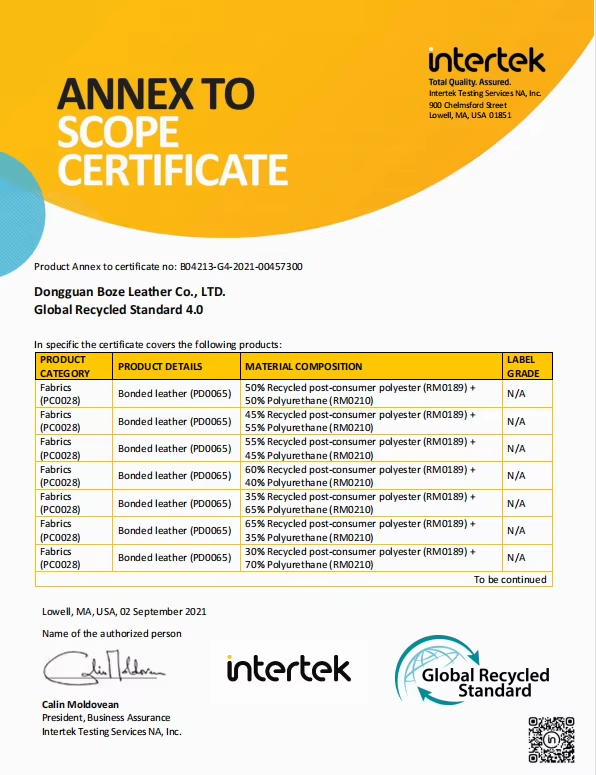
Meeting safety standards is essential before launching full-scale production. Synthetic leather samples must satisfy global chemical regulations like REACH, RoHS, and fluorine-free material standards, along with target-market fire retardancy requirements. Internationally recognized certifications—including GRS (Certificate No. B04213-G4), USDA (Certificate No. 521076632086130490), and Oeko-Tex 100 (Certificate No. SH015 120749)—confirm compliance with strict health and environmental criteria.
4. Batch Quality Control & Practical Case Application
Ensuring consistency between the test sample and bulk manufacturing relies on inspecting backing fabric adhesion, grain depth, and thickness tolerances. In a real-world project supplying 50,000 meters of custom synthetic leather to a Mexican automotive interior producer, sample validation emphasized grain precision, low odor, flame resistance, color stability, UV endurance, and backing adhesion. Adhering to ISO 9001 quality management guidelines guaranteed seamless delivery and uniform material standards.
Overview of Synthetic Leather Sample Testing Standards
| Assessment Category | Primary Test Parameters | Application Focus | Acceptance Standards |
|---|---|---|---|
| Mechanical Integrity | Martindale abrasion, seam slippage, tensile & tear strength | Office seating, living room sofas, armrests | High cycle count without surface peeling or delamination |
| Surface Durability | UV stability, stain resistance, scratch protection, easy-clean | Commercial furniture, automotive seating, high-use spaces | No visible yellowing, permanent stains, or surface damage |
| Safety & Eco-Standards | Flame retardancy, REACH, RoHS, fluorine-free, antimicrobial | Public venues, export goods, residential interiors | Compliance with GRS, USDA, and Oeko-Tex 100 benchmarks |
| Appearance & Consistency | Gauge thickness tolerance, grain texture, color matching | Uniform panel appearance across furniture collections | Precise color fidelity and uniform texture across batches |
Frequently Asked Questions
Which mechanical tests are mandatory for furniture synthetic leather?
Martindale abrasion resistance, flexing endurance, seam slippage, and tear strength are the most crucial physical tests. They verify that the synthetic leather can withstand repeated seating pressure without surface cracking or seam failure.
Why are flame retardancy and chemical compliance vital for sample approval?
Synthetic leather must meet local safety codes and international directives like REACH and RoHS. Achieving fire-retardant compliance and fluorine-free certification ensures legal saleability and end-user safety in target markets.
What role do sample thickness and backing fabric adhesion play?
Consistent thickness and robust adhesion between the surface coating and backing cloth prevent sagging, uneven stretching, or layer separation when upholstered tightly over furniture frames.
Procurement Guidance & Final Verdict
Prior to approving mass production, synthetic leather for furniture must pass comprehensive testing across physical, chemical, and aesthetic parameters. Operating under ISO 9001 quality controls, full OEM/ODM manufacturing protocols integrate raw material checks, inline processing reviews, lab analysis, and final shipment inspections. Flexible procurement terms—such as low MOQs starting at 100 meters, 7-to-30-day turnaround times, and payment options including T/T, L/C, or Trade Assurance—facilitate seamless international sourcing. For customized technical solutions, contact our team at vicky@bozeleather.com.
Company Overview
Dongguan Cigno Leather Co., Ltd. is a leading manufacturer of high-performance synthetic leather, including PU, PVC, water-based, and solvent-free materials. Founded in 2007, the company operates a 100,000 square meter facility supported by advanced R&D and over 30 national patents. Holding GRS, USDA, and Oeko-Tex 100 certifications, Cigno Leather supplies customized synthetic leather to automotive, furniture, footwear, and handbag industries worldwide.

REPORT