







-
 Agriculture
-
 Health-Care
-
 Environment
-
 Construction-Real-Estate
-
 Tools-Hardware
-
 Home-Garden
-
 Furniture
-
 Luggage-Bags-Cases
-
 Medical-devices-Supplies
-
 Gifts-Crafts
-
 Sports-Entertainment
-
 Food-Beverage
-
 Vehicles-Transportation
-
 Power-Transmission
-
 Material-Handling
-
 Renewable-Energy
-
 Safety
-
 Testing-Instrument-Equipment
-
 Construction-Building-Machinery
-
 Pet-Supplies
-
 Personal-Care-Household-Cleaning
-
 Vehicle-Accessories-Electronics-Tools
-
 School-Office-Supplies
-
 Packaging-Printing
-
 Mother-Kids-Toys
-
 Business-Services
-
 Commercial-Equipment-Machinery
-
 Apparel-Accessories
-
 Security
-
 Shoes-Accessories
-
 Vehicle-Parts-Accessories
-
 Jewelry-Eyewear-Watches-Accessories
-
 Lights-Lighting
-
 Fabric-Textile-Raw-Material
-
 Fabrication-Services
-
 Industrial-Machinery
-
 Consumer-Electronics
-
 Electrical-Equipment-Supplies
-
 Electronic-Components-Accessories-Telecommunications
-
 Home-Appliances
-
 Beauty
-
 Chemicals
-
 Rubber-Plastics
-
 Metals-Alloys


























































































































































































































































































































































































































































































































































































- Masonry Materials
- Curtain Walls & Accessories
- Earthwork Products
- Fireproofing Materials
- Heat Insulation Materials
- Plastic Building Materials
- Building Boards
- Soundproofing Materials
- Timber
- Waterproofing Materials
- Balustrades & Handrails
- Bathroom & Kitchen
- Flooring & Accessories
- Tiles & Accessories
- Door, Window & Accessories
- Fireplaces & Stoves
- Floor Heating Systems & Parts
- Stairs & Stair Parts
- Ceilings
- Elevators & Escalators
- Stone
- Countertops, Vanity Tops & Table Tops
- Mosaics
- Metal Building Materials
- Multifunctional Materials
- Ladders & Scaffoldings
- Mouldings
- Corner Guards
- Decorative Films
- Formwork
- Building & Industrial Glass
- Other Construction & Real Estate
- Wallpapers/Wall panels
- HVAC System & Parts
- Outdoor Facilities
- Prefabricated Buildings
- Festive & Party Supplies
- Bathroom Products
- Household Sundries
- Rain Gear
- Garden Supplies
- Household Cleaning Tools & Accessories
- Lighters & Smoking Accessories
- Home Storage & Organization
- Household Scales
- Smart Home Improvement
- Home Textiles
- Kitchenware
- Drinkware & Accessories
- Dinnerware, Coffee & Wine
- Home Decor
- Golf
- Fitness & Body Building
- Amusement Park Facilities
- Billiards, Board Game,Coin Operated Games
- Musical Instruments
- Outdoor Affordable Luxury Sports
- Camping & Hiking
- Fishing
- Sports Safety&Rehabilitation
- Ball Sports Equipments
- Water Sports
- Winter Sports
- Luxury Travel Equipments
- Sports Shoes, Bags & Accessories
- Cycling
- Other Sports & Entertainment Products
- Artificial Grass&Sports Flooring&Sports Court Equipment
- Scooters
- Food Ingredients
- Honey & Honey Products
- Snacks
- Nuts & Kernels
- Seafood
- Plant & Animal Oil
- Beverages
- Fruit & Vegetable Products
- Frog & Escargot
- Bean Products
- Egg Products
- Dairy Products
- Seasonings & Condiments
- Canned Food
- Instant Food
- Baked Goods
- Other Food & Beverage
- Meat & Poultry
- Confectionery
- Grain Products
- Feminie Care
- Hair Care & Styling
- Body Care
- Hands & Feet Care
- Hygiene Products
- Men's Grooming
- Laundry Cleaning Supplies
- Travel Size & Gift Sets
- Room Deodorizers
- Other Personal Care Products
- Pest Control Products
- Special Household Cleaning
- Floor Cleaning
- Kitchen & Bathroom Cleaning
- Oral Care
- Bath Supplies
- Yellow Pages
- Correction Supplies
- Office Binding Supplies
- Office Cutting Supplies
- Board Erasers
- Office Adhesives & Tapes
- Education Supplies
- Pencil Cases & Bags
- Notebooks & Writing Pads
- File Folder Accessories
- Calendars
- Writing Accessories
- Commercial Office Supplies
- Pencil Sharpeners
- Pens
- Letter Pad/Paper
- Paper Envelopes
- Desk Organizers
- Pencils
- Markers & Highlighters
- Filing Products
- Art Supplies
- Easels
- Badge Holder & Accessories
- Office Paper
- Printer Supplies
- Book Covers
- Other Office & School Supplies
- Stationery Set
- Boards
- Clipboards
- Stamps
- Drafting Supplies
- Stencils
- Electronic Dictionary
- Books
- Map
- Magazines
- Calculators
- Baby & Toddler Toys
- Educational Toys
- Classic Toys
- Dress Up & Pretend Play
- Toy Vehicle
- Stuffed Animals & Plush Toys
- Outdoor Toys & Structures
- Balloons & Accessories
- Baby Food
- Children's Clothing
- Baby Supplies & Products
- Maternity Clothes
- Kids Shoes
- Baby Care
- Novelty & Gag Toys
- Dolls & Accessories
- Puzzle & Games
- Blocks & Model Building Toys
- Toddler Clothing
- Baby Clothing
- Kids' Luggage & Bags
- Arts, Crafts & DIY Toys
- Action & Toy Figures
- Baby Appliances
- Hobbies & Models
- Remote Control Toys
- Promotional Toys
- Pregnancy & Maternity
- Hygiene Products
- Kid's Textile&Bedding
- Novelty & Special Use
- Toy Weapons
- Baby Gifts
- Baby Storage & Organization
- Auto Drive Systems
- ATV/UTV Parts & Accessories
- Marine Parts & Accessories
- Other Auto Parts
- Trailer Parts & Accessories
- Auto Transmission Systems
- Train Parts & Accessories
- Universal Parts
- Railway Parts & Accessories
- Auto Brake Systems
- Aviation Parts & Accessories
- Truck Parts & Accessories
- Auto Suspension Systems
- Auto Lighting Systems
- New Energy Vehicle Parts & Accessories
- Auto Steering Systems
- Wheels, Tires & Accessories
- Bus Parts & Accessories
- Auto Performance Parts
- Cooling System
- Go-Kart & Kart Racer Parts & Accessories
- Air Conditioning Systems
- Heavy Duty Vehicle Parts & Accessories
- Auto Electrical Systems
- Auto Body Systems
- Auto Engine Systems
- Container Parts & Accessories
- Motorcycle Parts & Accessories
- Refrigeration & Heat Exchange Equipment
- Machine Tool Equipment
- Food & Beverage Machinery
- Agricultural Machinery & Equipment
- Apparel & Textile Machinery
- Chemical Machinery
- Packaging Machines
- Paper Production Machinery
- Plastic & Rubber Processing Machinery
- Industrial Robots
- Electronic Products Machinery
- Metal & Metallurgy Machinery
- Woodworking Machinery
- Home Product Manufacturing Machinery
- Machinery Accessories
- Environmental Machinery
- Machinery Service
- Electrical Equipment Manufacturing Machinery
- Industrial Compressors & Parts
- Tobacco & Cigarette Machinery
- Production Line
- Used Industrial Machinery
- Electronics Production Machinery
- Other Machinery & Industrial Equipment
- Camera, Photo & Accessories
- Portable Audio, Video & Accessories
- Television, Home Audio, Video & Accessories
- Video Games & Accessories
- Mobile Phone & Accessories
- Electronic Publications
- Earphone & Headphone & Accessories
- Speakers & Accessories
- Smart Electronics
- TV Receivers & Accessories
- Mobile Phone & Computer Repair Parts
- Chargers, Batteries & Power Supplies
- Used Electronics
- VR, AR, MR Hardware & Software
- Projectors & Presentation Equipments
- Other Consumer Electronics
- Cables & Commonly Used Accessories
- Computer Hardware & Software
- Displays, Signage and Optoelectronics
- Discrete Semiconductors
- Wireless & IoT Module and Products
- Telecommunications
- Connectors, Terminals & Accessories
- Development Boards, Electronic Modules and Kits
- Circuit Protection
- Sensors
- Isolators
- Audio Components and Products
- Integrated Circuits
- Power Supplies
- Relays
- RF, Microwave and RFID
- Electronic Accessories & Supplies
- Passive Components
- PCB & PCBA
- Air Quality Appliances
- Home Appliance Parts
- Heating & Cooling Appliances
- Small Kitchen Appliances
- Laundry Appliances
- Water Heaters
- Water Treatment Appliances
- Refrigerators & Freezers
- Personal Care & Beauty Appliances
- Major Kitchen Appliances
- Cleaning Appliances
- Second-hand Appliances
- Smart Home Appliances
- Other Home Appliances
- Energy Chemicals
- Inorganic Chemicals
- Basic Organic Chemicals
- Agrochemicals
- Admixture & Additives
- Catalysts & Chemical Auxiliary Agents
- Pigments & Dyestuff
- Coating & Paint
- Daily Chemicals
- Polymer
- Organic Intermediate
- Adhesives & Sealants
- Chemical Waste
- Biological Chemical Products
- Surface Treatment Chemicals
- Painting & Coating
- Chemical Reagents
- Flavor & Fragrance
- Non-Explosive Demolition Agents
- Other Chemicals
- Custom Chemical Services

Essential Upholstery Leather Certifications & Performance Standards for Contract Furniture
Navigating Quality & Compliance in Commercial Upholstery Leather
Specifying synthetic leather for hospitality, healthcare, and contract furniture requires balancing aesthetic design with strict global compliance and technical endurance. Heavy public usage and rigorous cleaning regimens demand high-performance materials built under ISO 9001 quality management systems. From consistent tensile and peeling strength to customized surface textures, certified synthetic leathers deliver predictable durability across demanding commercial settings.
Core Sustainability & Chemical Safety Certifications
Environmental integrity and occupant safety are top priorities for contemporary interior designers and contract specifiers. Key international certifications include:
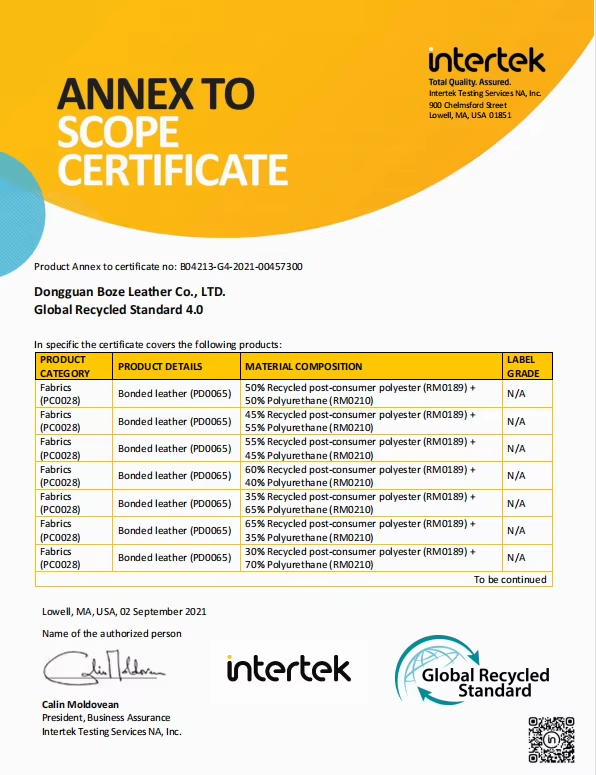
- GRS (Global Recycled Standard): Documents the traceability of post-consumer recycled inputs and enforces responsible environmental practices (Certificate No. B04213-G4).
- USDA Biobased Verification: Authenticates non-animal, bio-based renewable material content in upholstery formulations (Certificate No. 521076632086130490).
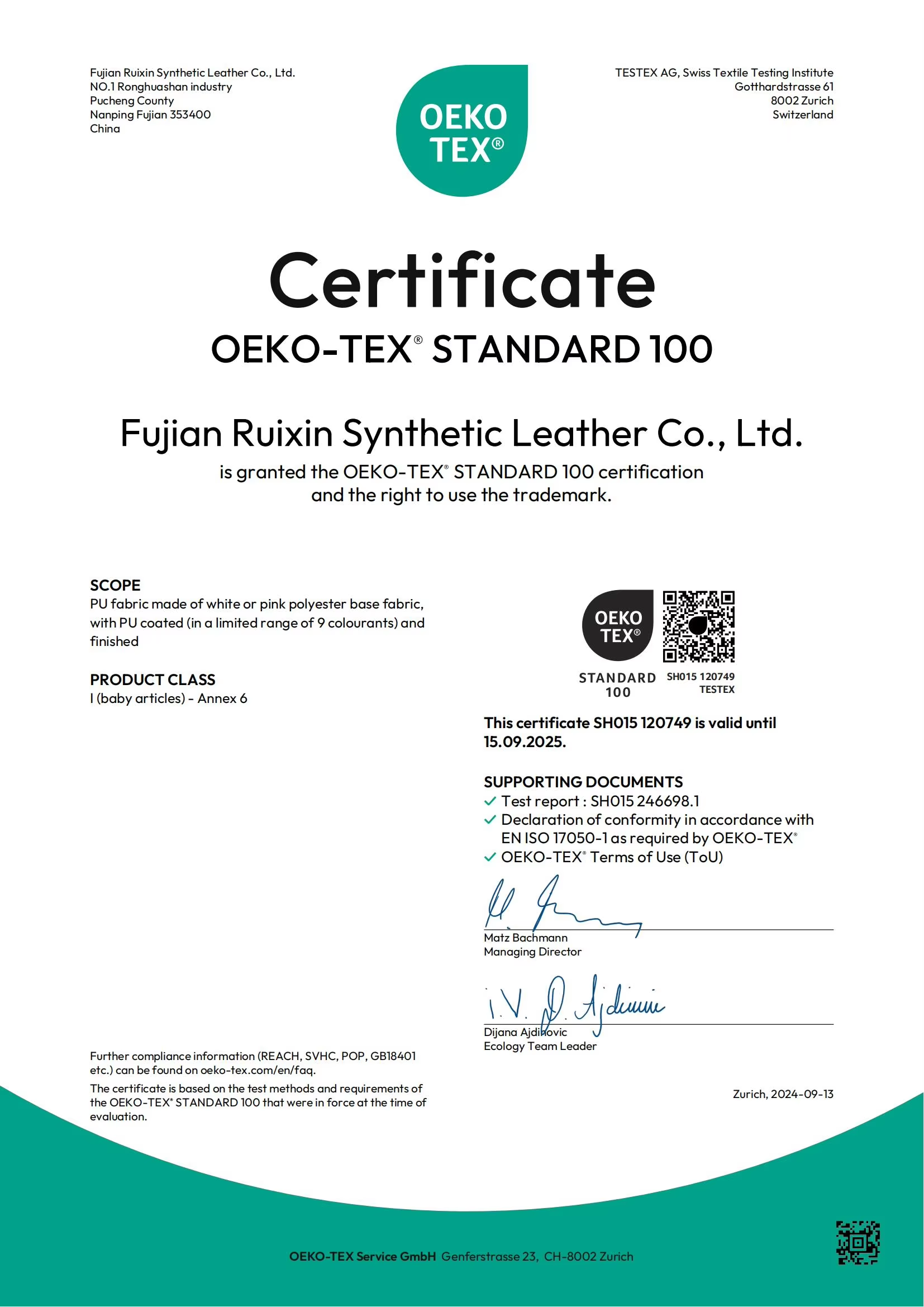
- Oeko-Tex Standard 100: Confirms that materials are thoroughly tested and free from toxic heavy metals, dangerous colorants, and hazardous residues (Certificate No. SH015 120749).
- REACH & RoHS Standards: Mandate regulatory compliance regarding restricted chemical substances and promote fluorine-free protective finishes.
Technical Performance & Functional Durability
Beyond eco-labeling, contract furniture materials must satisfy strict performance metrics. Synthetic leather solutions in PU, PVC, and microfiber undergo specialized laboratory evaluations for flame retardancy, UV endurance, and anti-bacterial/anti-mold treatments to withstand high-traffic environments. Standard technical specifications accommodate roll widths of 54/55 inches and customized thicknesses ranging from 0.8 mm up to 1.4 mm.
A proven track record in large-scale supply chain deployment is vital. For example, supplying 50,000 meters of specialized automotive synthetic leather to a client in Mexico required strict compliance with low-odor, abrasion-resistant, and fire-retardant standards.
Certification & Standard Specification Overview
| Standard / Accreditation | Primary Focus | Core Performance Benchmark | Target Use Case |
|---|---|---|---|
| Global Recycled Standard (GRS) | Recycled Content Origin | Input material supply chain traceability & eco-processing | Sustainable hotel & commercial furniture |
| USDA Biobased Program | Renewable Composition | Verified percentage of bio-based ingredients | Eco-conscious contract seating projects |
| Oeko-Tex Standard 100 | Human-Ecological Safety | Absence of heavy metals, toxic colorants & skin irritants | High-contact public & hospitality seating |
| REACH / RoHS Compliance | Chemical Substance Control | Strict limits on restricted substances & fluorine-free options | Global commercial trade & project specifications |
| Fire & Microbial Resistance Test Reports | Functional Safety | Flame retardancy, microbial growth inhibition & UV stability | Automotive, healthcare, & hotel upholstery |
Frequently Asked Questions
Which accreditations verify chemical safety for public seating upholstery?
Oeko-Tex Standard 100, REACH, and RoHS test reports ensure that synthetic leather options like PVC, PU, and microfiber are non-toxic and compliant with international chemical safety standards.
Why are anti-mold and antibacterial properties mandatory in hospitality projects?
Continuous foot traffic and frequent sanitization in commercial venues require surface treatments that actively suppress mold and bacterial growth, maintaining structural integrity and preventing odors.
What are the standard order quantities and production lead times?
Standard custom manufacturing features a minimum order quantity (MOQ) starting at 100 meters (or 1,000 meters per color for custom automotive seating specs), with delivery turnarounds between 7 and 30 days.
Manufacturing Capabilities & Final Recommendations
Choosing accredited upholstery materials certified under GRS, USDA, Oeko-Tex Standard 100, and comprehensive functional test protocols safeguards projects against compliance failure and material breakdown. Facilities featuring 6 modern production lines with monthly capacity reaching 6 million meters under ISO 9001 guidelines deliver reliable grain matching, physical stability, and prompt order fulfillment. For technical consultations or customized product inquiries, email us at vicky@bozeleather.com.
About Us
Dongguan Cigno Leather Co., Ltd. is a leading synthetic leather manufacturer located in Dongguan, China. Founded in 2007, the company operates a 100,000 sqm production center and exports 60% of its output worldwide. Backed by top-tier certifications including GRS, USDA, and Oeko-Tex Standard 100, the enterprise supplies high-grade faux leather for contract furniture, automotive interiors, footwear, and commercial applications.

REPORT