







-
 Agriculture
-
 Health-Care
-
 Environment
-
 Construction-Real-Estate
-
 Tools-Hardware
-
 Home-Garden
-
 Furniture
-
 Luggage-Bags-Cases
-
 Medical-devices-Supplies
-
 Gifts-Crafts
-
 Sports-Entertainment
-
 Food-Beverage
-
 Vehicles-Transportation
-
 Power-Transmission
-
 Material-Handling
-
 Renewable-Energy
-
 Safety
-
 Testing-Instrument-Equipment
-
 Construction-Building-Machinery
-
 Pet-Supplies
-
 Personal-Care-Household-Cleaning
-
 Vehicle-Accessories-Electronics-Tools
-
 School-Office-Supplies
-
 Packaging-Printing
-
 Mother-Kids-Toys
-
 Business-Services
-
 Commercial-Equipment-Machinery
-
 Apparel-Accessories
-
 Security
-
 Shoes-Accessories
-
 Vehicle-Parts-Accessories
-
 Jewelry-Eyewear-Watches-Accessories
-
 Lights-Lighting
-
 Fabric-Textile-Raw-Material
-
 Fabrication-Services
-
 Industrial-Machinery
-
 Consumer-Electronics
-
 Electrical-Equipment-Supplies
-
 Electronic-Components-Accessories-Telecommunications
-
 Home-Appliances
-
 Beauty
-
 Chemicals
-
 Rubber-Plastics
-
 Metals-Alloys


























































































































































































































































































































































































































































































































































































- Masonry Materials
- Curtain Walls & Accessories
- Earthwork Products
- Fireproofing Materials
- Heat Insulation Materials
- Plastic Building Materials
- Building Boards
- Soundproofing Materials
- Timber
- Waterproofing Materials
- Balustrades & Handrails
- Bathroom & Kitchen
- Flooring & Accessories
- Tiles & Accessories
- Door, Window & Accessories
- Fireplaces & Stoves
- Floor Heating Systems & Parts
- Stairs & Stair Parts
- Ceilings
- Elevators & Escalators
- Stone
- Countertops, Vanity Tops & Table Tops
- Mosaics
- Metal Building Materials
- Multifunctional Materials
- Ladders & Scaffoldings
- Mouldings
- Corner Guards
- Decorative Films
- Formwork
- Building & Industrial Glass
- Other Construction & Real Estate
- Wallpapers/Wall panels
- HVAC System & Parts
- Outdoor Facilities
- Prefabricated Buildings
- Festive & Party Supplies
- Bathroom Products
- Household Sundries
- Rain Gear
- Garden Supplies
- Household Cleaning Tools & Accessories
- Lighters & Smoking Accessories
- Home Storage & Organization
- Household Scales
- Smart Home Improvement
- Home Textiles
- Kitchenware
- Drinkware & Accessories
- Dinnerware, Coffee & Wine
- Home Decor
- Golf
- Fitness & Body Building
- Amusement Park Facilities
- Billiards, Board Game,Coin Operated Games
- Musical Instruments
- Outdoor Affordable Luxury Sports
- Camping & Hiking
- Fishing
- Sports Safety&Rehabilitation
- Ball Sports Equipments
- Water Sports
- Winter Sports
- Luxury Travel Equipments
- Sports Shoes, Bags & Accessories
- Cycling
- Other Sports & Entertainment Products
- Artificial Grass&Sports Flooring&Sports Court Equipment
- Scooters
- Food Ingredients
- Honey & Honey Products
- Snacks
- Nuts & Kernels
- Seafood
- Plant & Animal Oil
- Beverages
- Fruit & Vegetable Products
- Frog & Escargot
- Bean Products
- Egg Products
- Dairy Products
- Seasonings & Condiments
- Canned Food
- Instant Food
- Baked Goods
- Other Food & Beverage
- Meat & Poultry
- Confectionery
- Grain Products
- Feminie Care
- Hair Care & Styling
- Body Care
- Hands & Feet Care
- Hygiene Products
- Men's Grooming
- Laundry Cleaning Supplies
- Travel Size & Gift Sets
- Room Deodorizers
- Other Personal Care Products
- Pest Control Products
- Special Household Cleaning
- Floor Cleaning
- Kitchen & Bathroom Cleaning
- Oral Care
- Bath Supplies
- Yellow Pages
- Correction Supplies
- Office Binding Supplies
- Office Cutting Supplies
- Board Erasers
- Office Adhesives & Tapes
- Education Supplies
- Pencil Cases & Bags
- Notebooks & Writing Pads
- File Folder Accessories
- Calendars
- Writing Accessories
- Commercial Office Supplies
- Pencil Sharpeners
- Pens
- Letter Pad/Paper
- Paper Envelopes
- Desk Organizers
- Pencils
- Markers & Highlighters
- Filing Products
- Art Supplies
- Easels
- Badge Holder & Accessories
- Office Paper
- Printer Supplies
- Book Covers
- Other Office & School Supplies
- Stationery Set
- Boards
- Clipboards
- Stamps
- Drafting Supplies
- Stencils
- Electronic Dictionary
- Books
- Map
- Magazines
- Calculators
- Baby & Toddler Toys
- Educational Toys
- Classic Toys
- Dress Up & Pretend Play
- Toy Vehicle
- Stuffed Animals & Plush Toys
- Outdoor Toys & Structures
- Balloons & Accessories
- Baby Food
- Children's Clothing
- Baby Supplies & Products
- Maternity Clothes
- Kids Shoes
- Baby Care
- Novelty & Gag Toys
- Dolls & Accessories
- Puzzle & Games
- Blocks & Model Building Toys
- Toddler Clothing
- Baby Clothing
- Kids' Luggage & Bags
- Arts, Crafts & DIY Toys
- Action & Toy Figures
- Baby Appliances
- Hobbies & Models
- Remote Control Toys
- Promotional Toys
- Pregnancy & Maternity
- Hygiene Products
- Kid's Textile&Bedding
- Novelty & Special Use
- Toy Weapons
- Baby Gifts
- Baby Storage & Organization
- Auto Drive Systems
- ATV/UTV Parts & Accessories
- Marine Parts & Accessories
- Other Auto Parts
- Trailer Parts & Accessories
- Auto Transmission Systems
- Train Parts & Accessories
- Universal Parts
- Railway Parts & Accessories
- Auto Brake Systems
- Aviation Parts & Accessories
- Truck Parts & Accessories
- Auto Suspension Systems
- Auto Lighting Systems
- New Energy Vehicle Parts & Accessories
- Auto Steering Systems
- Wheels, Tires & Accessories
- Bus Parts & Accessories
- Auto Performance Parts
- Cooling System
- Go-Kart & Kart Racer Parts & Accessories
- Air Conditioning Systems
- Heavy Duty Vehicle Parts & Accessories
- Auto Electrical Systems
- Auto Body Systems
- Auto Engine Systems
- Container Parts & Accessories
- Motorcycle Parts & Accessories
- Refrigeration & Heat Exchange Equipment
- Machine Tool Equipment
- Food & Beverage Machinery
- Agricultural Machinery & Equipment
- Apparel & Textile Machinery
- Chemical Machinery
- Packaging Machines
- Paper Production Machinery
- Plastic & Rubber Processing Machinery
- Industrial Robots
- Electronic Products Machinery
- Metal & Metallurgy Machinery
- Woodworking Machinery
- Home Product Manufacturing Machinery
- Machinery Accessories
- Environmental Machinery
- Machinery Service
- Electrical Equipment Manufacturing Machinery
- Industrial Compressors & Parts
- Tobacco & Cigarette Machinery
- Production Line
- Used Industrial Machinery
- Electronics Production Machinery
- Other Machinery & Industrial Equipment
- Camera, Photo & Accessories
- Portable Audio, Video & Accessories
- Television, Home Audio, Video & Accessories
- Video Games & Accessories
- Mobile Phone & Accessories
- Electronic Publications
- Earphone & Headphone & Accessories
- Speakers & Accessories
- Smart Electronics
- TV Receivers & Accessories
- Mobile Phone & Computer Repair Parts
- Chargers, Batteries & Power Supplies
- Used Electronics
- VR, AR, MR Hardware & Software
- Projectors & Presentation Equipments
- Other Consumer Electronics
- Cables & Commonly Used Accessories
- Computer Hardware & Software
- Displays, Signage and Optoelectronics
- Discrete Semiconductors
- Wireless & IoT Module and Products
- Telecommunications
- Connectors, Terminals & Accessories
- Development Boards, Electronic Modules and Kits
- Circuit Protection
- Sensors
- Isolators
- Audio Components and Products
- Integrated Circuits
- Power Supplies
- Relays
- RF, Microwave and RFID
- Electronic Accessories & Supplies
- Passive Components
- PCB & PCBA
- Air Quality Appliances
- Home Appliance Parts
- Heating & Cooling Appliances
- Small Kitchen Appliances
- Laundry Appliances
- Water Heaters
- Water Treatment Appliances
- Refrigerators & Freezers
- Personal Care & Beauty Appliances
- Major Kitchen Appliances
- Cleaning Appliances
- Second-hand Appliances
- Smart Home Appliances
- Other Home Appliances
- Energy Chemicals
- Inorganic Chemicals
- Basic Organic Chemicals
- Agrochemicals
- Admixture & Additives
- Catalysts & Chemical Auxiliary Agents
- Pigments & Dyestuff
- Coating & Paint
- Daily Chemicals
- Polymer
- Organic Intermediate
- Adhesives & Sealants
- Chemical Waste
- Biological Chemical Products
- Surface Treatment Chemicals
- Painting & Coating
- Chemical Reagents
- Flavor & Fragrance
- Non-Explosive Demolition Agents
- Other Chemicals
- Custom Chemical Services

How New Technologies Can Improve CNC Tenoning Machine Efficiency
Improving CNC Tenoning Machine efficiency requires more than faster cutting cycles. Advances in digital parameter management, automatic calibration, intelligent control programming, production testing, and remote service can improve accuracy, shorten setup periods, strengthen operating stability, and speed up maintenance response. Although the supplied information does not identify a particular CNC tenoning model, its manufacturing and support practices indicate several practical technology directions for this type of woodworking equipment.
Key Technologies for Higher Efficiency
- Digital supervision of dimensional tolerances, fitting clearances, transmission coaxiality, and electrical compatibility can help prevent production and commissioning deviations.
- Automated precision calibration and refined control software can reduce manual adjustments and accelerate production startup.
- Extended full-load operation, vibration and noise inspection, and electrical stability testing can reveal faults before equipment is delivered.
- Remote video troubleshooting, real-time controller debugging, and upgrade services can reduce downtime during equipment use.
How These Technologies Apply to CNC Tenoning
Digital Control of Critical Parameters
A CNC tenoning process depends on accurate coordination between the frame, transmission components, cutting tools, positioning system, and electrical controls. Digital management throughout sheet metal processing, frame welding, assembly, and machine commissioning can improve control over these relationships. Monitoring key production parameters makes it easier to identify deviations early and maintain repeatable tenon dimensions and joint positions.
Automatic Calibration and Control Optimization
Precision calibration before shipment can reduce the amount of adjustment required after installation. Checking mechanical clearances, positioning accuracy, transmission alignment, and control settings in advance helps the machine reach production condition more quickly. Optimized CNC programs can further improve positioning consistency, cycle coordination, and repeatability across multiple workpieces.
Long-Term Load and Stability Testing
Short no-load operation may not expose problems that develop during continuous woodworking production. A more complete inspection process can combine no-load checks with extended full-load running, repeat precision measurements, noise and vibration analysis, and electrical stability testing. For a tenoning machine performing repeated cutting and joint-processing cycles, these tests can help identify mechanical or control issues before they affect the customer's production line.
Remote Diagnostics and Upgrade Support
Remote service technologies can make fault response more efficient. Video-based diagnosis and real-time control-system debugging allow technicians to assess operating problems and guide corrective work without waiting for an on-site visit. After the fault and required components are confirmed, spare-parts coordination can proceed more efficiently. Remote technical support can also assist with machine modification, functional upgrades, and control-system optimization when an existing line needs higher output or improved automation.
Production-Line and Application Considerations
Efficiency improvements become especially important when several machines must work together in a complete production line. Foshan Sun Hunt Woodworking Machinery Co.,Ltd. has reported equipment-planning projects, including a 19-machine purchase for a wooden-door factory in India and a 10-machine purchase for a wood-processing factory in the UAE. These examples reflect the importance of equipment stability, line coordination, productivity, and responsive after-sales service in larger manufacturing projects.
Relevant application environments include wooden-door and wooden-window production, solid-wood furniture manufacturing, panel furniture factories, and small woodworking workshops. In these settings, CNC tenoning efficiency can reduce manual fitting work while supporting consistent dimensions and repeatable structural processing.
The company's supplied Computer Panel Saw information also demonstrates the use of measurable automation features, including automatic feeding, stepless saw-base feed speed, a scoring saw, an air-flotation table, and dust-exhaust equipment. These specifications belong to a panel saw and should not be interpreted as specifications for a CNC tenoning machine. They nevertheless illustrate the type of automated control and production detail that can inform efficiency planning for woodworking machinery.
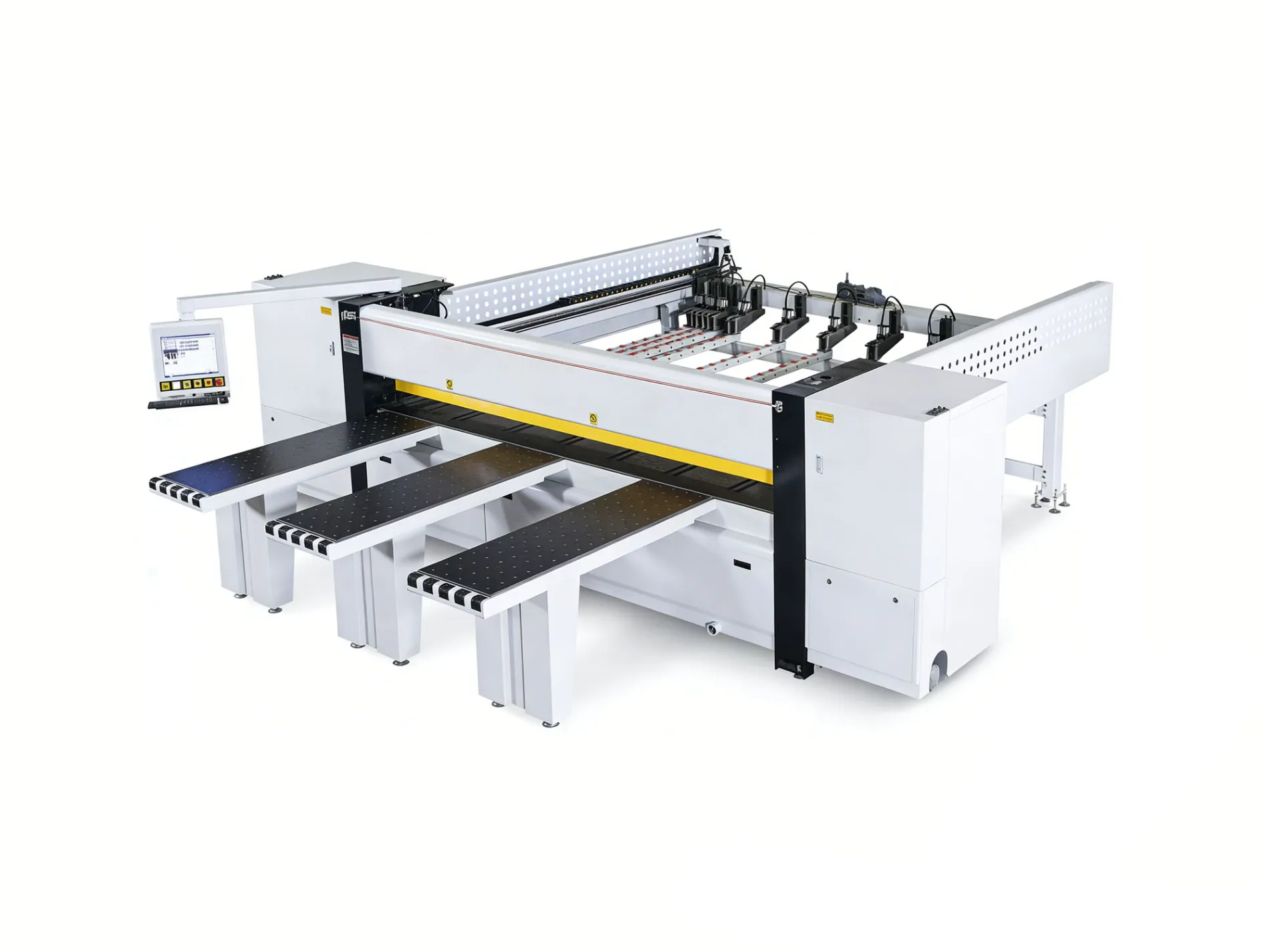
Technology Comparison
| Technology | Possible benefit for CNC tenoning operations |
|---|---|
| Digital key-parameter monitoring | Improves control of dimensional tolerance, fitting clearance, transmission alignment, and electrical matching. |
| Automated calibration and optimized CNC programs | Reduces installation adjustments and supports more consistent positioning and production startup. |
| Full-load and stability testing | Helps detect mechanical, electrical, noise, vibration, and performance problems before shipment. |
| Remote diagnosis and equipment upgrades | Shortens troubleshooting cycles and supports productivity improvements or control-system modifications. |
Frequently Asked Questions
Does the supplied information identify a specific CNC Tenoning Machine model?
No. The documented product data describes a Computer Panel Saw. The recommendations for CNC tenoning are therefore based on the company's manufacturing controls, inspection methods, and technical-support capabilities rather than on the specifications of a named tenoning model.
Which technology can reduce setup time most effectively?
Pre-delivery precision calibration combined with optimized control programs is likely to reduce repeated adjustments to positioning, transmission, and control parameters after installation. This preparation can help the machine enter production sooner.
How can technology improve CNC tenoning maintenance?
Remote video fault diagnosis and real-time control-system debugging can help technicians confirm problems and recommend corrective action more quickly. Machine modification, function upgrades, and control optimization are also available for equipment that requires greater productivity.
Conclusion and Recommendations
The strongest efficiency opportunities for CNC Tenoning Machines are digital monitoring of critical parameters, automated precision calibration, optimized control programming, extended full-load testing, and remote technical service. Together, these technologies can improve repeatability, reduce commissioning work, support stable production, and shorten maintenance response times.
Foshan Sun Hunt supports customized non-standard machinery and complete production-line solutions. The company states a minimum order quantity of one set and a normal delivery period of 20 to 35 days. For a detailed technical proposal or service consultation, contact vincent@fsshmachine.cn.
About Foshan Sun Hunt
Foshan Sun Hunt Woodworking Machinery Co.,Ltd., also known as Foshan Sun Hunt and Sheng Heng, develops and manufactures woodworking equipment for various processing applications in Lunjiao Town, Shunde District, Foshan City. Founded in 2014, the company has management and research and development teams dedicated to woodworking machinery technology. Its product range includes CNC Router Machines, Double-End Saw Series, Planer Machines, Drilling Machines, Edge Banding Machines, and Panel Saw equipment. The company serves customers in multiple industries through woodworking machinery supply and complete production-line planning.

REPORT