







-
 Agriculture
-
 Health-Care
-
 Environment
-
 Construction-Real-Estate
-
 Tools-Hardware
-
 Home-Garden
-
 Furniture
-
 Luggage-Bags-Cases
-
 Medical-devices-Supplies
-
 Gifts-Crafts
-
 Sports-Entertainment
-
 Food-Beverage
-
 Vehicles-Transportation
-
 Power-Transmission
-
 Material-Handling
-
 Renewable-Energy
-
 Safety
-
 Testing-Instrument-Equipment
-
 Construction-Building-Machinery
-
 Pet-Supplies
-
 Personal-Care-Household-Cleaning
-
 Vehicle-Accessories-Electronics-Tools
-
 School-Office-Supplies
-
 Packaging-Printing
-
 Mother-Kids-Toys
-
 Business-Services
-
 Commercial-Equipment-Machinery
-
 Apparel-Accessories
-
 Security
-
 Shoes-Accessories
-
 Vehicle-Parts-Accessories
-
 Jewelry-Eyewear-Watches-Accessories
-
 Lights-Lighting
-
 Fabric-Textile-Raw-Material
-
 Fabrication-Services
-
 Industrial-Machinery
-
 Consumer-Electronics
-
 Electrical-Equipment-Supplies
-
 Electronic-Components-Accessories-Telecommunications
-
 Home-Appliances
-
 Beauty
-
 Chemicals
-
 Rubber-Plastics
-
 Metals-Alloys


























































































































































































































































































































































































































































































































































































- Masonry Materials
- Curtain Walls & Accessories
- Earthwork Products
- Fireproofing Materials
- Heat Insulation Materials
- Plastic Building Materials
- Building Boards
- Soundproofing Materials
- Timber
- Waterproofing Materials
- Balustrades & Handrails
- Bathroom & Kitchen
- Flooring & Accessories
- Tiles & Accessories
- Door, Window & Accessories
- Fireplaces & Stoves
- Floor Heating Systems & Parts
- Stairs & Stair Parts
- Ceilings
- Elevators & Escalators
- Stone
- Countertops, Vanity Tops & Table Tops
- Mosaics
- Metal Building Materials
- Multifunctional Materials
- Ladders & Scaffoldings
- Mouldings
- Corner Guards
- Decorative Films
- Formwork
- Building & Industrial Glass
- Other Construction & Real Estate
- Wallpapers/Wall panels
- HVAC System & Parts
- Outdoor Facilities
- Prefabricated Buildings
- Festive & Party Supplies
- Bathroom Products
- Household Sundries
- Rain Gear
- Garden Supplies
- Household Cleaning Tools & Accessories
- Lighters & Smoking Accessories
- Home Storage & Organization
- Household Scales
- Smart Home Improvement
- Home Textiles
- Kitchenware
- Drinkware & Accessories
- Dinnerware, Coffee & Wine
- Home Decor
- Golf
- Fitness & Body Building
- Amusement Park Facilities
- Billiards, Board Game,Coin Operated Games
- Musical Instruments
- Outdoor Affordable Luxury Sports
- Camping & Hiking
- Fishing
- Sports Safety&Rehabilitation
- Ball Sports Equipments
- Water Sports
- Winter Sports
- Luxury Travel Equipments
- Sports Shoes, Bags & Accessories
- Cycling
- Other Sports & Entertainment Products
- Artificial Grass&Sports Flooring&Sports Court Equipment
- Scooters
- Food Ingredients
- Honey & Honey Products
- Snacks
- Nuts & Kernels
- Seafood
- Plant & Animal Oil
- Beverages
- Fruit & Vegetable Products
- Frog & Escargot
- Bean Products
- Egg Products
- Dairy Products
- Seasonings & Condiments
- Canned Food
- Instant Food
- Baked Goods
- Other Food & Beverage
- Meat & Poultry
- Confectionery
- Grain Products
- Feminie Care
- Hair Care & Styling
- Body Care
- Hands & Feet Care
- Hygiene Products
- Men's Grooming
- Laundry Cleaning Supplies
- Travel Size & Gift Sets
- Room Deodorizers
- Other Personal Care Products
- Pest Control Products
- Special Household Cleaning
- Floor Cleaning
- Kitchen & Bathroom Cleaning
- Oral Care
- Bath Supplies
- Yellow Pages
- Correction Supplies
- Office Binding Supplies
- Office Cutting Supplies
- Board Erasers
- Office Adhesives & Tapes
- Education Supplies
- Pencil Cases & Bags
- Notebooks & Writing Pads
- File Folder Accessories
- Calendars
- Writing Accessories
- Commercial Office Supplies
- Pencil Sharpeners
- Pens
- Letter Pad/Paper
- Paper Envelopes
- Desk Organizers
- Pencils
- Markers & Highlighters
- Filing Products
- Art Supplies
- Easels
- Badge Holder & Accessories
- Office Paper
- Printer Supplies
- Book Covers
- Other Office & School Supplies
- Stationery Set
- Boards
- Clipboards
- Stamps
- Drafting Supplies
- Stencils
- Electronic Dictionary
- Books
- Map
- Magazines
- Calculators
- Baby & Toddler Toys
- Educational Toys
- Classic Toys
- Dress Up & Pretend Play
- Toy Vehicle
- Stuffed Animals & Plush Toys
- Outdoor Toys & Structures
- Balloons & Accessories
- Baby Food
- Children's Clothing
- Baby Supplies & Products
- Maternity Clothes
- Kids Shoes
- Baby Care
- Novelty & Gag Toys
- Dolls & Accessories
- Puzzle & Games
- Blocks & Model Building Toys
- Toddler Clothing
- Baby Clothing
- Kids' Luggage & Bags
- Arts, Crafts & DIY Toys
- Action & Toy Figures
- Baby Appliances
- Hobbies & Models
- Remote Control Toys
- Promotional Toys
- Pregnancy & Maternity
- Hygiene Products
- Kid's Textile&Bedding
- Novelty & Special Use
- Toy Weapons
- Baby Gifts
- Baby Storage & Organization
- Auto Drive Systems
- ATV/UTV Parts & Accessories
- Marine Parts & Accessories
- Other Auto Parts
- Trailer Parts & Accessories
- Auto Transmission Systems
- Train Parts & Accessories
- Universal Parts
- Railway Parts & Accessories
- Auto Brake Systems
- Aviation Parts & Accessories
- Truck Parts & Accessories
- Auto Suspension Systems
- Auto Lighting Systems
- New Energy Vehicle Parts & Accessories
- Auto Steering Systems
- Wheels, Tires & Accessories
- Bus Parts & Accessories
- Auto Performance Parts
- Cooling System
- Go-Kart & Kart Racer Parts & Accessories
- Air Conditioning Systems
- Heavy Duty Vehicle Parts & Accessories
- Auto Electrical Systems
- Auto Body Systems
- Auto Engine Systems
- Container Parts & Accessories
- Motorcycle Parts & Accessories
- Refrigeration & Heat Exchange Equipment
- Machine Tool Equipment
- Food & Beverage Machinery
- Agricultural Machinery & Equipment
- Apparel & Textile Machinery
- Chemical Machinery
- Packaging Machines
- Paper Production Machinery
- Plastic & Rubber Processing Machinery
- Industrial Robots
- Electronic Products Machinery
- Metal & Metallurgy Machinery
- Woodworking Machinery
- Home Product Manufacturing Machinery
- Machinery Accessories
- Environmental Machinery
- Machinery Service
- Electrical Equipment Manufacturing Machinery
- Industrial Compressors & Parts
- Tobacco & Cigarette Machinery
- Production Line
- Used Industrial Machinery
- Electronics Production Machinery
- Other Machinery & Industrial Equipment
- Camera, Photo & Accessories
- Portable Audio, Video & Accessories
- Television, Home Audio, Video & Accessories
- Video Games & Accessories
- Mobile Phone & Accessories
- Electronic Publications
- Earphone & Headphone & Accessories
- Speakers & Accessories
- Smart Electronics
- TV Receivers & Accessories
- Mobile Phone & Computer Repair Parts
- Chargers, Batteries & Power Supplies
- Used Electronics
- VR, AR, MR Hardware & Software
- Projectors & Presentation Equipments
- Other Consumer Electronics
- Cables & Commonly Used Accessories
- Computer Hardware & Software
- Displays, Signage and Optoelectronics
- Discrete Semiconductors
- Wireless & IoT Module and Products
- Telecommunications
- Connectors, Terminals & Accessories
- Development Boards, Electronic Modules and Kits
- Circuit Protection
- Sensors
- Isolators
- Audio Components and Products
- Integrated Circuits
- Power Supplies
- Relays
- RF, Microwave and RFID
- Electronic Accessories & Supplies
- Passive Components
- PCB & PCBA
- Air Quality Appliances
- Home Appliance Parts
- Heating & Cooling Appliances
- Small Kitchen Appliances
- Laundry Appliances
- Water Heaters
- Water Treatment Appliances
- Refrigerators & Freezers
- Personal Care & Beauty Appliances
- Major Kitchen Appliances
- Cleaning Appliances
- Second-hand Appliances
- Smart Home Appliances
- Other Home Appliances
- Energy Chemicals
- Inorganic Chemicals
- Basic Organic Chemicals
- Agrochemicals
- Admixture & Additives
- Catalysts & Chemical Auxiliary Agents
- Pigments & Dyestuff
- Coating & Paint
- Daily Chemicals
- Polymer
- Organic Intermediate
- Adhesives & Sealants
- Chemical Waste
- Biological Chemical Products
- Surface Treatment Chemicals
- Painting & Coating
- Chemical Reagents
- Flavor & Fragrance
- Non-Explosive Demolition Agents
- Other Chemicals
- Custom Chemical Services

How to Check Softness Retention in Chemically Processed Crochet Human Hair
To determine whether crochet human hair stays soft after chemical treatment, compare processed hair with an untreated sample made from the same hair type, texture, length, and color. Test separate samples after dyeing, bleaching, or restyling, then assess their feel and performance under consistent conditions.
Practical Testing Method and Main Findings
- Set aside an untreated human hair bundle as the control sample before applying any chemical process.
- Evaluate both dry and lightly damp hair for softness, flexibility, surface smoothness, and finger-combing ease.
- Inspect texture retention, shedding, tangling, length, weight, color, and weft stability after processing.
- Use the results to judge suitability for crochet hairstyles, protective styling, salon installation, and retail applications.
Step-by-Step Principle for Comparing Processed Hair
1. Establish a Consistent Reference
The comparison is most reliable when the control and treated samples come from equivalent hair. MEIRHAIR offers 100% human hair in Straight, Body Wave, Deep Wave, Loose Wave, Deep Curly, Kinky Curly, and Water Wave patterns. Selecting matching samples helps ensure that the test measures chemical impact rather than natural differences between unrelated textures.
Keep one portion untreated and process other portions using the intended dyeing, bleaching, or restyling method. Label each piece clearly and apply the same handling procedure to every sample. This creates a practical baseline for evaluating softness retention.
2. Check Dry and Damp Hand Feel
Begin with a dry-feel inspection. Run the fingers through each sample and note whether the processed hair remains smooth, supple, and flexible. A rougher surface, stiff movement, or noticeable friction compared with the control suggests that softness has declined.
Next, lightly dampen the samples and repeat the inspection. Some chemically processed hair feels acceptable when dry but becomes coarse, rigid, or difficult to manage when moisture is introduced. Record whether damp handling produces the same softness as the untreated reference.
3. Assess Styling Performance and Construction
Finger-combing provides another useful indicator. Observe how easily the strands separate, whether resistance or tangling develops, and whether combing causes unusual shedding. Also compare the original wave or curl definition with the treated sample to determine whether the texture remains recognizable.
Softness should be reviewed together with construction quality. Examine the weft for loosening, uneven stitching, or other visible weakening. Note any changes in hair quality, length, weight, color, texture, or weft condition so that a softness issue can be distinguished from a broader processing problem.
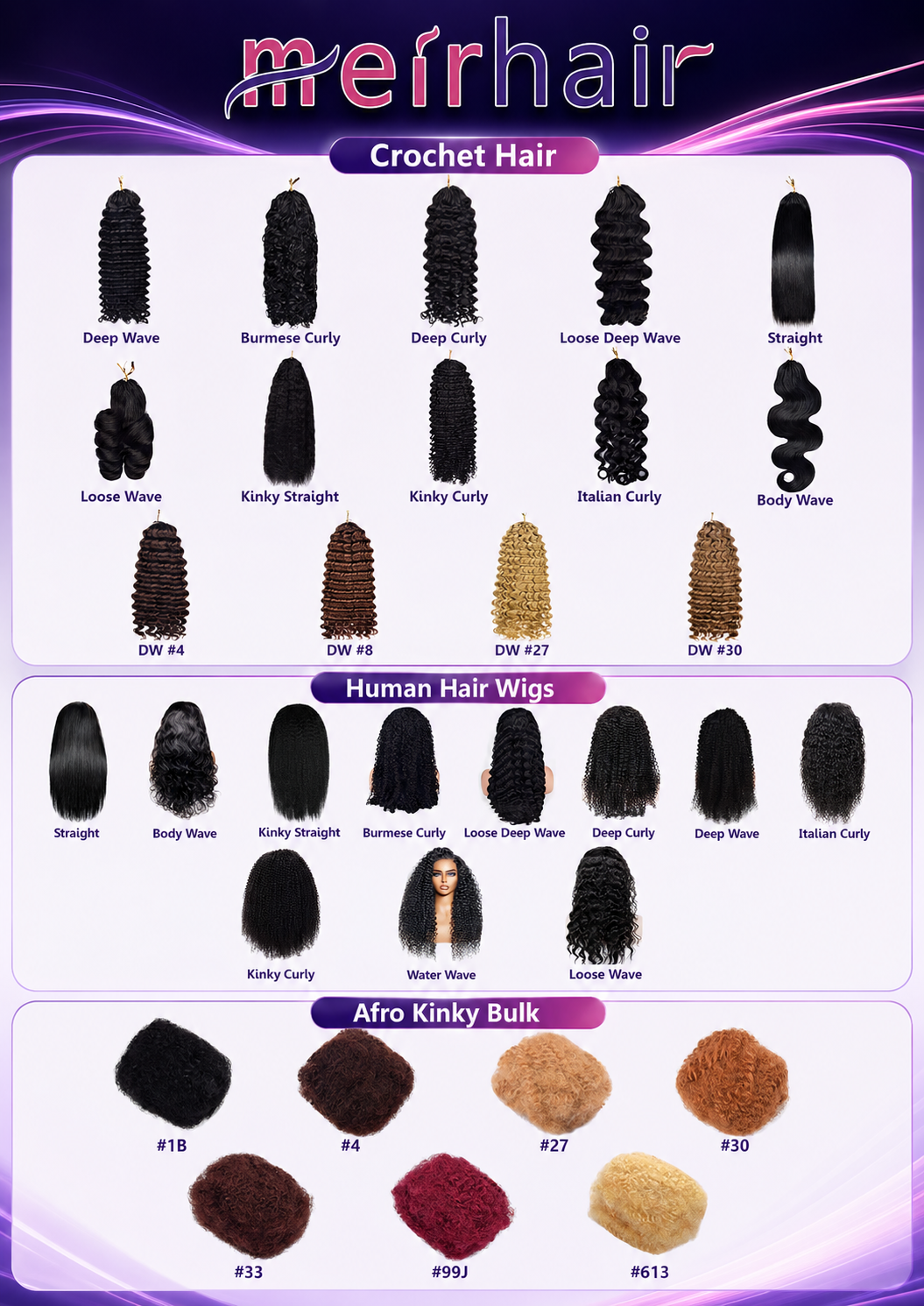
For a realistic salon or retail assessment, test the hair in the setting where it will be installed. Crochet hair is intended for crochet hairstyles, protective hairstyles, and professional salon use, so the final evaluation should cover both tactile softness and practical handling during preparation, installation, and styling.
MEIRHAIR states that every order receives a pre-shipment inspection covering hair quality, length, weight, color, texture, and weft condition. The company also records cooperation involving crochet human hair supplied to a beauty distributor in France for crochet styles, protective looks, and salon installation.
Comparison Chart for Softness Retention
| Inspection Point | Untreated Control | Processed Hair | Suggested Record |
|---|---|---|---|
| Dry feel | Describe the original smoothness, softness, and flexibility | Compare surface feel and movement directly with the control | Retained, reduced, or poor softness |
| Damp feel | Observe texture and flexibility after light dampening | Look for increased coarseness, stiffness, or drag | Consistent or changed softness |
| Finger-combing | Record how easily the strands separate | Check resistance, tangling, and shedding during handling | Easy, moderate, or difficult |
| Texture definition | Document the original straight, wavy, or curly pattern | Compare the treated pattern with the control sample | Retained or altered texture |
| Weft structure | Inspect the original stitching and overall stability | Look for loosening, weakness, or irregular construction | Intact or affected |
Frequently Asked Questions
Which chemical treatments can be tested?
The listed hair is suitable for dyeing, bleaching, and restyling. Treat each process as a separate test group and compare it with the same untreated reference whenever possible.
How do I measure softness if no numerical standard is provided?
Use a repeatable qualitative scale such as retained, reduced, or poor. Support the rating with notes about dry and damp hand feel, smoothness, flexibility, finger-combing, shedding, texture, and weft condition.
Why inspect more than the hair’s surface feel?
A chemical process may affect texture definition, shedding, or weft stability even when the hair still feels soft. Reviewing hair quality, length, weight, color, texture, and construction gives a more complete result.
Conclusion and Product Recommendations
The most dependable way to test crochet human hair after chemical processing is to compare dyed, bleached, or restyled samples with an untreated control made from matching hair. Evaluate dry and damp softness, flexibility, finger-combing, shedding, texture definition, and weft condition using the same procedure and clear qualitative ratings. MEIRHAIR offers OEM/ODM, private-label, wholesale, and small-batch support, with a stated minimum order quantity of 1 pc. For technical guidance or customized solutions, contact sales@brazilianhairtop.com.
About MEIRHAIR
Guangzhou Ruiju E-Commerce Co., Ltd. operates the MEIRHAIR human hair brand and supplies wigs, bundles, extensions, braiding hair, and customized hair products to international beauty markets. Founded in 2014, the company develops and customizes textures, lengths, colors, densities, lace dimensions, cap designs, and attachment methods. Its products are distributed across North America, Europe, Africa, the Middle East, South America, Southeast Asia, and other regions.

REPORT