







-
 Agriculture
-
 Health-Care
-
 Environment
-
 Construction-Real-Estate
-
 Tools-Hardware
-
 Home-Garden
-
 Furniture
-
 Luggage-Bags-Cases
-
 Medical-devices-Supplies
-
 Gifts-Crafts
-
 Sports-Entertainment
-
 Food-Beverage
-
 Vehicles-Transportation
-
 Power-Transmission
-
 Material-Handling
-
 Renewable-Energy
-
 Safety
-
 Testing-Instrument-Equipment
-
 Construction-Building-Machinery
-
 Pet-Supplies
-
 Personal-Care-Household-Cleaning
-
 Vehicle-Accessories-Electronics-Tools
-
 School-Office-Supplies
-
 Packaging-Printing
-
 Mother-Kids-Toys
-
 Business-Services
-
 Commercial-Equipment-Machinery
-
 Apparel-Accessories
-
 Security
-
 Shoes-Accessories
-
 Vehicle-Parts-Accessories
-
 Jewelry-Eyewear-Watches-Accessories
-
 Lights-Lighting
-
 Fabric-Textile-Raw-Material
-
 Fabrication-Services
-
 Industrial-Machinery
-
 Consumer-Electronics
-
 Electrical-Equipment-Supplies
-
 Electronic-Components-Accessories-Telecommunications
-
 Home-Appliances
-
 Beauty
-
 Chemicals
-
 Rubber-Plastics
-
 Metals-Alloys


























































































































































































































































































































































































































































































































































































- Masonry Materials
- Curtain Walls & Accessories
- Earthwork Products
- Fireproofing Materials
- Heat Insulation Materials
- Plastic Building Materials
- Building Boards
- Soundproofing Materials
- Timber
- Waterproofing Materials
- Balustrades & Handrails
- Bathroom & Kitchen
- Flooring & Accessories
- Tiles & Accessories
- Door, Window & Accessories
- Fireplaces & Stoves
- Floor Heating Systems & Parts
- Stairs & Stair Parts
- Ceilings
- Elevators & Escalators
- Stone
- Countertops, Vanity Tops & Table Tops
- Mosaics
- Metal Building Materials
- Multifunctional Materials
- Ladders & Scaffoldings
- Mouldings
- Corner Guards
- Decorative Films
- Formwork
- Building & Industrial Glass
- Other Construction & Real Estate
- Wallpapers/Wall panels
- HVAC System & Parts
- Outdoor Facilities
- Prefabricated Buildings
- Festive & Party Supplies
- Bathroom Products
- Household Sundries
- Rain Gear
- Garden Supplies
- Household Cleaning Tools & Accessories
- Lighters & Smoking Accessories
- Home Storage & Organization
- Household Scales
- Smart Home Improvement
- Home Textiles
- Kitchenware
- Drinkware & Accessories
- Dinnerware, Coffee & Wine
- Home Decor
- Golf
- Fitness & Body Building
- Amusement Park Facilities
- Billiards, Board Game,Coin Operated Games
- Musical Instruments
- Outdoor Affordable Luxury Sports
- Camping & Hiking
- Fishing
- Sports Safety&Rehabilitation
- Ball Sports Equipments
- Water Sports
- Winter Sports
- Luxury Travel Equipments
- Sports Shoes, Bags & Accessories
- Cycling
- Other Sports & Entertainment Products
- Artificial Grass&Sports Flooring&Sports Court Equipment
- Scooters
- Food Ingredients
- Honey & Honey Products
- Snacks
- Nuts & Kernels
- Seafood
- Plant & Animal Oil
- Beverages
- Fruit & Vegetable Products
- Frog & Escargot
- Bean Products
- Egg Products
- Dairy Products
- Seasonings & Condiments
- Canned Food
- Instant Food
- Baked Goods
- Other Food & Beverage
- Meat & Poultry
- Confectionery
- Grain Products
- Feminie Care
- Hair Care & Styling
- Body Care
- Hands & Feet Care
- Hygiene Products
- Men's Grooming
- Laundry Cleaning Supplies
- Travel Size & Gift Sets
- Room Deodorizers
- Other Personal Care Products
- Pest Control Products
- Special Household Cleaning
- Floor Cleaning
- Kitchen & Bathroom Cleaning
- Oral Care
- Bath Supplies
- Yellow Pages
- Correction Supplies
- Office Binding Supplies
- Office Cutting Supplies
- Board Erasers
- Office Adhesives & Tapes
- Education Supplies
- Pencil Cases & Bags
- Notebooks & Writing Pads
- File Folder Accessories
- Calendars
- Writing Accessories
- Commercial Office Supplies
- Pencil Sharpeners
- Pens
- Letter Pad/Paper
- Paper Envelopes
- Desk Organizers
- Pencils
- Markers & Highlighters
- Filing Products
- Art Supplies
- Easels
- Badge Holder & Accessories
- Office Paper
- Printer Supplies
- Book Covers
- Other Office & School Supplies
- Stationery Set
- Boards
- Clipboards
- Stamps
- Drafting Supplies
- Stencils
- Electronic Dictionary
- Books
- Map
- Magazines
- Calculators
- Baby & Toddler Toys
- Educational Toys
- Classic Toys
- Dress Up & Pretend Play
- Toy Vehicle
- Stuffed Animals & Plush Toys
- Outdoor Toys & Structures
- Balloons & Accessories
- Baby Food
- Children's Clothing
- Baby Supplies & Products
- Maternity Clothes
- Kids Shoes
- Baby Care
- Novelty & Gag Toys
- Dolls & Accessories
- Puzzle & Games
- Blocks & Model Building Toys
- Toddler Clothing
- Baby Clothing
- Kids' Luggage & Bags
- Arts, Crafts & DIY Toys
- Action & Toy Figures
- Baby Appliances
- Hobbies & Models
- Remote Control Toys
- Promotional Toys
- Pregnancy & Maternity
- Hygiene Products
- Kid's Textile&Bedding
- Novelty & Special Use
- Toy Weapons
- Baby Gifts
- Baby Storage & Organization
- Auto Drive Systems
- ATV/UTV Parts & Accessories
- Marine Parts & Accessories
- Other Auto Parts
- Trailer Parts & Accessories
- Auto Transmission Systems
- Train Parts & Accessories
- Universal Parts
- Railway Parts & Accessories
- Auto Brake Systems
- Aviation Parts & Accessories
- Truck Parts & Accessories
- Auto Suspension Systems
- Auto Lighting Systems
- New Energy Vehicle Parts & Accessories
- Auto Steering Systems
- Wheels, Tires & Accessories
- Bus Parts & Accessories
- Auto Performance Parts
- Cooling System
- Go-Kart & Kart Racer Parts & Accessories
- Air Conditioning Systems
- Heavy Duty Vehicle Parts & Accessories
- Auto Electrical Systems
- Auto Body Systems
- Auto Engine Systems
- Container Parts & Accessories
- Motorcycle Parts & Accessories
- Refrigeration & Heat Exchange Equipment
- Machine Tool Equipment
- Food & Beverage Machinery
- Agricultural Machinery & Equipment
- Apparel & Textile Machinery
- Chemical Machinery
- Packaging Machines
- Paper Production Machinery
- Plastic & Rubber Processing Machinery
- Industrial Robots
- Electronic Products Machinery
- Metal & Metallurgy Machinery
- Woodworking Machinery
- Home Product Manufacturing Machinery
- Machinery Accessories
- Environmental Machinery
- Machinery Service
- Electrical Equipment Manufacturing Machinery
- Industrial Compressors & Parts
- Tobacco & Cigarette Machinery
- Production Line
- Used Industrial Machinery
- Electronics Production Machinery
- Other Machinery & Industrial Equipment
- Camera, Photo & Accessories
- Portable Audio, Video & Accessories
- Television, Home Audio, Video & Accessories
- Video Games & Accessories
- Mobile Phone & Accessories
- Electronic Publications
- Earphone & Headphone & Accessories
- Speakers & Accessories
- Smart Electronics
- TV Receivers & Accessories
- Mobile Phone & Computer Repair Parts
- Chargers, Batteries & Power Supplies
- Used Electronics
- VR, AR, MR Hardware & Software
- Projectors & Presentation Equipments
- Other Consumer Electronics
- Cables & Commonly Used Accessories
- Computer Hardware & Software
- Displays, Signage and Optoelectronics
- Discrete Semiconductors
- Wireless & IoT Module and Products
- Telecommunications
- Connectors, Terminals & Accessories
- Development Boards, Electronic Modules and Kits
- Circuit Protection
- Sensors
- Isolators
- Audio Components and Products
- Integrated Circuits
- Power Supplies
- Relays
- RF, Microwave and RFID
- Electronic Accessories & Supplies
- Passive Components
- PCB & PCBA
- Air Quality Appliances
- Home Appliance Parts
- Heating & Cooling Appliances
- Small Kitchen Appliances
- Laundry Appliances
- Water Heaters
- Water Treatment Appliances
- Refrigerators & Freezers
- Personal Care & Beauty Appliances
- Major Kitchen Appliances
- Cleaning Appliances
- Second-hand Appliances
- Smart Home Appliances
- Other Home Appliances
- Energy Chemicals
- Inorganic Chemicals
- Basic Organic Chemicals
- Agrochemicals
- Admixture & Additives
- Catalysts & Chemical Auxiliary Agents
- Pigments & Dyestuff
- Coating & Paint
- Daily Chemicals
- Polymer
- Organic Intermediate
- Adhesives & Sealants
- Chemical Waste
- Biological Chemical Products
- Surface Treatment Chemicals
- Painting & Coating
- Chemical Reagents
- Flavor & Fragrance
- Non-Explosive Demolition Agents
- Other Chemicals
- Custom Chemical Services

How to Communicate Precise Outdoor Table and Chair Details from CAD Drawings
Clear CAD communication allows suppliers to manufacture outdoor tables and chairs according to the approved design. A complete specification should combine dimensioned drawings with written details covering materials, finishes, colors, seating capacity, construction, customization, inspection, packaging, and installation requirements. Each requirement should be connected to a drawing reference and controlled by a clear revision number.
Essential Information to Include
- Show the overall length, width, height, tabletop dimensions, seat height, spacing, component thickness, and connection positions.
- Identify materials by individual component, such as aluminum for the frame, teak wood for a tabletop or accent, and fabric for cushions.
- List color, coating, texture, and surface treatment requirements separately from the base material specifications.
- Mark all selected options, including dimensions, seating capacity, fabric, structural features, assembly method, and packaging requirements.
- Describe the intended application, whether the furniture is for a hotel terrace, resort garden, rooftop restaurant, villa, outdoor dining area, or poolside project.
Build a Controlled CAD Specification Package
A CAD drawing becomes an effective production document when its visual information agrees with the written schedule. Assign a unique item code to every table and chair, then add the revision number, drawing date, measurement unit, and scale. This information enables the supplier, purchasing team, quality inspector, and installer to work from the same approved version during quotation, sampling, production, and delivery.
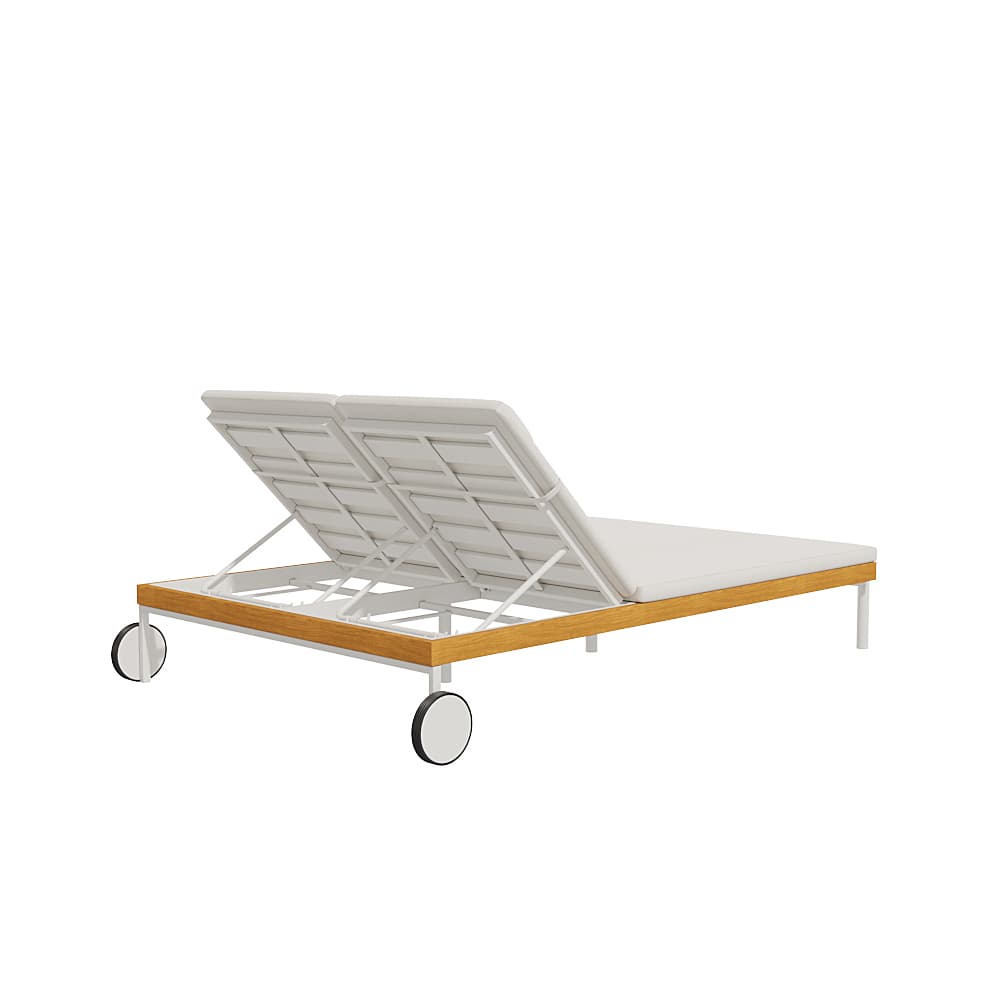
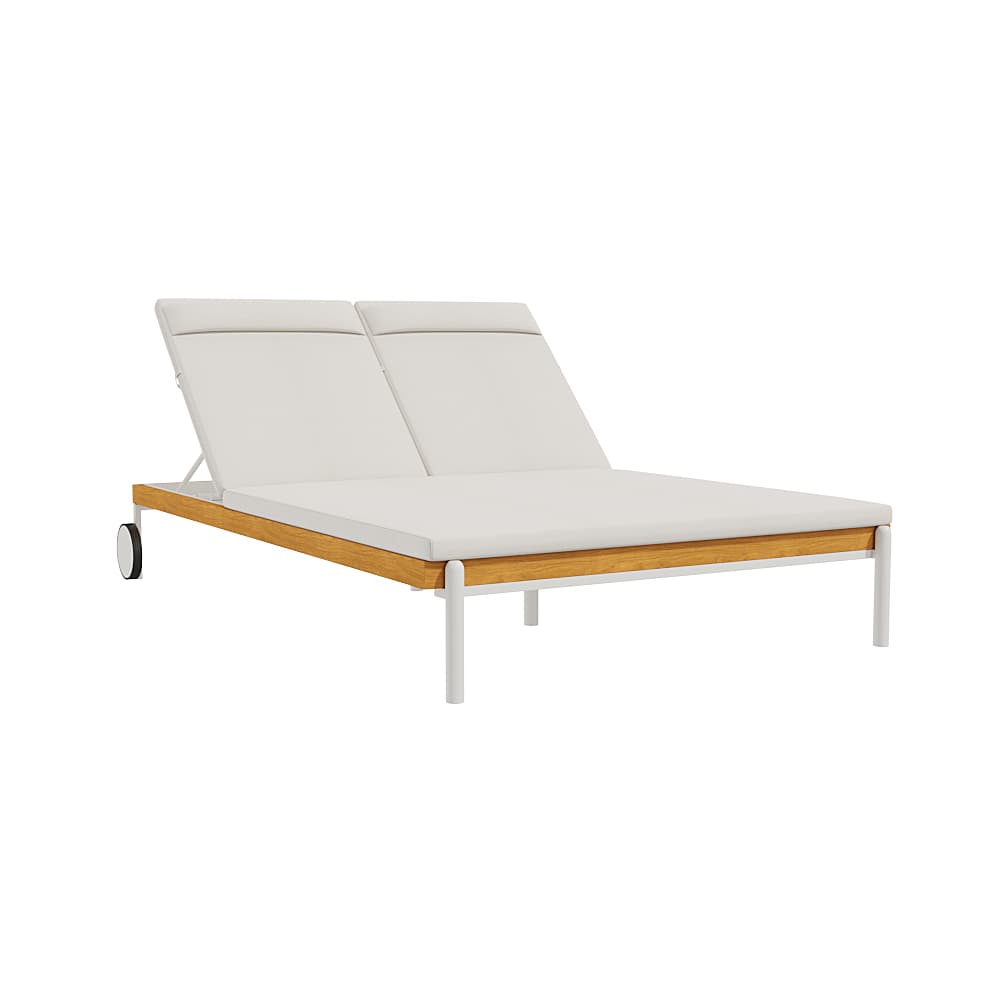
Separate objective measurements from appearance requirements. Measurements may include overall dimensions, leg locations, seat height, tabletop size, material thickness, load rating, and the number of users. Appearance details should cover the material combination, color, finish, fabric, grain direction, and other visible features. For example, a related daybed specification identifies an aluminum frame, teak wood, a customized color, a 150 kg capacity per seat, and dimensions of 200 × 146 × 34 cm.
Use Multiple Drawing Views
Organize the CAD package so that each view answers a specific manufacturing question. Front, side, and top views should establish the main dimensions and overall proportions. Enlarged detail views can show joints, fasteners, welds, supports, edge treatments, and transitions between materials. A 3D view helps confirm the intended appearance, while a component schedule links every part to its material, quantity, finish, and assembly position.
Place customization notes next to the relevant drawing feature and repeat critical selections in the purchasing schedule. A note might specify an aluminum frame, teak wood surface, and customized color. If a table is intended for six, ten, or twelve people, show that capacity in both the title block and the order specification. Unselected alternatives should be removed or clearly crossed out so that quotation, sampling, and production teams cannot interpret the design differently.
Connect Design Details with Manufacturing and Quality
Kingwell supports OEM and ODM projects through CAD drawings, 3D design, and customization of dimensions, materials, colors, and construction details. Its production capability combines manual workmanship with automatic cutting equipment and robotic welding arms, allowing the factory to produce both straightforward aluminum frames and more complex outdoor furniture structures.
The quality plan should reference the approved CAD revision throughout the project. Incoming checks can verify raw materials, teak grades, fabric specifications, and coating requirements. During production, inspectors can review dimensions, welding, assembly, and structural stability. Final inspection should confirm appearance, product size, quantity, load-related requirements where applicable, and packaging condition before dispatch.
Kingwell lists credentials and standards including BS 5852 for outdoor furniture in the European region, FSC for teak wood outdoor furniture worldwide, EN 581 for outdoor tables in European countries, ISO90001 for outdoor furniture globally, RoHS for outdoor sofas, and CE for outdoor dining sets. The applicable certificate should always be matched to the specific product, destination market, and project requirement rather than treated as a replacement for drawing approval.
Previous project examples include an 80-piece outdoor single-sofa order for a luxury hotel in New Zealand, a 500-plus-piece sun lounger order for an American resort pool, and a 50-plus-piece rattan outdoor sofa project for a five-star hotel beach leisure area in Spain. These projects demonstrate why quantity, location, furniture category, operating conditions, and design style should be communicated together.
CAD Communication Checklist
| Specification area | Information to provide | Why it matters |
|---|---|---|
| Dimensions and capacity | Overall size, part measurements, seat count, and weight capacity where required | Confirms layout, comfort, fit, and structural expectations |
| Materials and finishes | Aluminum, teak wood, fabric, color, coating, and surface treatment | Aligns purchasing, appearance, and material selection |
| Construction | Joints, welds, fasteners, supports, component quantities, and assembly references | Helps production and inspection follow the intended structure |
| Customization control | Item code, selected options, revision number, and marked changes | Prevents conflicting versions between teams |
| Quality and shipment | Inspection points, packaging method, quantity verification, and delivery expectations | Links the approved design to dispatch readiness |
Prepare the Quotation and Order Documents
Send the CAD files with a written product schedule when requesting a quotation. The schedule should state the furniture type, quantity, dimensions, materials by component, color, finish, customization status, packaging instructions, and expected delivery date. Kingwell lists no minimum quantity for sample products and a standard order minimum of approximately 5–10 sets, with mixed one-stop production available. Its aluminum daybed information indicates a sample lead time of 7–10 days and a formal order lead time of 30–45 days.
Frequently Asked Questions
What information should appear beside an outdoor table or chair CAD drawing?
Include the item code, revision, measurement unit, overall dimensions, component materials, color, finish, capacity, assembly information, and project-specific notes. Every written instruction should point to a visible drawing feature or a numbered schedule entry.
What is the clearest way to specify materials?
Describe each material according to its component. For example, identify aluminum as the frame material and teak wood as the selected surface or accent material, then provide fabric and finish details separately. Avoid using one broad material label for the entire product.
How can the CAD package help with final inspection?
Use the approved drawing revision as the inspection baseline. Inspectors can compare the finished product against its dimensions, appearance, material schedule, structural stability, component quantity, and packaging requirements. Raw material, teak grade, and fabric checks should also be included when relevant.
Conclusion
The most reliable way to communicate outdoor table and chair details is to combine dimensioned CAD views with a controlled written schedule. Include material-by-component information, selected colors and capacities, construction details, customization marks, revision control, and a matching inspection checklist. Kingwell provides Manufacturer, OEM & ODM, and Custom Project Solutions, with checks covering incoming materials, production stages, and final products. For technical guidance or project support, contact info@kingwellgrou.com.
About Us
Foshan Kingwell Industry Co., Ltd. supplies outdoor furniture for engineering and commercial projects, including aluminum and teak furniture. Established in 2015, the company operates a 26,800 sqm factory and provides design, product development, customization, manufacturing, logistics, and after-sales support. Its in-house capabilities cover CAD drawings, 3D designs, OEM, and ODM projects. Listed credentials include FSC and EN 581, and its products have been supplied to clients across several industries.

REPORT