







-
 Agriculture
-
 Health-Care
-
 Environment
-
 Construction-Real-Estate
-
 Tools-Hardware
-
 Home-Garden
-
 Furniture
-
 Luggage-Bags-Cases
-
 Medical-devices-Supplies
-
 Gifts-Crafts
-
 Sports-Entertainment
-
 Food-Beverage
-
 Vehicles-Transportation
-
 Power-Transmission
-
 Material-Handling
-
 Renewable-Energy
-
 Safety
-
 Testing-Instrument-Equipment
-
 Construction-Building-Machinery
-
 Pet-Supplies
-
 Personal-Care-Household-Cleaning
-
 Vehicle-Accessories-Electronics-Tools
-
 School-Office-Supplies
-
 Packaging-Printing
-
 Mother-Kids-Toys
-
 Business-Services
-
 Commercial-Equipment-Machinery
-
 Apparel-Accessories
-
 Security
-
 Shoes-Accessories
-
 Vehicle-Parts-Accessories
-
 Jewelry-Eyewear-Watches-Accessories
-
 Lights-Lighting
-
 Fabric-Textile-Raw-Material
-
 Fabrication-Services
-
 Industrial-Machinery
-
 Consumer-Electronics
-
 Electrical-Equipment-Supplies
-
 Electronic-Components-Accessories-Telecommunications
-
 Home-Appliances
-
 Beauty
-
 Chemicals
-
 Rubber-Plastics
-
 Metals-Alloys


























































































































































































































































































































































































































































































































































































- Masonry Materials
- Curtain Walls & Accessories
- Earthwork Products
- Fireproofing Materials
- Heat Insulation Materials
- Plastic Building Materials
- Building Boards
- Soundproofing Materials
- Timber
- Waterproofing Materials
- Balustrades & Handrails
- Bathroom & Kitchen
- Flooring & Accessories
- Tiles & Accessories
- Door, Window & Accessories
- Fireplaces & Stoves
- Floor Heating Systems & Parts
- Stairs & Stair Parts
- Ceilings
- Elevators & Escalators
- Stone
- Countertops, Vanity Tops & Table Tops
- Mosaics
- Metal Building Materials
- Multifunctional Materials
- Ladders & Scaffoldings
- Mouldings
- Corner Guards
- Decorative Films
- Formwork
- Building & Industrial Glass
- Other Construction & Real Estate
- Wallpapers/Wall panels
- HVAC System & Parts
- Outdoor Facilities
- Prefabricated Buildings
- Festive & Party Supplies
- Bathroom Products
- Household Sundries
- Rain Gear
- Garden Supplies
- Household Cleaning Tools & Accessories
- Lighters & Smoking Accessories
- Home Storage & Organization
- Household Scales
- Smart Home Improvement
- Home Textiles
- Kitchenware
- Drinkware & Accessories
- Dinnerware, Coffee & Wine
- Home Decor
- Golf
- Fitness & Body Building
- Amusement Park Facilities
- Billiards, Board Game,Coin Operated Games
- Musical Instruments
- Outdoor Affordable Luxury Sports
- Camping & Hiking
- Fishing
- Sports Safety&Rehabilitation
- Ball Sports Equipments
- Water Sports
- Winter Sports
- Luxury Travel Equipments
- Sports Shoes, Bags & Accessories
- Cycling
- Other Sports & Entertainment Products
- Artificial Grass&Sports Flooring&Sports Court Equipment
- Scooters
- Food Ingredients
- Honey & Honey Products
- Snacks
- Nuts & Kernels
- Seafood
- Plant & Animal Oil
- Beverages
- Fruit & Vegetable Products
- Frog & Escargot
- Bean Products
- Egg Products
- Dairy Products
- Seasonings & Condiments
- Canned Food
- Instant Food
- Baked Goods
- Other Food & Beverage
- Meat & Poultry
- Confectionery
- Grain Products
- Feminie Care
- Hair Care & Styling
- Body Care
- Hands & Feet Care
- Hygiene Products
- Men's Grooming
- Laundry Cleaning Supplies
- Travel Size & Gift Sets
- Room Deodorizers
- Other Personal Care Products
- Pest Control Products
- Special Household Cleaning
- Floor Cleaning
- Kitchen & Bathroom Cleaning
- Oral Care
- Bath Supplies
- Yellow Pages
- Correction Supplies
- Office Binding Supplies
- Office Cutting Supplies
- Board Erasers
- Office Adhesives & Tapes
- Education Supplies
- Pencil Cases & Bags
- Notebooks & Writing Pads
- File Folder Accessories
- Calendars
- Writing Accessories
- Commercial Office Supplies
- Pencil Sharpeners
- Pens
- Letter Pad/Paper
- Paper Envelopes
- Desk Organizers
- Pencils
- Markers & Highlighters
- Filing Products
- Art Supplies
- Easels
- Badge Holder & Accessories
- Office Paper
- Printer Supplies
- Book Covers
- Other Office & School Supplies
- Stationery Set
- Boards
- Clipboards
- Stamps
- Drafting Supplies
- Stencils
- Electronic Dictionary
- Books
- Map
- Magazines
- Calculators
- Baby & Toddler Toys
- Educational Toys
- Classic Toys
- Dress Up & Pretend Play
- Toy Vehicle
- Stuffed Animals & Plush Toys
- Outdoor Toys & Structures
- Balloons & Accessories
- Baby Food
- Children's Clothing
- Baby Supplies & Products
- Maternity Clothes
- Kids Shoes
- Baby Care
- Novelty & Gag Toys
- Dolls & Accessories
- Puzzle & Games
- Blocks & Model Building Toys
- Toddler Clothing
- Baby Clothing
- Kids' Luggage & Bags
- Arts, Crafts & DIY Toys
- Action & Toy Figures
- Baby Appliances
- Hobbies & Models
- Remote Control Toys
- Promotional Toys
- Pregnancy & Maternity
- Hygiene Products
- Kid's Textile&Bedding
- Novelty & Special Use
- Toy Weapons
- Baby Gifts
- Baby Storage & Organization
- Auto Drive Systems
- ATV/UTV Parts & Accessories
- Marine Parts & Accessories
- Other Auto Parts
- Trailer Parts & Accessories
- Auto Transmission Systems
- Train Parts & Accessories
- Universal Parts
- Railway Parts & Accessories
- Auto Brake Systems
- Aviation Parts & Accessories
- Truck Parts & Accessories
- Auto Suspension Systems
- Auto Lighting Systems
- New Energy Vehicle Parts & Accessories
- Auto Steering Systems
- Wheels, Tires & Accessories
- Bus Parts & Accessories
- Auto Performance Parts
- Cooling System
- Go-Kart & Kart Racer Parts & Accessories
- Air Conditioning Systems
- Heavy Duty Vehicle Parts & Accessories
- Auto Electrical Systems
- Auto Body Systems
- Auto Engine Systems
- Container Parts & Accessories
- Motorcycle Parts & Accessories
- Refrigeration & Heat Exchange Equipment
- Machine Tool Equipment
- Food & Beverage Machinery
- Agricultural Machinery & Equipment
- Apparel & Textile Machinery
- Chemical Machinery
- Packaging Machines
- Paper Production Machinery
- Plastic & Rubber Processing Machinery
- Industrial Robots
- Electronic Products Machinery
- Metal & Metallurgy Machinery
- Woodworking Machinery
- Home Product Manufacturing Machinery
- Machinery Accessories
- Environmental Machinery
- Machinery Service
- Electrical Equipment Manufacturing Machinery
- Industrial Compressors & Parts
- Tobacco & Cigarette Machinery
- Production Line
- Used Industrial Machinery
- Electronics Production Machinery
- Other Machinery & Industrial Equipment
- Camera, Photo & Accessories
- Portable Audio, Video & Accessories
- Television, Home Audio, Video & Accessories
- Video Games & Accessories
- Mobile Phone & Accessories
- Electronic Publications
- Earphone & Headphone & Accessories
- Speakers & Accessories
- Smart Electronics
- TV Receivers & Accessories
- Mobile Phone & Computer Repair Parts
- Chargers, Batteries & Power Supplies
- Used Electronics
- VR, AR, MR Hardware & Software
- Projectors & Presentation Equipments
- Other Consumer Electronics
- Cables & Commonly Used Accessories
- Computer Hardware & Software
- Displays, Signage and Optoelectronics
- Discrete Semiconductors
- Wireless & IoT Module and Products
- Telecommunications
- Connectors, Terminals & Accessories
- Development Boards, Electronic Modules and Kits
- Circuit Protection
- Sensors
- Isolators
- Audio Components and Products
- Integrated Circuits
- Power Supplies
- Relays
- RF, Microwave and RFID
- Electronic Accessories & Supplies
- Passive Components
- PCB & PCBA
- Air Quality Appliances
- Home Appliance Parts
- Heating & Cooling Appliances
- Small Kitchen Appliances
- Laundry Appliances
- Water Heaters
- Water Treatment Appliances
- Refrigerators & Freezers
- Personal Care & Beauty Appliances
- Major Kitchen Appliances
- Cleaning Appliances
- Second-hand Appliances
- Smart Home Appliances
- Other Home Appliances
- Energy Chemicals
- Inorganic Chemicals
- Basic Organic Chemicals
- Agrochemicals
- Admixture & Additives
- Catalysts & Chemical Auxiliary Agents
- Pigments & Dyestuff
- Coating & Paint
- Daily Chemicals
- Polymer
- Organic Intermediate
- Adhesives & Sealants
- Chemical Waste
- Biological Chemical Products
- Surface Treatment Chemicals
- Painting & Coating
- Chemical Reagents
- Flavor & Fragrance
- Non-Explosive Demolition Agents
- Other Chemicals
- Custom Chemical Services

How to Compare the Total Cost of Food Packing Machinery
Comparing food packing machinery requires more than checking the purchase price. Buyers should evaluate the complete ownership cost, including machine configuration, production capacity, installation, testing, utilities, labor, packaging materials, maintenance, shipping, and payment conditions. For a toast bread packaging project, the slicer, bagging or wrapping system, sealing equipment, controls, and inspection options should be assessed as one coordinated production solution.
How to Build a Complete Cost Comparison
Begin by defining the product and packaging requirements before requesting quotations. Confirm the loaf weight and dimensions, slice thickness, desired output, bag style, closing method, coding requirements, and available factory utilities. Without these details, two quotations may appear comparable while covering different equipment configurations and performance levels.
Separate Investment Costs from Operating Costs
- Identify one-time expenses such as the main machinery, optional modules, tooling, testing, installation, commissioning, transport, and import-related charges.
- Calculate recurring expenses, including film or bags, clips or twist ties, electricity, compressed air, coding supplies, operators, preventive maintenance, and replacement parts.
- Check whether the quotation includes product transfer conveyors, change parts, control cabinets, safety devices, manuals, training, and after-sales support.
- Compare the expected output and labor requirements instead of judging equipment only by its initial price.
Toast Bread Packaging Line Configuration
A typical toast bread line may connect continuous slicing with bagging or flow wrapping, followed by sealing or closing and optional coding and inspection. The slicing section uses a continuous band-blade design with adjustable feeding belts, pneumatic blade tensioning, and blade-break detection. For 0.6 kg loaves, the stated capacity can reach 2,500 loaves per hour. The standard slice thickness is 11 mm, while 13 mm and 15 mm versions are also available.
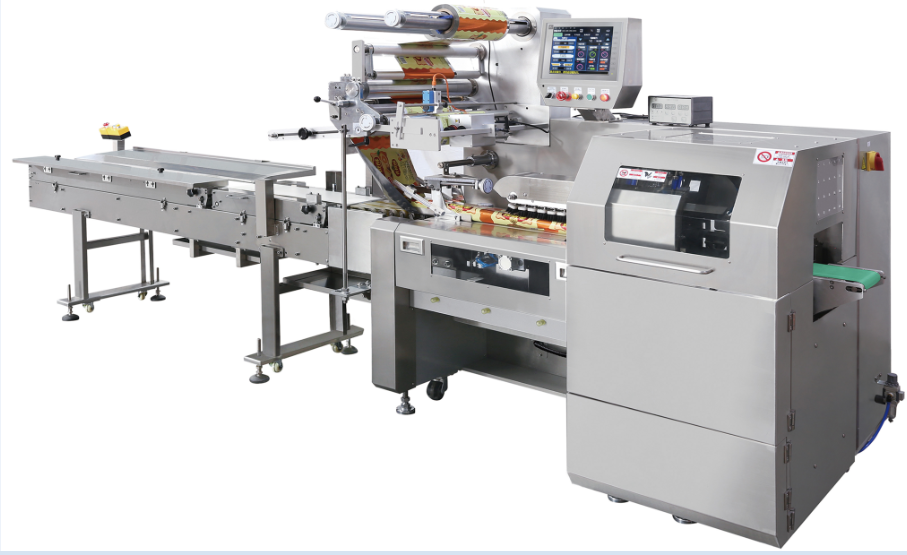
The packaging method has a direct effect on both investment and running costs. A horizontal flow-wrapper creates pillow packs at a stated speed of 20 to 120 bags per minute and can operate with paper, plastic, or composite film. A pre-formed bagging system instead uses wicket bags made from PE film and closes them with a clip band or twist tie. Date coding can be added when required. Because these systems use different materials, closing components, changeover procedures, and consumables, they should be listed as separate alternatives in the quotation.
An integrated slicer and bagger is specified for output of up to 65 loaves per minute. Its automatic dual wicket exchange can support bag replacement without stopping the production line, which may improve availability and reduce interruptions. The system may also include PLC and HMI controls, recipe storage, removable crumb trays, and centralized operation. Optional metal detection, checkweighing, label application, and thermal printing should each be clearly marked as included, optional, or excluded.
Technical Validation and Site Requirements
Testing is an important part of the total-cost review because it helps confirm that the machine can handle the buyer's actual product and packaging materials. The available product information refers to 48-hour testing or customer testing with supplied samples. Before shipment, buyers should verify product feeding, slicing quality, bag opening, pack appearance, sealing or closing performance, operating speed, and changeover behavior.
The purchase review should also document electrical requirements, compressed-air consumption, floor space, line height, ventilation, and operator access. These factors can create additional site-preparation costs. The supplied CE certification covers flow packaging machines, automatic packaging systems, cartoning machines, and palletizing robots, but the buyer should confirm which specific equipment and configuration are covered by the supplied documentation.
Reference projects can help buyers judge whether a standalone machine or a complete automation system offers better value. A documented cake and pie packaging project includes high-volume bakery production, automated wrapping, robotic palletizing, monitoring, and batch traceability at facilities in Vietnam, Korea, and China. For a bread project, this type of example is useful when comparing the cost and labor impact of an individual wrapper with a connected packaging and end-of-line solution.
Cost Comparison Checklist
| Comparison category | Relevant equipment or scope | Questions for the supplier |
|---|---|---|
| Slicing | Continuous band-blade slicer; up to 2,500 loaves per hour for 0.6 kg loaves; 11 mm standard slices with 13 mm and 15 mm options | Does the machine suit the loaf size, weight, slice thickness, and planned production rate? |
| Flow wrapping | Horizontal pillow-pack system; 20 to 120 bags per minute; paper, plastic, or composite film | Which film material, width, sealing method, speed, and change parts are included? |
| Pre-formed bagging | Wicket bags, PE film, clip-band or twist-tie closure, and optional date coding | Are bag opening, closing, coding, and format-change components included in the price? |
| Controls and inspection | PLC and HMI control with optional metal detector, checkweigher, labeler, and thermal printer | Which control and quality functions are standard, optional, or supplied by another vendor? |
| Testing and acceptance | 48-hour machine testing or testing with customer product samples | What samples, test duration, acceptance criteria, and corrective actions will be documented? |
| Installation and delivery | Installation scope, packing, site commissioning, and transport by sea, air, or truck | Does the delivered cost specify the shipping method, destination, insurance, installation, and site responsibilities? |
| Payment | 100% TT or LC; commonly 30% deposit and 70% on or before shipment | How do deposit requirements, testing, shipment, and final payment affect project cash flow? |
Frequently Asked Questions
Is it better to buy the toast bread slicer and packaging machine separately?
Both approaches should be evaluated. Separate machines may work well when a bakery already has conveyors, controls, or a defined production layout. An integrated slicer-bagger or complete packaging line can reduce manual transfer, simplify operation, and coordinate product handling. The comparison must include interface work, conveyors, change parts, controls, installation, and responsibility for line integration.
Which operating expenses are commonly overlooked?
Besides film and bags, include electricity, compressed air, closure materials, date-coding supplies, labor, cleaning, routine service, spare parts, tooling, and production losses during changeovers. Also review whether the selected film or bag format requires special storage or produces more material waste.
How can a buyer avoid selecting an unsuitable food packing machine?
Send representative loaves and packaging materials for a documented factory test. Confirm loaf dimensions, weight range, slice thickness, bag material, closing style, target speed, electrical supply, compressed-air availability, inspection functions, and acceptance standards. These details should appear in the technical specification and commercial quotation.
Conclusion: Compare Total Ownership Cost
The most reliable purchasing decision connects the required toast bread process with the correct slicing, packaging, closing, control, inspection, testing, logistics, and payment scope. Ask for an itemized quotation that separates standard equipment from optional modules and states installation, sample testing, delivery, training, warranty, and technical support responsibilities. This makes it easier to compare suppliers on production capability and long-term operating cost rather than on equipment price alone.
Foshan Ruipuhua Machinery Equipment Co. Ltd supports manufacturing and OEM business models, with supplied CE certification covering relevant packaging equipment categories. For detailed technical solutions or support, please contact lotuspack@ruipuhua.com.
About Foshan Ruipuhua Machinery Equipment Co. Ltd
Foshan Ruipuhua Machinery Equipment Co. Ltd manufactures intelligent packaging machinery and integrated packaging and palletizing systems for food, bakery, biscuit, snack, noodle, pharmaceutical, daily chemical, soap, and hardware applications. Founded in 2005, the company has 300 employees, a factory area of 50,000, and annual production capacity of more than 500 automatic packaging machines and complete lines. Its product portfolio includes bakery automatic packaging lines, ultrasonic bread slicing and packaging lines, flow wrapping systems, cartoning machines, case packers, and palletizing robots. The company holds CE certification for applicable packaging equipment and serves customers in several industries.

REPORT