







-
 Agriculture
-
 Health-Care
-
 Environment
-
 Construction-Real-Estate
-
 Tools-Hardware
-
 Home-Garden
-
 Furniture
-
 Luggage-Bags-Cases
-
 Medical-devices-Supplies
-
 Gifts-Crafts
-
 Sports-Entertainment
-
 Food-Beverage
-
 Vehicles-Transportation
-
 Power-Transmission
-
 Material-Handling
-
 Renewable-Energy
-
 Safety
-
 Testing-Instrument-Equipment
-
 Construction-Building-Machinery
-
 Pet-Supplies
-
 Personal-Care-Household-Cleaning
-
 Vehicle-Accessories-Electronics-Tools
-
 School-Office-Supplies
-
 Packaging-Printing
-
 Mother-Kids-Toys
-
 Business-Services
-
 Commercial-Equipment-Machinery
-
 Apparel-Accessories
-
 Security
-
 Shoes-Accessories
-
 Vehicle-Parts-Accessories
-
 Jewelry-Eyewear-Watches-Accessories
-
 Lights-Lighting
-
 Fabric-Textile-Raw-Material
-
 Fabrication-Services
-
 Industrial-Machinery
-
 Consumer-Electronics
-
 Electrical-Equipment-Supplies
-
 Electronic-Components-Accessories-Telecommunications
-
 Home-Appliances
-
 Beauty
-
 Chemicals
-
 Rubber-Plastics
-
 Metals-Alloys


























































































































































































































































































































































































































































































































































































- Masonry Materials
- Curtain Walls & Accessories
- Earthwork Products
- Fireproofing Materials
- Heat Insulation Materials
- Plastic Building Materials
- Building Boards
- Soundproofing Materials
- Timber
- Waterproofing Materials
- Balustrades & Handrails
- Bathroom & Kitchen
- Flooring & Accessories
- Tiles & Accessories
- Door, Window & Accessories
- Fireplaces & Stoves
- Floor Heating Systems & Parts
- Stairs & Stair Parts
- Ceilings
- Elevators & Escalators
- Stone
- Countertops, Vanity Tops & Table Tops
- Mosaics
- Metal Building Materials
- Multifunctional Materials
- Ladders & Scaffoldings
- Mouldings
- Corner Guards
- Decorative Films
- Formwork
- Building & Industrial Glass
- Other Construction & Real Estate
- Wallpapers/Wall panels
- HVAC System & Parts
- Outdoor Facilities
- Prefabricated Buildings
- Festive & Party Supplies
- Bathroom Products
- Household Sundries
- Rain Gear
- Garden Supplies
- Household Cleaning Tools & Accessories
- Lighters & Smoking Accessories
- Home Storage & Organization
- Household Scales
- Smart Home Improvement
- Home Textiles
- Kitchenware
- Drinkware & Accessories
- Dinnerware, Coffee & Wine
- Home Decor
- Golf
- Fitness & Body Building
- Amusement Park Facilities
- Billiards, Board Game,Coin Operated Games
- Musical Instruments
- Outdoor Affordable Luxury Sports
- Camping & Hiking
- Fishing
- Sports Safety&Rehabilitation
- Ball Sports Equipments
- Water Sports
- Winter Sports
- Luxury Travel Equipments
- Sports Shoes, Bags & Accessories
- Cycling
- Other Sports & Entertainment Products
- Artificial Grass&Sports Flooring&Sports Court Equipment
- Scooters
- Food Ingredients
- Honey & Honey Products
- Snacks
- Nuts & Kernels
- Seafood
- Plant & Animal Oil
- Beverages
- Fruit & Vegetable Products
- Frog & Escargot
- Bean Products
- Egg Products
- Dairy Products
- Seasonings & Condiments
- Canned Food
- Instant Food
- Baked Goods
- Other Food & Beverage
- Meat & Poultry
- Confectionery
- Grain Products
- Feminie Care
- Hair Care & Styling
- Body Care
- Hands & Feet Care
- Hygiene Products
- Men's Grooming
- Laundry Cleaning Supplies
- Travel Size & Gift Sets
- Room Deodorizers
- Other Personal Care Products
- Pest Control Products
- Special Household Cleaning
- Floor Cleaning
- Kitchen & Bathroom Cleaning
- Oral Care
- Bath Supplies
- Yellow Pages
- Correction Supplies
- Office Binding Supplies
- Office Cutting Supplies
- Board Erasers
- Office Adhesives & Tapes
- Education Supplies
- Pencil Cases & Bags
- Notebooks & Writing Pads
- File Folder Accessories
- Calendars
- Writing Accessories
- Commercial Office Supplies
- Pencil Sharpeners
- Pens
- Letter Pad/Paper
- Paper Envelopes
- Desk Organizers
- Pencils
- Markers & Highlighters
- Filing Products
- Art Supplies
- Easels
- Badge Holder & Accessories
- Office Paper
- Printer Supplies
- Book Covers
- Other Office & School Supplies
- Stationery Set
- Boards
- Clipboards
- Stamps
- Drafting Supplies
- Stencils
- Electronic Dictionary
- Books
- Map
- Magazines
- Calculators
- Baby & Toddler Toys
- Educational Toys
- Classic Toys
- Dress Up & Pretend Play
- Toy Vehicle
- Stuffed Animals & Plush Toys
- Outdoor Toys & Structures
- Balloons & Accessories
- Baby Food
- Children's Clothing
- Baby Supplies & Products
- Maternity Clothes
- Kids Shoes
- Baby Care
- Novelty & Gag Toys
- Dolls & Accessories
- Puzzle & Games
- Blocks & Model Building Toys
- Toddler Clothing
- Baby Clothing
- Kids' Luggage & Bags
- Arts, Crafts & DIY Toys
- Action & Toy Figures
- Baby Appliances
- Hobbies & Models
- Remote Control Toys
- Promotional Toys
- Pregnancy & Maternity
- Hygiene Products
- Kid's Textile&Bedding
- Novelty & Special Use
- Toy Weapons
- Baby Gifts
- Baby Storage & Organization
- Auto Drive Systems
- ATV/UTV Parts & Accessories
- Marine Parts & Accessories
- Other Auto Parts
- Trailer Parts & Accessories
- Auto Transmission Systems
- Train Parts & Accessories
- Universal Parts
- Railway Parts & Accessories
- Auto Brake Systems
- Aviation Parts & Accessories
- Truck Parts & Accessories
- Auto Suspension Systems
- Auto Lighting Systems
- New Energy Vehicle Parts & Accessories
- Auto Steering Systems
- Wheels, Tires & Accessories
- Bus Parts & Accessories
- Auto Performance Parts
- Cooling System
- Go-Kart & Kart Racer Parts & Accessories
- Air Conditioning Systems
- Heavy Duty Vehicle Parts & Accessories
- Auto Electrical Systems
- Auto Body Systems
- Auto Engine Systems
- Container Parts & Accessories
- Motorcycle Parts & Accessories
- Refrigeration & Heat Exchange Equipment
- Machine Tool Equipment
- Food & Beverage Machinery
- Agricultural Machinery & Equipment
- Apparel & Textile Machinery
- Chemical Machinery
- Packaging Machines
- Paper Production Machinery
- Plastic & Rubber Processing Machinery
- Industrial Robots
- Electronic Products Machinery
- Metal & Metallurgy Machinery
- Woodworking Machinery
- Home Product Manufacturing Machinery
- Machinery Accessories
- Environmental Machinery
- Machinery Service
- Electrical Equipment Manufacturing Machinery
- Industrial Compressors & Parts
- Tobacco & Cigarette Machinery
- Production Line
- Used Industrial Machinery
- Electronics Production Machinery
- Other Machinery & Industrial Equipment
- Camera, Photo & Accessories
- Portable Audio, Video & Accessories
- Television, Home Audio, Video & Accessories
- Video Games & Accessories
- Mobile Phone & Accessories
- Electronic Publications
- Earphone & Headphone & Accessories
- Speakers & Accessories
- Smart Electronics
- TV Receivers & Accessories
- Mobile Phone & Computer Repair Parts
- Chargers, Batteries & Power Supplies
- Used Electronics
- VR, AR, MR Hardware & Software
- Projectors & Presentation Equipments
- Other Consumer Electronics
- Cables & Commonly Used Accessories
- Computer Hardware & Software
- Displays, Signage and Optoelectronics
- Discrete Semiconductors
- Wireless & IoT Module and Products
- Telecommunications
- Connectors, Terminals & Accessories
- Development Boards, Electronic Modules and Kits
- Circuit Protection
- Sensors
- Isolators
- Audio Components and Products
- Integrated Circuits
- Power Supplies
- Relays
- RF, Microwave and RFID
- Electronic Accessories & Supplies
- Passive Components
- PCB & PCBA
- Air Quality Appliances
- Home Appliance Parts
- Heating & Cooling Appliances
- Small Kitchen Appliances
- Laundry Appliances
- Water Heaters
- Water Treatment Appliances
- Refrigerators & Freezers
- Personal Care & Beauty Appliances
- Major Kitchen Appliances
- Cleaning Appliances
- Second-hand Appliances
- Smart Home Appliances
- Other Home Appliances
- Energy Chemicals
- Inorganic Chemicals
- Basic Organic Chemicals
- Agrochemicals
- Admixture & Additives
- Catalysts & Chemical Auxiliary Agents
- Pigments & Dyestuff
- Coating & Paint
- Daily Chemicals
- Polymer
- Organic Intermediate
- Adhesives & Sealants
- Chemical Waste
- Biological Chemical Products
- Surface Treatment Chemicals
- Painting & Coating
- Chemical Reagents
- Flavor & Fragrance
- Non-Explosive Demolition Agents
- Other Chemicals
- Custom Chemical Services

How to Confirm Handwheel Coatings Comply with Restricted Substance Requirements
To confirm that a handwheel coating satisfies restricted substance requirements, first identify the exact material and finishing process, then obtain supporting compliance and quality documents from the supplier. The review should cover the handwheel specification, RoHS and REACH records, material certificates, production controls, and final inspection results before stainless steel, carbon steel, aluminum, or engineering-plastic parts are released for production.
Practical Verification Steps
- Document the handwheel material, grade, dimensions, application, and surface treatment, including polishing, passivation, plating, anodizing, powder coating, or plastic finishing.
- Request a material certificate together with product-specific RoHS and REACH compliance documentation.
- Compare the approved coating specification with manufacturing and inspection records to confirm that the required finish was maintained.
- For food-processing and marine equipment, assess hygiene, cleanability, corrosion resistance, and material suitability in addition to restricted substance requirements.
How to Build a Reliable Compliance Review
1. Identify the Material and Finish
A meaningful restricted substance review starts with accurate product identification. Record the handwheel material, material grade, surface treatment, dimensions, and intended operating environment. Product options may include stainless steel, carbon steel, aluminum alloy, engineering plastics, and rubber or TPR grip materials.
The finish must also be clearly defined. Common options include polished, brushed, passivated, electropolished, black oxide, zinc-plated, nickel-plated, chrome-plated, powder-coated, anodized, and sandblasted surfaces. Because different treatments can involve different chemical inputs, compliance evidence should correspond to the actual finish supplied rather than to a general product family.
2. Match Documentation to the Ordered Part
Ask the manufacturer for the material certificate connected to the purchase order and verify that it identifies the selected material. The available product information states that material certificates can be supplied and that the products are RoHS compliant and REACH compliant. These claims should be checked against the quotation, technical drawing, purchase specification, coating requirement, and batch documentation.
Where the coating is customized, the order documents should specify the treatment, color if applicable, restricted substance requirements, and the records required for approval. This creates a direct connection between the compliance statement and the exact handwheel delivered.
3. Review Quality and Inspection Controls
Quality-system records provide additional confidence that the approved specification is being followed consistently. Zhejiang Dream Industry Limited identifies ISO 9001 certification, full dimensional inspection, and First Article Inspection (FAI) among its quality controls. The company knowledge base lists ISO certificate number ZT-Q-24120011S for stainless steel handwheels, bushings, bolts, and machined non-standard parts.
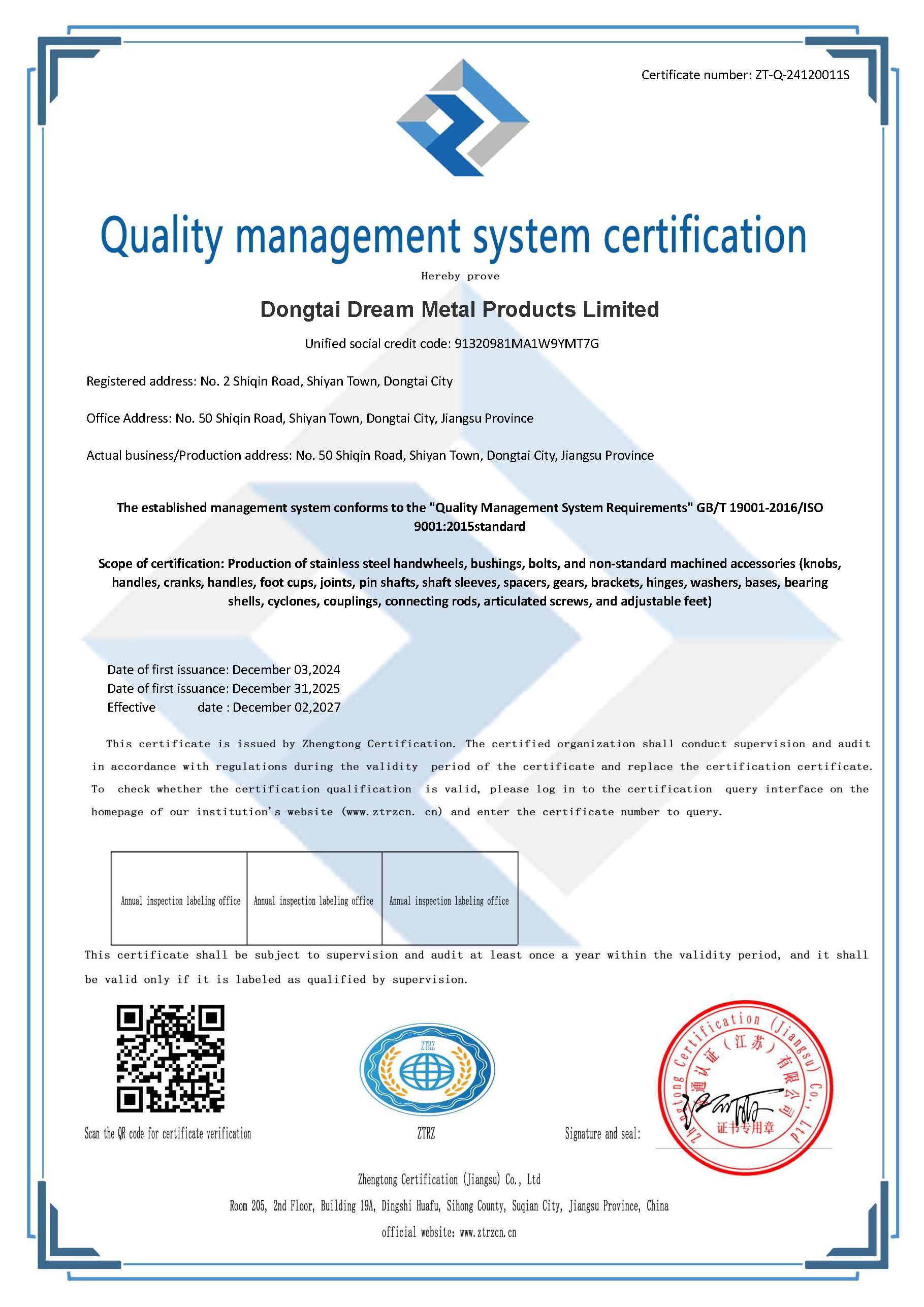
ISO 9001 supports confidence in the supplier's management system, but it does not independently prove that a coating is free from every restricted substance. The compliance review should therefore connect the quality certificate, material records, coating information, and inspection results to the part number and production batch.
4. Consider the Service Environment
The right surface treatment depends on how the handwheel will be used. Food-processing machinery may require a smooth, hygienic, and easy-to-clean surface. Marine and offshore equipment may place greater emphasis on corrosion resistance and long-term environmental durability. These application requirements should be evaluated together with the material selection and restricted substance documentation.
Past application experience can offer useful context. A German food machinery manufacturer used stainless steel handwheels for food production line controls and hygienic equipment adjustment mechanisms. A Norwegian marine equipment supplier used marine-grade handwheels for offshore machinery and marine valve systems. Such examples demonstrate manufacturing experience, but approval must still rely on the documents for the specific order.
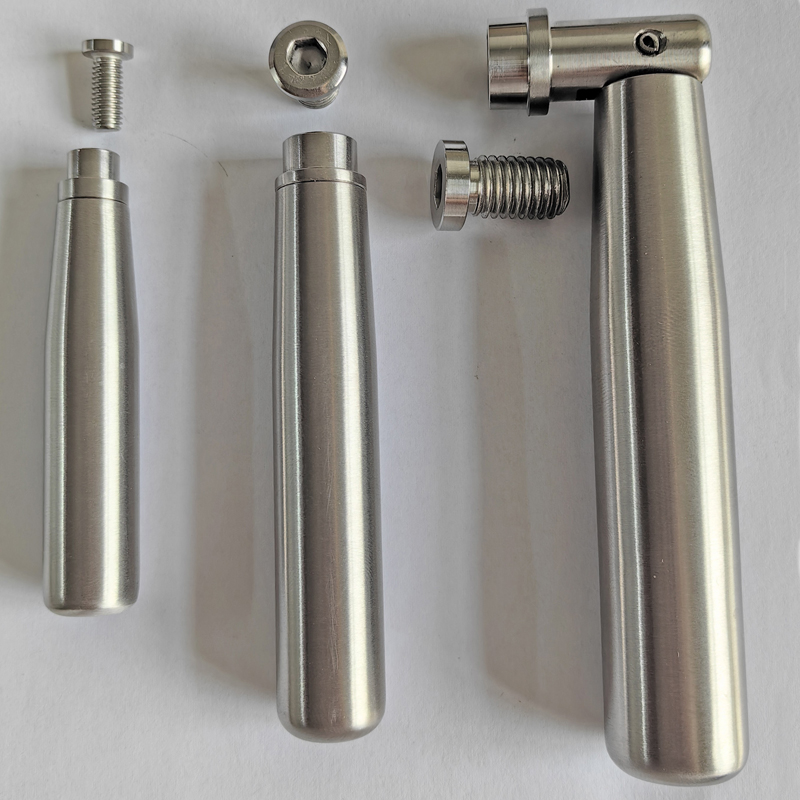
The folding-handle product information also indicates support for OEM and ODM projects, custom materials, surface treatments, colors, logos, and packaging. For a customized handwheel or handle, the approved specification should define the substrate, finish, compliance standard, inspection method, and required certificates before production begins.
Compliance Evidence Comparison
| Review Area | Evidence or Recommended Action | Verification Objective |
|---|---|---|
| Restricted substances | RoHS and REACH compliance documentation | Confirm that the declarations apply to the selected component and coating |
| Material traceability | Material certificate linked to the order or batch | Verify that the supplied material matches the approved handwheel specification |
| Supplier quality | ISO 9001 certification, dimensional inspection, and FAI records | Assess whether production and inspection controls support specification consistency |
| Surface treatment | Records for passivation, electropolishing, plating, powder coating, anodizing, or other finishes | Ensure that the delivered treatment matches the drawing and purchase requirements |
Frequently Asked Questions
What records are needed to approve a coated handwheel?
Request the applicable material certificate and RoHS and REACH compliance records. The documents should identify, or clearly cover, the ordered component, base material, and surface treatment.
Can ISO 9001 certification demonstrate that a coating meets restricted substance rules?
No. ISO 9001 concerns the supplier's quality management system. Restricted substance approval requires relevant RoHS and REACH evidence, supported where necessary by material and coating documentation.
What application information should be included in the assessment?
Include the handwheel material, coating or finishing process, operating environment, and equipment type. Food machinery and marine equipment may require different hygiene, durability, and corrosion-resistance considerations.
Approval Recommendations
A handwheel coating can be approved when the material and finish correspond with the technical specification, the material certificate is available, RoHS and REACH requirements are documented, and the supplier's quality and inspection records support traceability. Zhejiang Dream Industry Limited provides OEM and ODM manufacturing, custom CNC machining, factory-direct supply, and flexible support for both small-batch and bulk production. For technical assistance or project support, contact 86-15868979792.
About Us
ZheJiang Dream Industry Limited has more than 20 years of precision manufacturing experience in custom CNC-machined parts and assemblies made from stainless steel, aluminum, brass, copper, carbon steel, and engineering plastics. Established in 2008, the company operates a 2500sqm factory. Its engineering and R&D capabilities cover product design, structural optimization, precision machining, mold development, surface finishing, and customized manufacturing. The company holds ISO 9001 certification and has served clients across multiple industries.
REPORT