







-
 Agriculture
-
 Health-Care
-
 Environment
-
 Construction-Real-Estate
-
 Tools-Hardware
-
 Home-Garden
-
 Furniture
-
 Luggage-Bags-Cases
-
 Medical-devices-Supplies
-
 Gifts-Crafts
-
 Sports-Entertainment
-
 Food-Beverage
-
 Vehicles-Transportation
-
 Power-Transmission
-
 Material-Handling
-
 Renewable-Energy
-
 Safety
-
 Testing-Instrument-Equipment
-
 Construction-Building-Machinery
-
 Pet-Supplies
-
 Personal-Care-Household-Cleaning
-
 Vehicle-Accessories-Electronics-Tools
-
 School-Office-Supplies
-
 Packaging-Printing
-
 Mother-Kids-Toys
-
 Business-Services
-
 Commercial-Equipment-Machinery
-
 Apparel-Accessories
-
 Security
-
 Shoes-Accessories
-
 Vehicle-Parts-Accessories
-
 Jewelry-Eyewear-Watches-Accessories
-
 Lights-Lighting
-
 Fabric-Textile-Raw-Material
-
 Fabrication-Services
-
 Industrial-Machinery
-
 Consumer-Electronics
-
 Electrical-Equipment-Supplies
-
 Electronic-Components-Accessories-Telecommunications
-
 Home-Appliances
-
 Beauty
-
 Chemicals
-
 Rubber-Plastics
-
 Metals-Alloys


























































































































































































































































































































































































































































































































































































- Masonry Materials
- Curtain Walls & Accessories
- Earthwork Products
- Fireproofing Materials
- Heat Insulation Materials
- Plastic Building Materials
- Building Boards
- Soundproofing Materials
- Timber
- Waterproofing Materials
- Balustrades & Handrails
- Bathroom & Kitchen
- Flooring & Accessories
- Tiles & Accessories
- Door, Window & Accessories
- Fireplaces & Stoves
- Floor Heating Systems & Parts
- Stairs & Stair Parts
- Ceilings
- Elevators & Escalators
- Stone
- Countertops, Vanity Tops & Table Tops
- Mosaics
- Metal Building Materials
- Multifunctional Materials
- Ladders & Scaffoldings
- Mouldings
- Corner Guards
- Decorative Films
- Formwork
- Building & Industrial Glass
- Other Construction & Real Estate
- Wallpapers/Wall panels
- HVAC System & Parts
- Outdoor Facilities
- Prefabricated Buildings
- Festive & Party Supplies
- Bathroom Products
- Household Sundries
- Rain Gear
- Garden Supplies
- Household Cleaning Tools & Accessories
- Lighters & Smoking Accessories
- Home Storage & Organization
- Household Scales
- Smart Home Improvement
- Home Textiles
- Kitchenware
- Drinkware & Accessories
- Dinnerware, Coffee & Wine
- Home Decor
- Golf
- Fitness & Body Building
- Amusement Park Facilities
- Billiards, Board Game,Coin Operated Games
- Musical Instruments
- Outdoor Affordable Luxury Sports
- Camping & Hiking
- Fishing
- Sports Safety&Rehabilitation
- Ball Sports Equipments
- Water Sports
- Winter Sports
- Luxury Travel Equipments
- Sports Shoes, Bags & Accessories
- Cycling
- Other Sports & Entertainment Products
- Artificial Grass&Sports Flooring&Sports Court Equipment
- Scooters
- Food Ingredients
- Honey & Honey Products
- Snacks
- Nuts & Kernels
- Seafood
- Plant & Animal Oil
- Beverages
- Fruit & Vegetable Products
- Frog & Escargot
- Bean Products
- Egg Products
- Dairy Products
- Seasonings & Condiments
- Canned Food
- Instant Food
- Baked Goods
- Other Food & Beverage
- Meat & Poultry
- Confectionery
- Grain Products
- Feminie Care
- Hair Care & Styling
- Body Care
- Hands & Feet Care
- Hygiene Products
- Men's Grooming
- Laundry Cleaning Supplies
- Travel Size & Gift Sets
- Room Deodorizers
- Other Personal Care Products
- Pest Control Products
- Special Household Cleaning
- Floor Cleaning
- Kitchen & Bathroom Cleaning
- Oral Care
- Bath Supplies
- Yellow Pages
- Correction Supplies
- Office Binding Supplies
- Office Cutting Supplies
- Board Erasers
- Office Adhesives & Tapes
- Education Supplies
- Pencil Cases & Bags
- Notebooks & Writing Pads
- File Folder Accessories
- Calendars
- Writing Accessories
- Commercial Office Supplies
- Pencil Sharpeners
- Pens
- Letter Pad/Paper
- Paper Envelopes
- Desk Organizers
- Pencils
- Markers & Highlighters
- Filing Products
- Art Supplies
- Easels
- Badge Holder & Accessories
- Office Paper
- Printer Supplies
- Book Covers
- Other Office & School Supplies
- Stationery Set
- Boards
- Clipboards
- Stamps
- Drafting Supplies
- Stencils
- Electronic Dictionary
- Books
- Map
- Magazines
- Calculators
- Baby & Toddler Toys
- Educational Toys
- Classic Toys
- Dress Up & Pretend Play
- Toy Vehicle
- Stuffed Animals & Plush Toys
- Outdoor Toys & Structures
- Balloons & Accessories
- Baby Food
- Children's Clothing
- Baby Supplies & Products
- Maternity Clothes
- Kids Shoes
- Baby Care
- Novelty & Gag Toys
- Dolls & Accessories
- Puzzle & Games
- Blocks & Model Building Toys
- Toddler Clothing
- Baby Clothing
- Kids' Luggage & Bags
- Arts, Crafts & DIY Toys
- Action & Toy Figures
- Baby Appliances
- Hobbies & Models
- Remote Control Toys
- Promotional Toys
- Pregnancy & Maternity
- Hygiene Products
- Kid's Textile&Bedding
- Novelty & Special Use
- Toy Weapons
- Baby Gifts
- Baby Storage & Organization
- Auto Drive Systems
- ATV/UTV Parts & Accessories
- Marine Parts & Accessories
- Other Auto Parts
- Trailer Parts & Accessories
- Auto Transmission Systems
- Train Parts & Accessories
- Universal Parts
- Railway Parts & Accessories
- Auto Brake Systems
- Aviation Parts & Accessories
- Truck Parts & Accessories
- Auto Suspension Systems
- Auto Lighting Systems
- New Energy Vehicle Parts & Accessories
- Auto Steering Systems
- Wheels, Tires & Accessories
- Bus Parts & Accessories
- Auto Performance Parts
- Cooling System
- Go-Kart & Kart Racer Parts & Accessories
- Air Conditioning Systems
- Heavy Duty Vehicle Parts & Accessories
- Auto Electrical Systems
- Auto Body Systems
- Auto Engine Systems
- Container Parts & Accessories
- Motorcycle Parts & Accessories
- Refrigeration & Heat Exchange Equipment
- Machine Tool Equipment
- Food & Beverage Machinery
- Agricultural Machinery & Equipment
- Apparel & Textile Machinery
- Chemical Machinery
- Packaging Machines
- Paper Production Machinery
- Plastic & Rubber Processing Machinery
- Industrial Robots
- Electronic Products Machinery
- Metal & Metallurgy Machinery
- Woodworking Machinery
- Home Product Manufacturing Machinery
- Machinery Accessories
- Environmental Machinery
- Machinery Service
- Electrical Equipment Manufacturing Machinery
- Industrial Compressors & Parts
- Tobacco & Cigarette Machinery
- Production Line
- Used Industrial Machinery
- Electronics Production Machinery
- Other Machinery & Industrial Equipment
- Camera, Photo & Accessories
- Portable Audio, Video & Accessories
- Television, Home Audio, Video & Accessories
- Video Games & Accessories
- Mobile Phone & Accessories
- Electronic Publications
- Earphone & Headphone & Accessories
- Speakers & Accessories
- Smart Electronics
- TV Receivers & Accessories
- Mobile Phone & Computer Repair Parts
- Chargers, Batteries & Power Supplies
- Used Electronics
- VR, AR, MR Hardware & Software
- Projectors & Presentation Equipments
- Other Consumer Electronics
- Cables & Commonly Used Accessories
- Computer Hardware & Software
- Displays, Signage and Optoelectronics
- Discrete Semiconductors
- Wireless & IoT Module and Products
- Telecommunications
- Connectors, Terminals & Accessories
- Development Boards, Electronic Modules and Kits
- Circuit Protection
- Sensors
- Isolators
- Audio Components and Products
- Integrated Circuits
- Power Supplies
- Relays
- RF, Microwave and RFID
- Electronic Accessories & Supplies
- Passive Components
- PCB & PCBA
- Air Quality Appliances
- Home Appliance Parts
- Heating & Cooling Appliances
- Small Kitchen Appliances
- Laundry Appliances
- Water Heaters
- Water Treatment Appliances
- Refrigerators & Freezers
- Personal Care & Beauty Appliances
- Major Kitchen Appliances
- Cleaning Appliances
- Second-hand Appliances
- Smart Home Appliances
- Other Home Appliances
- Energy Chemicals
- Inorganic Chemicals
- Basic Organic Chemicals
- Agrochemicals
- Admixture & Additives
- Catalysts & Chemical Auxiliary Agents
- Pigments & Dyestuff
- Coating & Paint
- Daily Chemicals
- Polymer
- Organic Intermediate
- Adhesives & Sealants
- Chemical Waste
- Biological Chemical Products
- Surface Treatment Chemicals
- Painting & Coating
- Chemical Reagents
- Flavor & Fragrance
- Non-Explosive Demolition Agents
- Other Chemicals
- Custom Chemical Services

How to Customize an Insulated Food Delivery Bag for a New Brand
Launching a branded insulated food delivery bag involves several configurable elements, including the exterior material, EPE foam construction, closure style, print colours, dimensions, and order quantity. Available outer finishes include aluminium foil, kraft paper, and white waterproof film. The bag can use a standard-density EPE foam core, with samples generally completed in 3 to 5 working days and production scheduled within 15 to 25 days after artwork approval.
Customization Overview
- Select aluminium foil, kraft paper, or white waterproof film to match the visual identity and operating environment of the brand.
- Use a two-panel, standard-density EPE foam structure. The relaxed foam thickness is approximately 40 mm in total, reducing to about 10 mm in total after compression for shipment.
- Choose a two-rib zip, peel-and-seal strip, or heat-seal closure according to the delivery process.
- Specify one- or two-colour exterior printing for restaurant takeaway, hot food delivery, meal kits, or other temperature-sensitive parcel applications.
Construction and Material Options
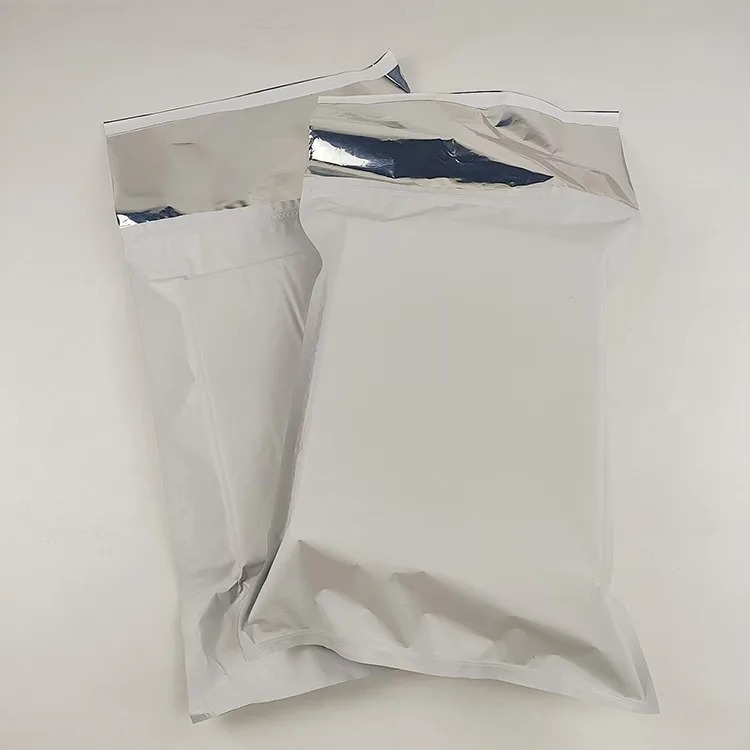
This insulated mailer is built with vacuum-compressed EPE foam and two internal panels positioned on either side of the product load. Its compression ratio is approximately 4:1, although the final recovery depends on the foam and handling conditions. This structure reduces storage and transport volume before use while retaining the insulation layer required for short urban delivery cycles.
The exterior can be produced with aluminium foil, kraft paper, or white waterproof film. Aluminium foil gives the package a reflective, higher-barrier appearance, while kraft paper creates a paper-based presentation and white waterproof film provides a clean printable surface with moisture resistance. The outer face supports one- or two-colour printing, allowing a new brand to display its logo, product information, or delivery message.
Closure and Format Selection
The closure should be chosen according to how the bag is handled after packing. A two-rib zip is suitable when the package needs to be opened and closed more than once. A peel-and-seal strip provides a quick self-sealing format for dispatch, while heat sealing creates a fixed closure for applications where the parcel is intended to remain closed during transport.
These options allow the same general bag format to support different food delivery workflows. Reusable restaurant delivery operations may favour a zip closure, while high-volume takeaway fulfilment may benefit from peel-and-seal or heat-seal production.
Dimensions, Artwork, and Sampling
Standard custom dimensions range from 20 x 30 cm to 35 x 45 cm, with cutting available according to order requirements. The finished dimensions should be calculated from the food container footprint, the number of items packed together, and the clearance needed for loading and closure. A flat base can help keep containers level while the bag is carried on a bicycle rack or placed on a vehicle seat.
Before printing plates are produced, the manufacturer provides a 3D structural drawing for review. This step gives the buyer an opportunity to confirm the shape, dimensions, panel arrangement, and closure position. Samples typically require 3 to 5 working days. Once the artwork is approved, regular production generally takes 15 to 25 days.
Application and Manufacturing Support
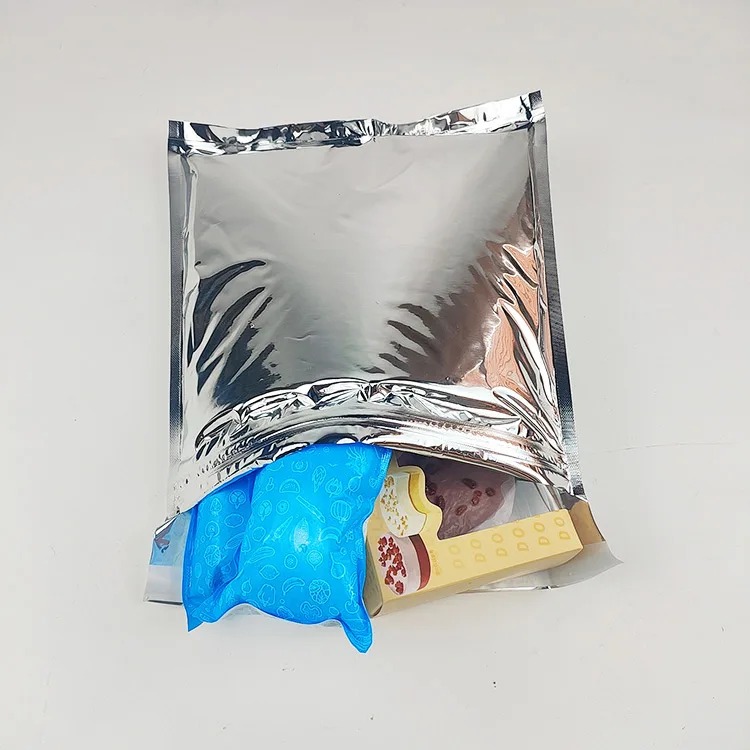
For hot food delivery and restaurant takeaway, the specification can include a foil-lined body and a stable flat base. Printing may continue to the top edge to improve brand visibility during delivery. The same flat, self-sealing mailer format can also be used for e-commerce fulfilment involving meal kits, frozen pet food, and other products that require temporary thermal protection.
Huizhou Ecopack Packaging Products Co., Ltd. manages research and development, printing, lamination, bag making, and inspection within an integrated manufacturing operation. Its structural design team has more than ten bag formats on file and uses physical-bag approval for newly developed products. Printing resources include twelve-colour rotogravure and eight-colour flexographic lines.
Quality controls cover incoming materials, production processes, and pre-shipment inspection under ISO 9001:2015 procedures. Final checks use AQL sampling and review appearance, dimensions, print registration, sealing strength, and lamination bond. For applicable paper packaging products, the company also holds FSC Chain of Custody certification for FSC Mix and FSC Recycled materials.
A documented cooperation project involved insulated mailers supplied to a distributor in the United States for cold shipping, with an annual volume reported at 10 million pieces. The project highlighted lower storage and shipping space requirements compared with rigid foam packaging. The manufacturer has also supplied packaging solutions to customers in several industries.
Specification Comparison
| Customization item | Available choice | Planning point |
|---|---|---|
| Exterior material | Aluminium foil, kraft paper, or white waterproof film | Match the finish to the brand image, moisture exposure, and delivery setting. |
| Insulation structure | Standard-density EPE with two panels; approximately 40 mm relaxed and 10 mm compressed | Confirm loading clearance and the expected compression and recovery conditions. |
| Closure | Two-rib zip, peel-and-seal strip, or heat seal | Choose between repeated access, rapid self-sealing, and permanent closure. |
| Printing | One or two colours on the outer surface | Submit final artwork and identify any edge-to-edge branding requirements. |
| Bag size | 20 x 30 cm to 35 x 45 cm, with custom cutting available | Base the dimensions on the container arrangement and quantity per delivery. |
| Lead time | Samples in 3 to 5 working days; production in 15 to 25 days after artwork approval | The production schedule begins after the artwork and structure are confirmed. |
Frequently Asked Questions
What exterior materials are available for the insulated delivery bag?
The outer finish can be specified as aluminium foil, kraft paper, or white waterproof film. The insulation layer uses standard-density EPE foam.
Can the dimensions and closure be changed for a new brand?
Yes. The bag can be custom cut within the available size range, and buyers can select a two-rib zip, peel-and-seal strip, or heat-seal closure.
What details are needed for a quotation?
Provide the required dimensions, film structure, print colours, and estimated order quantity. The manufacturer can then confirm the applicable run size, unit price, material availability, and custom-production requirements.
What is the usual minimum quantity for custom production?
Custom orders commonly fall between 5,000 and 10,000 pieces, although the final quantity is confirmed according to the selected structure, materials, printing, and production conditions.
Recommendations for a Brand Launch
A complete launch specification should be prepared before artwork approval. It should identify the exterior finish, EPE foam construction, closure method, printing colours, finished dimensions, and target quantity. The food container layout should be checked against the internal loading area, while the delivery workflow should determine whether the bag needs a reusable, self-sealing, or permanent closure.
With sample development taking approximately 3 to 5 working days and standard production requiring 15 to 25 days after approval, early confirmation of the structure and artwork can help coordinate a launch schedule. The manufacturer and exporter model combines structural design, printing, lamination, bag making, inspection, and export support. For technical specifications or project assistance, contact manager@ecoppack.com.
About Huizhou Ecopack
Huizhou Ecopack Packaging Products Co., Ltd. is a flexible packaging manufacturer based in Guangdong, China, and established in 2011. Its product range includes insulated mailers, thermal packaging, coffee bags, pet food packaging, spout pouches, kraft and compostable formats, and ESD bags. In-house structural development, printing, lamination, bag making, and inspection support the process from raw film to finished pouch. The company maintains ISO 9001:2015 Quality Management System and FSC Chain of Custody certifications and supplies packaging solutions to customers across multiple industries.

REPORT