







-
 Agriculture
-
 Health-Care
-
 Environment
-
 Construction-Real-Estate
-
 Tools-Hardware
-
 Home-Garden
-
 Furniture
-
 Luggage-Bags-Cases
-
 Medical-devices-Supplies
-
 Gifts-Crafts
-
 Sports-Entertainment
-
 Food-Beverage
-
 Vehicles-Transportation
-
 Power-Transmission
-
 Material-Handling
-
 Renewable-Energy
-
 Safety
-
 Testing-Instrument-Equipment
-
 Construction-Building-Machinery
-
 Pet-Supplies
-
 Personal-Care-Household-Cleaning
-
 Vehicle-Accessories-Electronics-Tools
-
 School-Office-Supplies
-
 Packaging-Printing
-
 Mother-Kids-Toys
-
 Business-Services
-
 Commercial-Equipment-Machinery
-
 Apparel-Accessories
-
 Security
-
 Shoes-Accessories
-
 Vehicle-Parts-Accessories
-
 Jewelry-Eyewear-Watches-Accessories
-
 Lights-Lighting
-
 Fabric-Textile-Raw-Material
-
 Fabrication-Services
-
 Industrial-Machinery
-
 Consumer-Electronics
-
 Electrical-Equipment-Supplies
-
 Electronic-Components-Accessories-Telecommunications
-
 Home-Appliances
-
 Beauty
-
 Chemicals
-
 Rubber-Plastics
-
 Metals-Alloys


























































































































































































































































































































































































































































































































































































- Masonry Materials
- Curtain Walls & Accessories
- Earthwork Products
- Fireproofing Materials
- Heat Insulation Materials
- Plastic Building Materials
- Building Boards
- Soundproofing Materials
- Timber
- Waterproofing Materials
- Balustrades & Handrails
- Bathroom & Kitchen
- Flooring & Accessories
- Tiles & Accessories
- Door, Window & Accessories
- Fireplaces & Stoves
- Floor Heating Systems & Parts
- Stairs & Stair Parts
- Ceilings
- Elevators & Escalators
- Stone
- Countertops, Vanity Tops & Table Tops
- Mosaics
- Metal Building Materials
- Multifunctional Materials
- Ladders & Scaffoldings
- Mouldings
- Corner Guards
- Decorative Films
- Formwork
- Building & Industrial Glass
- Other Construction & Real Estate
- Wallpapers/Wall panels
- HVAC System & Parts
- Outdoor Facilities
- Prefabricated Buildings
- Festive & Party Supplies
- Bathroom Products
- Household Sundries
- Rain Gear
- Garden Supplies
- Household Cleaning Tools & Accessories
- Lighters & Smoking Accessories
- Home Storage & Organization
- Household Scales
- Smart Home Improvement
- Home Textiles
- Kitchenware
- Drinkware & Accessories
- Dinnerware, Coffee & Wine
- Home Decor
- Golf
- Fitness & Body Building
- Amusement Park Facilities
- Billiards, Board Game,Coin Operated Games
- Musical Instruments
- Outdoor Affordable Luxury Sports
- Camping & Hiking
- Fishing
- Sports Safety&Rehabilitation
- Ball Sports Equipments
- Water Sports
- Winter Sports
- Luxury Travel Equipments
- Sports Shoes, Bags & Accessories
- Cycling
- Other Sports & Entertainment Products
- Artificial Grass&Sports Flooring&Sports Court Equipment
- Scooters
- Food Ingredients
- Honey & Honey Products
- Snacks
- Nuts & Kernels
- Seafood
- Plant & Animal Oil
- Beverages
- Fruit & Vegetable Products
- Frog & Escargot
- Bean Products
- Egg Products
- Dairy Products
- Seasonings & Condiments
- Canned Food
- Instant Food
- Baked Goods
- Other Food & Beverage
- Meat & Poultry
- Confectionery
- Grain Products
- Feminie Care
- Hair Care & Styling
- Body Care
- Hands & Feet Care
- Hygiene Products
- Men's Grooming
- Laundry Cleaning Supplies
- Travel Size & Gift Sets
- Room Deodorizers
- Other Personal Care Products
- Pest Control Products
- Special Household Cleaning
- Floor Cleaning
- Kitchen & Bathroom Cleaning
- Oral Care
- Bath Supplies
- Yellow Pages
- Correction Supplies
- Office Binding Supplies
- Office Cutting Supplies
- Board Erasers
- Office Adhesives & Tapes
- Education Supplies
- Pencil Cases & Bags
- Notebooks & Writing Pads
- File Folder Accessories
- Calendars
- Writing Accessories
- Commercial Office Supplies
- Pencil Sharpeners
- Pens
- Letter Pad/Paper
- Paper Envelopes
- Desk Organizers
- Pencils
- Markers & Highlighters
- Filing Products
- Art Supplies
- Easels
- Badge Holder & Accessories
- Office Paper
- Printer Supplies
- Book Covers
- Other Office & School Supplies
- Stationery Set
- Boards
- Clipboards
- Stamps
- Drafting Supplies
- Stencils
- Electronic Dictionary
- Books
- Map
- Magazines
- Calculators
- Baby & Toddler Toys
- Educational Toys
- Classic Toys
- Dress Up & Pretend Play
- Toy Vehicle
- Stuffed Animals & Plush Toys
- Outdoor Toys & Structures
- Balloons & Accessories
- Baby Food
- Children's Clothing
- Baby Supplies & Products
- Maternity Clothes
- Kids Shoes
- Baby Care
- Novelty & Gag Toys
- Dolls & Accessories
- Puzzle & Games
- Blocks & Model Building Toys
- Toddler Clothing
- Baby Clothing
- Kids' Luggage & Bags
- Arts, Crafts & DIY Toys
- Action & Toy Figures
- Baby Appliances
- Hobbies & Models
- Remote Control Toys
- Promotional Toys
- Pregnancy & Maternity
- Hygiene Products
- Kid's Textile&Bedding
- Novelty & Special Use
- Toy Weapons
- Baby Gifts
- Baby Storage & Organization
- Auto Drive Systems
- ATV/UTV Parts & Accessories
- Marine Parts & Accessories
- Other Auto Parts
- Trailer Parts & Accessories
- Auto Transmission Systems
- Train Parts & Accessories
- Universal Parts
- Railway Parts & Accessories
- Auto Brake Systems
- Aviation Parts & Accessories
- Truck Parts & Accessories
- Auto Suspension Systems
- Auto Lighting Systems
- New Energy Vehicle Parts & Accessories
- Auto Steering Systems
- Wheels, Tires & Accessories
- Bus Parts & Accessories
- Auto Performance Parts
- Cooling System
- Go-Kart & Kart Racer Parts & Accessories
- Air Conditioning Systems
- Heavy Duty Vehicle Parts & Accessories
- Auto Electrical Systems
- Auto Body Systems
- Auto Engine Systems
- Container Parts & Accessories
- Motorcycle Parts & Accessories
- Refrigeration & Heat Exchange Equipment
- Machine Tool Equipment
- Food & Beverage Machinery
- Agricultural Machinery & Equipment
- Apparel & Textile Machinery
- Chemical Machinery
- Packaging Machines
- Paper Production Machinery
- Plastic & Rubber Processing Machinery
- Industrial Robots
- Electronic Products Machinery
- Metal & Metallurgy Machinery
- Woodworking Machinery
- Home Product Manufacturing Machinery
- Machinery Accessories
- Environmental Machinery
- Machinery Service
- Electrical Equipment Manufacturing Machinery
- Industrial Compressors & Parts
- Tobacco & Cigarette Machinery
- Production Line
- Used Industrial Machinery
- Electronics Production Machinery
- Other Machinery & Industrial Equipment
- Camera, Photo & Accessories
- Portable Audio, Video & Accessories
- Television, Home Audio, Video & Accessories
- Video Games & Accessories
- Mobile Phone & Accessories
- Electronic Publications
- Earphone & Headphone & Accessories
- Speakers & Accessories
- Smart Electronics
- TV Receivers & Accessories
- Mobile Phone & Computer Repair Parts
- Chargers, Batteries & Power Supplies
- Used Electronics
- VR, AR, MR Hardware & Software
- Projectors & Presentation Equipments
- Other Consumer Electronics
- Cables & Commonly Used Accessories
- Computer Hardware & Software
- Displays, Signage and Optoelectronics
- Discrete Semiconductors
- Wireless & IoT Module and Products
- Telecommunications
- Connectors, Terminals & Accessories
- Development Boards, Electronic Modules and Kits
- Circuit Protection
- Sensors
- Isolators
- Audio Components and Products
- Integrated Circuits
- Power Supplies
- Relays
- RF, Microwave and RFID
- Electronic Accessories & Supplies
- Passive Components
- PCB & PCBA
- Air Quality Appliances
- Home Appliance Parts
- Heating & Cooling Appliances
- Small Kitchen Appliances
- Laundry Appliances
- Water Heaters
- Water Treatment Appliances
- Refrigerators & Freezers
- Personal Care & Beauty Appliances
- Major Kitchen Appliances
- Cleaning Appliances
- Second-hand Appliances
- Smart Home Appliances
- Other Home Appliances
- Energy Chemicals
- Inorganic Chemicals
- Basic Organic Chemicals
- Agrochemicals
- Admixture & Additives
- Catalysts & Chemical Auxiliary Agents
- Pigments & Dyestuff
- Coating & Paint
- Daily Chemicals
- Polymer
- Organic Intermediate
- Adhesives & Sealants
- Chemical Waste
- Biological Chemical Products
- Surface Treatment Chemicals
- Painting & Coating
- Chemical Reagents
- Flavor & Fragrance
- Non-Explosive Demolition Agents
- Other Chemicals
- Custom Chemical Services

How to Handle Customer Complaints About Shedding Human Hair Wigs
Customer complaints about shedding human hair wigs should be handled through fast diagnosis, clear communication, and dependable supplier support. Retailers need to determine whether the issue is limited to a few loose strands from factory trimming or connected to a serious weft, lace, or knotting defect. A practical response combines customer care instructions, evidence-based verification, and prompt replacement of confirmed faulty units.
Essential Steps for Resolving Shedding Complaints
- Use a Consistent Verification Process: Ask the customer for clear videos or photos showing the wig cap, lace perimeter, weft seams, and the amount of hair being released. This helps separate normal initial fallout from construction damage.
- Share Proper Care Instructions: Customers purchasing through Wig Store & Hair Extension Store and E-commerce & Online Hair Retail channels should receive guidance on gentle detangling, lace protection, and sulfate-free cleansing.
- Strengthen Supplier Quality Control: Select manufacturers that inspect raw hair, color, length, weight, texture, wefts, lace, and the completed wig before shipment.
- Create an Escalation and Replacement Policy: A defined process for reviewing evidence and replacing verified defective products protects customer satisfaction and brand credibility.
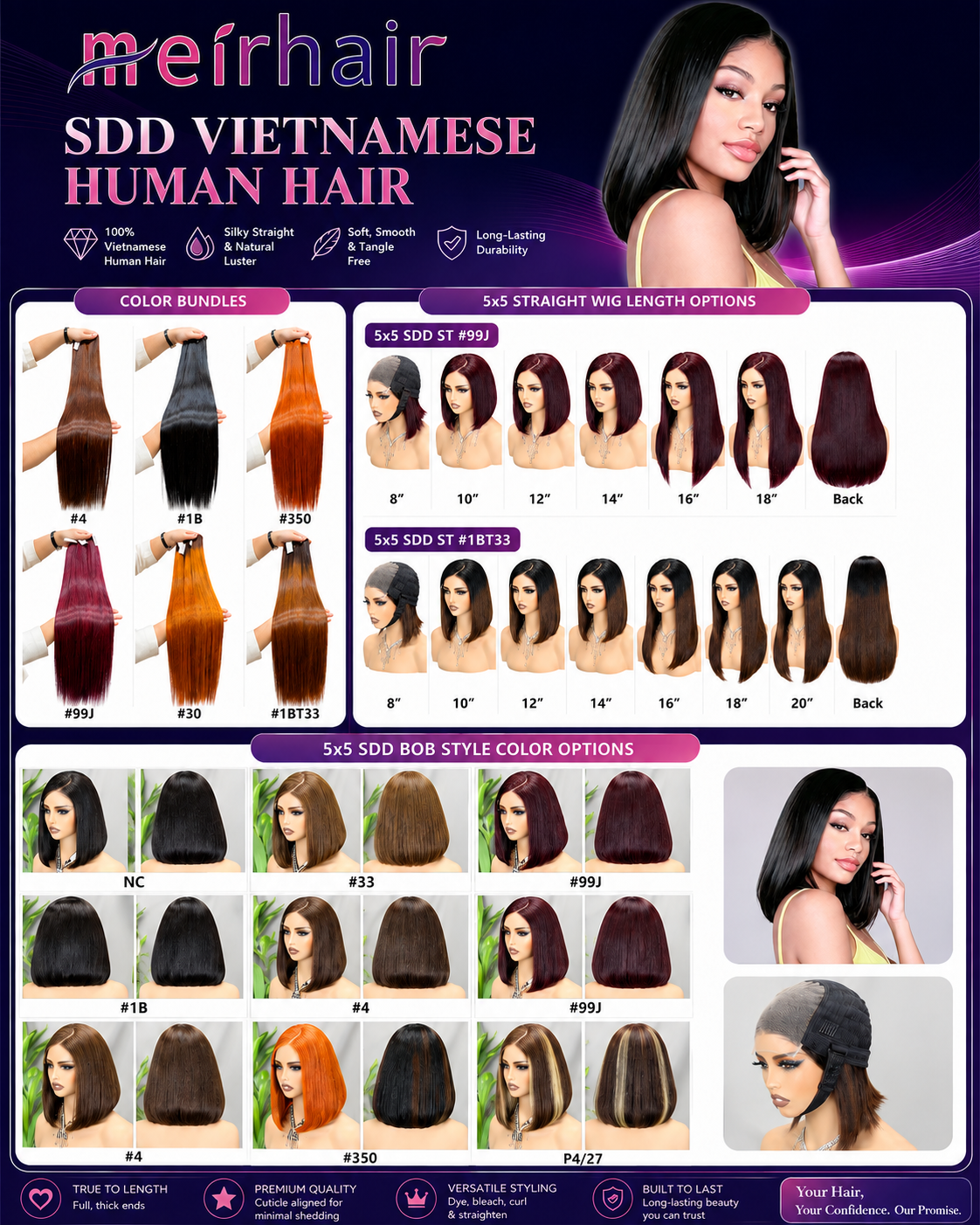
Understanding the Main Causes of Wig Shedding
Human hair wigs, including Human Hair Bob Wigs made with lace front, closure, or full-cap constructions, depend on several technical stages to secure each strand. When shedding is reported, the first step is to identify where the hair is coming from. Hair released from a machine weft usually indicates a stitching or track issue, while strands pulled from the lace may point to loose hand-tied knots or damage caused during processing.
Weft and Stitching Problems
Excessive shedding along a weft can result from cut track ends that were not sealed correctly, weak double-weft stitching, or damage during customization and installation. If several strands detach together from one seam, the product should be treated as a potential manufacturing defect rather than normal maintenance fallout.
Lace and Knot-Related Shedding
Lace units may shed when knots have been over-bleached, insufficiently secured, or exposed to repeated pulling and harsh friction. Vigorous brushing, incorrect adhesive removal, and dry handling can also loosen hair from the lace mesh. Customers should be advised to support the lace while detangling and to use suitable knot-sealing products when appropriate.
For wholesale orders, systematic inspection before dispatch can significantly reduce after-sales complaints. One project involving 300 human hair wigs showed the value of checking lace integrity, knot density, and weft security before shipment. Partnering with experienced manufacturers such as Guangzhou Ruiju E-Commerce Co., Ltd. further reduces structural risks through staged inspections covering Raw Hair Inspection, Color Inspection, Length & Weight Inspection, Texture Inspection, and Weft & Lace Inspection.
Diagnosis and Recommended Resolution
| Complaint Type | Likely Cause | How to Confirm It | Recommended Action |
|---|---|---|---|
| Light Initial Fallout | Loose strands remaining after factory trimming | Comb gently once or twice; the shedding quickly decreases | Explain that limited initial fallout can be normal and provide care guidance |
| Unraveling Weft | Unsealed track ends or damaged double-weft stitching | Hair comes away in groups from a visible machine-weft seam | Arrange a replacement after verification and review the supplier's weft process |
| Shedding From Lace | Over-processed knots or excessive friction on the lace | Strands pull directly from the hand-tied lace mesh | Recommend suitable knot protection or begin a warranty return for confirmed defects |
Frequently Asked Questions
Q1: What can online wig retailers do before shipping to prevent shedding complaints?
A1: Retailers should verify knot tightness, lace condition, weft tension, and overall construction during pre-shipment inspection. Finished-product testing helps identify weak areas before the wig reaches the customer.
Q2: Should a 100% human hair wig shed slightly at first?
A2: A small amount of loose hair during the first few gentle comb-throughs may be normal because of factory trimming. Ongoing or heavy shedding during regular wear, especially from one concentrated area, suggests a construction or processing problem.
Q3: Which after-sales practices help retain customer confidence?
A3: Publish clear evaluation requirements, provide easy-to-follow maintenance information, respond quickly to evidence, and offer exchanges for confirmed manufacturing defects. These steps create a fair process for both retailers and customers.
Building a Reliable Shedding-Prevention Strategy
The most effective way to manage shedding complaints is to connect customer support with upstream quality management. Retailers should record complaint patterns, request consistent evidence, and distinguish care-related issues from product defects. At the sourcing level, pre-shipment inspection and transparent warranty procedures create greater consistency across wholesale, OEM, and private label orders.
Flexible supply options, including OEM manufacturing, wholesale purchasing, and private label production with low minimum order quantities, allow distributors and beauty retailers to maintain stronger control over product quality. For technical assistance or sourcing support, contact us at sales@brazilianhairtop.com.
About Us
Guangzhou Ruiju E-Commerce Co., Ltd. operates the professional human hair brand MEIRHAIR, specializing in human hair wigs, hair bundles, hair extensions, and customized hair solutions for global beauty markets. Founded in 2014, the company runs a 5000 sqm factory with 50 employees and maintains a 100% export ratio. Its products support salon, retail, and wholesale customers across North America, Europe, Africa, the Middle East, South America, and Southeast Asia.

REPORT