







-
 Agriculture
-
 Health-Care
-
 Environment
-
 Construction-Real-Estate
-
 Tools-Hardware
-
 Home-Garden
-
 Furniture
-
 Luggage-Bags-Cases
-
 Medical-devices-Supplies
-
 Gifts-Crafts
-
 Sports-Entertainment
-
 Food-Beverage
-
 Vehicles-Transportation
-
 Power-Transmission
-
 Material-Handling
-
 Renewable-Energy
-
 Safety
-
 Testing-Instrument-Equipment
-
 Construction-Building-Machinery
-
 Pet-Supplies
-
 Personal-Care-Household-Cleaning
-
 Vehicle-Accessories-Electronics-Tools
-
 School-Office-Supplies
-
 Packaging-Printing
-
 Mother-Kids-Toys
-
 Business-Services
-
 Commercial-Equipment-Machinery
-
 Apparel-Accessories
-
 Security
-
 Shoes-Accessories
-
 Vehicle-Parts-Accessories
-
 Jewelry-Eyewear-Watches-Accessories
-
 Lights-Lighting
-
 Fabric-Textile-Raw-Material
-
 Fabrication-Services
-
 Industrial-Machinery
-
 Consumer-Electronics
-
 Electrical-Equipment-Supplies
-
 Electronic-Components-Accessories-Telecommunications
-
 Home-Appliances
-
 Beauty
-
 Chemicals
-
 Rubber-Plastics
-
 Metals-Alloys


























































































































































































































































































































































































































































































































































































- Masonry Materials
- Curtain Walls & Accessories
- Earthwork Products
- Fireproofing Materials
- Heat Insulation Materials
- Plastic Building Materials
- Building Boards
- Soundproofing Materials
- Timber
- Waterproofing Materials
- Balustrades & Handrails
- Bathroom & Kitchen
- Flooring & Accessories
- Tiles & Accessories
- Door, Window & Accessories
- Fireplaces & Stoves
- Floor Heating Systems & Parts
- Stairs & Stair Parts
- Ceilings
- Elevators & Escalators
- Stone
- Countertops, Vanity Tops & Table Tops
- Mosaics
- Metal Building Materials
- Multifunctional Materials
- Ladders & Scaffoldings
- Mouldings
- Corner Guards
- Decorative Films
- Formwork
- Building & Industrial Glass
- Other Construction & Real Estate
- Wallpapers/Wall panels
- HVAC System & Parts
- Outdoor Facilities
- Prefabricated Buildings
- Festive & Party Supplies
- Bathroom Products
- Household Sundries
- Rain Gear
- Garden Supplies
- Household Cleaning Tools & Accessories
- Lighters & Smoking Accessories
- Home Storage & Organization
- Household Scales
- Smart Home Improvement
- Home Textiles
- Kitchenware
- Drinkware & Accessories
- Dinnerware, Coffee & Wine
- Home Decor
- Golf
- Fitness & Body Building
- Amusement Park Facilities
- Billiards, Board Game,Coin Operated Games
- Musical Instruments
- Outdoor Affordable Luxury Sports
- Camping & Hiking
- Fishing
- Sports Safety&Rehabilitation
- Ball Sports Equipments
- Water Sports
- Winter Sports
- Luxury Travel Equipments
- Sports Shoes, Bags & Accessories
- Cycling
- Other Sports & Entertainment Products
- Artificial Grass&Sports Flooring&Sports Court Equipment
- Scooters
- Food Ingredients
- Honey & Honey Products
- Snacks
- Nuts & Kernels
- Seafood
- Plant & Animal Oil
- Beverages
- Fruit & Vegetable Products
- Frog & Escargot
- Bean Products
- Egg Products
- Dairy Products
- Seasonings & Condiments
- Canned Food
- Instant Food
- Baked Goods
- Other Food & Beverage
- Meat & Poultry
- Confectionery
- Grain Products
- Feminie Care
- Hair Care & Styling
- Body Care
- Hands & Feet Care
- Hygiene Products
- Men's Grooming
- Laundry Cleaning Supplies
- Travel Size & Gift Sets
- Room Deodorizers
- Other Personal Care Products
- Pest Control Products
- Special Household Cleaning
- Floor Cleaning
- Kitchen & Bathroom Cleaning
- Oral Care
- Bath Supplies
- Yellow Pages
- Correction Supplies
- Office Binding Supplies
- Office Cutting Supplies
- Board Erasers
- Office Adhesives & Tapes
- Education Supplies
- Pencil Cases & Bags
- Notebooks & Writing Pads
- File Folder Accessories
- Calendars
- Writing Accessories
- Commercial Office Supplies
- Pencil Sharpeners
- Pens
- Letter Pad/Paper
- Paper Envelopes
- Desk Organizers
- Pencils
- Markers & Highlighters
- Filing Products
- Art Supplies
- Easels
- Badge Holder & Accessories
- Office Paper
- Printer Supplies
- Book Covers
- Other Office & School Supplies
- Stationery Set
- Boards
- Clipboards
- Stamps
- Drafting Supplies
- Stencils
- Electronic Dictionary
- Books
- Map
- Magazines
- Calculators
- Baby & Toddler Toys
- Educational Toys
- Classic Toys
- Dress Up & Pretend Play
- Toy Vehicle
- Stuffed Animals & Plush Toys
- Outdoor Toys & Structures
- Balloons & Accessories
- Baby Food
- Children's Clothing
- Baby Supplies & Products
- Maternity Clothes
- Kids Shoes
- Baby Care
- Novelty & Gag Toys
- Dolls & Accessories
- Puzzle & Games
- Blocks & Model Building Toys
- Toddler Clothing
- Baby Clothing
- Kids' Luggage & Bags
- Arts, Crafts & DIY Toys
- Action & Toy Figures
- Baby Appliances
- Hobbies & Models
- Remote Control Toys
- Promotional Toys
- Pregnancy & Maternity
- Hygiene Products
- Kid's Textile&Bedding
- Novelty & Special Use
- Toy Weapons
- Baby Gifts
- Baby Storage & Organization
- Auto Drive Systems
- ATV/UTV Parts & Accessories
- Marine Parts & Accessories
- Other Auto Parts
- Trailer Parts & Accessories
- Auto Transmission Systems
- Train Parts & Accessories
- Universal Parts
- Railway Parts & Accessories
- Auto Brake Systems
- Aviation Parts & Accessories
- Truck Parts & Accessories
- Auto Suspension Systems
- Auto Lighting Systems
- New Energy Vehicle Parts & Accessories
- Auto Steering Systems
- Wheels, Tires & Accessories
- Bus Parts & Accessories
- Auto Performance Parts
- Cooling System
- Go-Kart & Kart Racer Parts & Accessories
- Air Conditioning Systems
- Heavy Duty Vehicle Parts & Accessories
- Auto Electrical Systems
- Auto Body Systems
- Auto Engine Systems
- Container Parts & Accessories
- Motorcycle Parts & Accessories
- Refrigeration & Heat Exchange Equipment
- Machine Tool Equipment
- Food & Beverage Machinery
- Agricultural Machinery & Equipment
- Apparel & Textile Machinery
- Chemical Machinery
- Packaging Machines
- Paper Production Machinery
- Plastic & Rubber Processing Machinery
- Industrial Robots
- Electronic Products Machinery
- Metal & Metallurgy Machinery
- Woodworking Machinery
- Home Product Manufacturing Machinery
- Machinery Accessories
- Environmental Machinery
- Machinery Service
- Electrical Equipment Manufacturing Machinery
- Industrial Compressors & Parts
- Tobacco & Cigarette Machinery
- Production Line
- Used Industrial Machinery
- Electronics Production Machinery
- Other Machinery & Industrial Equipment
- Camera, Photo & Accessories
- Portable Audio, Video & Accessories
- Television, Home Audio, Video & Accessories
- Video Games & Accessories
- Mobile Phone & Accessories
- Electronic Publications
- Earphone & Headphone & Accessories
- Speakers & Accessories
- Smart Electronics
- TV Receivers & Accessories
- Mobile Phone & Computer Repair Parts
- Chargers, Batteries & Power Supplies
- Used Electronics
- VR, AR, MR Hardware & Software
- Projectors & Presentation Equipments
- Other Consumer Electronics
- Cables & Commonly Used Accessories
- Computer Hardware & Software
- Displays, Signage and Optoelectronics
- Discrete Semiconductors
- Wireless & IoT Module and Products
- Telecommunications
- Connectors, Terminals & Accessories
- Development Boards, Electronic Modules and Kits
- Circuit Protection
- Sensors
- Isolators
- Audio Components and Products
- Integrated Circuits
- Power Supplies
- Relays
- RF, Microwave and RFID
- Electronic Accessories & Supplies
- Passive Components
- PCB & PCBA
- Air Quality Appliances
- Home Appliance Parts
- Heating & Cooling Appliances
- Small Kitchen Appliances
- Laundry Appliances
- Water Heaters
- Water Treatment Appliances
- Refrigerators & Freezers
- Personal Care & Beauty Appliances
- Major Kitchen Appliances
- Cleaning Appliances
- Second-hand Appliances
- Smart Home Appliances
- Other Home Appliances
- Energy Chemicals
- Inorganic Chemicals
- Basic Organic Chemicals
- Agrochemicals
- Admixture & Additives
- Catalysts & Chemical Auxiliary Agents
- Pigments & Dyestuff
- Coating & Paint
- Daily Chemicals
- Polymer
- Organic Intermediate
- Adhesives & Sealants
- Chemical Waste
- Biological Chemical Products
- Surface Treatment Chemicals
- Painting & Coating
- Chemical Reagents
- Flavor & Fragrance
- Non-Explosive Demolition Agents
- Other Chemicals
- Custom Chemical Services

How to Identify Fit Problems in Lace Front Human Hair Wig Samples
Before approving lace front wigs human hair samples, buyers should assess how the unit fits, rests on the head, and supports the requested styling requirements. The main checkpoints include cap structure, lace positioning, front hairline coverage, density, length, texture, color, and wearing comfort. A suitable sample should remain secure without creating excessive pressure, while the lace should follow the intended hairline and the bob shape should match the approved specification.
Essential Sample-Fit Checks
- Review the cap construction and make sure the wig sits evenly and securely.
- Check lace placement, front coverage, and the transition from lace to hair.
- Confirm that density, length, texture, and color correspond to the purchase requirements.
- Compare the stated 8–16 inch range with the requested straight, body wave, or customized bob design.
- Assess comfort, styling flexibility, and suitability for salon, retail, wholesale, or private-label use.
How to Evaluate the Construction and Hairline
Begin the inspection with the selected cap format. MEIRHAIR offers lace front, closure, and full wig configurations, and each design should be assessed according to its intended use. Place the sample correctly and observe whether the cap remains balanced during handling and light styling. A cap that shifts, pulls, or leaves uneven pressure points may require adjustment before production approval.
The lace should cover the required front area and align naturally with the planned installation. Look for uneven placement, insufficient coverage, rough edges, or an irregular transition between the lace and the hair. Lace condition and cap stability should be documented together because both factors affect installation quality and the final appearance.
Density, Length, and Shape
Density can influence both visual proportion and the way a wig feels on the head. If the hair is too light or too heavy for the selected bob, the shape may look unbalanced and the cap may not present as expected. Compare the distribution around the front, crown, sides, and back with the approved density requirement.
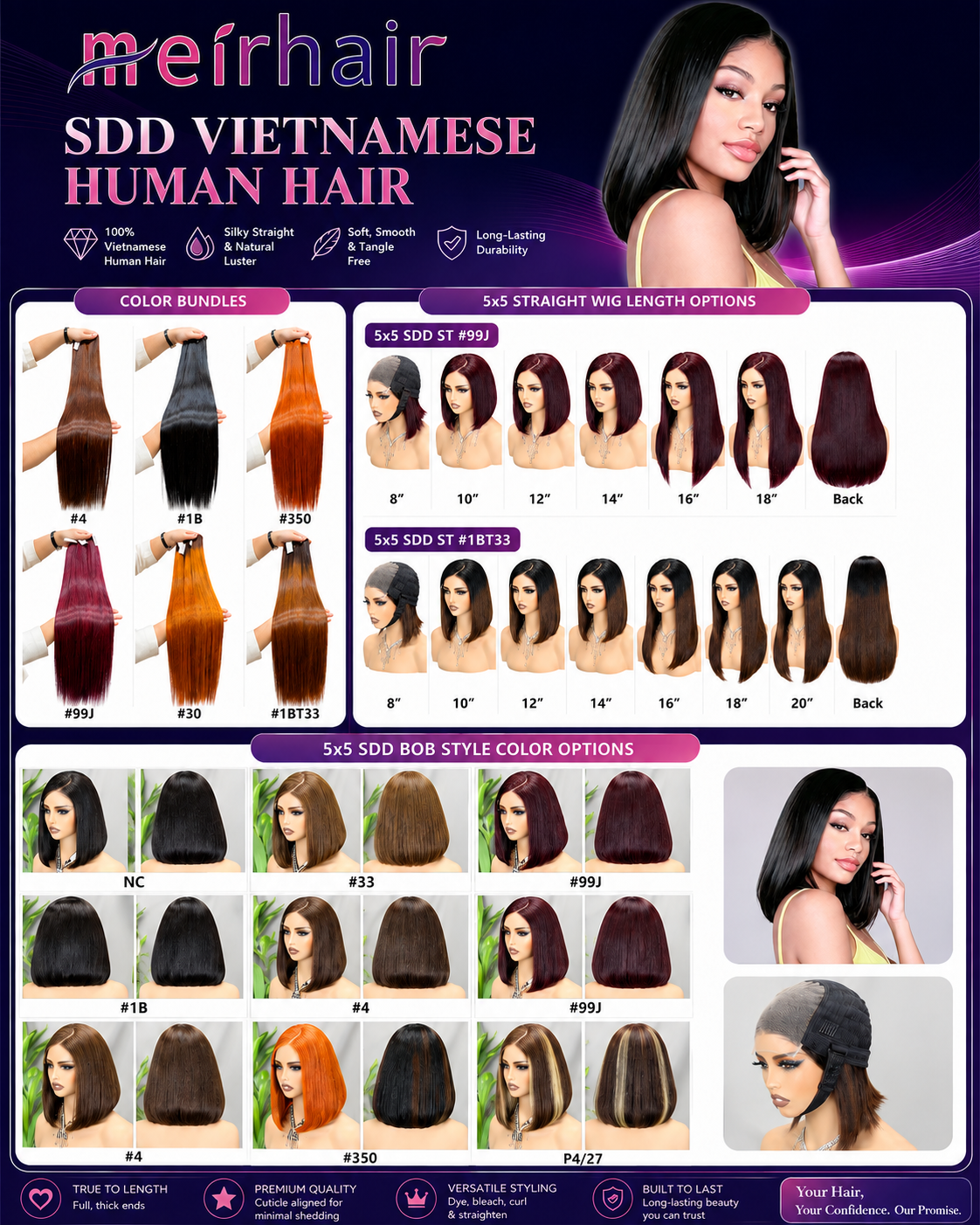
Measure the sample instead of relying only on the listed size. MEIRHAIR provides straight bob, body wave bob, and customized bob styles in lengths from 8 to 16 inches. Confirm that the measured length, cut, and overall silhouette match the order. The texture should remain consistent throughout the unit, without unexpected changes between the top, sides, and ends.
Texture, Color, and Practical Use
Color approval should be based on the confirmed requirement, whether the order calls for natural black, brown, blonde, or a customized shade. Check the color under suitable lighting and review whether it is even across the hair and lace area. Straight and body wave textures should also be compared with the approved reference, especially when the unit will be sold as a repeatable stock item.
For a consistent approval process, record findings in four categories: cap construction, lace and hairline, density and length, and texture and color. This method helps buyers distinguish between a minor sample variance and a problem that needs OEM or ODM correction. It also supports later decisions about private labeling, packaging, and customer-specific customization.
MEIRHAIR’s cooperation experience includes a United States wholesale project supplying human hair wigs for wig stores and beauty salons, as well as a Nigeria lace closure and frontal project for customized wig making, replacement units, and professional salon production. These applications demonstrate why stable fit, lace consistency, and repeatable specifications matter across both distribution and manufacturing programs.
Sample Inspection Comparison
| Inspection Category | Recommended Evaluation | Related Product Support |
|---|---|---|
| Cap construction | Check balanced seating, secure wear, pressure points, and compatibility with the selected format. | Lace front, closure, and full wig options |
| Lace and hairline | Review placement, front coverage, edge condition, and installation suitability. | Lace inspection included in quality control |
| Density and length | Measure the unit and compare its distribution and bob shape with the confirmed specification. | 8–16 inch lengths and multiple density choices |
| Texture and color | Verify uniform straight or body wave texture and accurate shade matching. | Natural black, brown, blonde, and customized colors |
| Order readiness | Determine whether the sample can enter stock production or needs technical modification. | OEM/ODM, private label, and custom packaging services |
Frequently Asked Questions
What should be examined first in a lace front human hair wig sample?
Start with the cap structure and lace placement. These two areas determine whether the unit sits evenly and whether the front lace provides adequate coverage for the planned installation.
How do I confirm that a bob wig sample matches the order?
Compare its measured length, density, cap construction, lace coverage, texture, and color with the approved specification. Straight, body wave, and customized bob designs are available in the 8–16 inch range.
Can fit problems be corrected for a private-label program?
Yes. Fit and appearance findings can be reviewed for OEM/ODM adjustment. Available support includes private labeling, custom packaging, product consultation, and modifications based on the buyer’s requirements.
Conclusion and Approval Recommendations
A lace front wigs human hair sample should be approved only after its construction and appearance have been evaluated as a complete system. Confirm the cap fit, lace coverage, hairline, density, length, texture, and color, then record every variance before moving to production. This process is useful for salons, retailers, wholesalers, online stores, and private-label buyers seeking consistent customer-ready units.
Guangzhou Ruiju supports OEM manufacturing, ODM development, wholesale supply, private-label programs, ready-stock products, and flexible small-batch orders. For technical guidance or project support, contact sales@brazilianhairtop.com.
About MEIRHAIR
Guangzhou Ruiju E-Commerce Co., Ltd. operates the MEIRHAIR brand and specializes in human hair wigs, SDD Vietnamese human hair wigs, hair bundles, extensions, braiding hair, and customized hair solutions for international beauty businesses. Founded in 2014, the company operates a 5,000 sqm factory and develops products in different textures, lengths, colors, densities, lace dimensions, cap structures, and attachment methods. Its service markets include North America, Europe, Africa, the Middle East, South America, and Southeast Asia.
MEIRHAIR has supported customers in wig wholesale, human hair bundle distribution, lace closure and frontal manufacturing, boho braid supply, and crochet hair programs.

REPORT