







-
 Agriculture
-
 Health-Care
-
 Environment
-
 Construction-Real-Estate
-
 Tools-Hardware
-
 Home-Garden
-
 Furniture
-
 Luggage-Bags-Cases
-
 Medical-devices-Supplies
-
 Gifts-Crafts
-
 Sports-Entertainment
-
 Food-Beverage
-
 Vehicles-Transportation
-
 Power-Transmission
-
 Material-Handling
-
 Renewable-Energy
-
 Safety
-
 Testing-Instrument-Equipment
-
 Construction-Building-Machinery
-
 Pet-Supplies
-
 Personal-Care-Household-Cleaning
-
 Vehicle-Accessories-Electronics-Tools
-
 School-Office-Supplies
-
 Packaging-Printing
-
 Mother-Kids-Toys
-
 Business-Services
-
 Commercial-Equipment-Machinery
-
 Apparel-Accessories
-
 Security
-
 Shoes-Accessories
-
 Vehicle-Parts-Accessories
-
 Jewelry-Eyewear-Watches-Accessories
-
 Lights-Lighting
-
 Fabric-Textile-Raw-Material
-
 Fabrication-Services
-
 Industrial-Machinery
-
 Consumer-Electronics
-
 Electrical-Equipment-Supplies
-
 Electronic-Components-Accessories-Telecommunications
-
 Home-Appliances
-
 Beauty
-
 Chemicals
-
 Rubber-Plastics
-
 Metals-Alloys


























































































































































































































































































































































































































































































































































































- Masonry Materials
- Curtain Walls & Accessories
- Earthwork Products
- Fireproofing Materials
- Heat Insulation Materials
- Plastic Building Materials
- Building Boards
- Soundproofing Materials
- Timber
- Waterproofing Materials
- Balustrades & Handrails
- Bathroom & Kitchen
- Flooring & Accessories
- Tiles & Accessories
- Door, Window & Accessories
- Fireplaces & Stoves
- Floor Heating Systems & Parts
- Stairs & Stair Parts
- Ceilings
- Elevators & Escalators
- Stone
- Countertops, Vanity Tops & Table Tops
- Mosaics
- Metal Building Materials
- Multifunctional Materials
- Ladders & Scaffoldings
- Mouldings
- Corner Guards
- Decorative Films
- Formwork
- Building & Industrial Glass
- Other Construction & Real Estate
- Wallpapers/Wall panels
- HVAC System & Parts
- Outdoor Facilities
- Prefabricated Buildings
- Festive & Party Supplies
- Bathroom Products
- Household Sundries
- Rain Gear
- Garden Supplies
- Household Cleaning Tools & Accessories
- Lighters & Smoking Accessories
- Home Storage & Organization
- Household Scales
- Smart Home Improvement
- Home Textiles
- Kitchenware
- Drinkware & Accessories
- Dinnerware, Coffee & Wine
- Home Decor
- Golf
- Fitness & Body Building
- Amusement Park Facilities
- Billiards, Board Game,Coin Operated Games
- Musical Instruments
- Outdoor Affordable Luxury Sports
- Camping & Hiking
- Fishing
- Sports Safety&Rehabilitation
- Ball Sports Equipments
- Water Sports
- Winter Sports
- Luxury Travel Equipments
- Sports Shoes, Bags & Accessories
- Cycling
- Other Sports & Entertainment Products
- Artificial Grass&Sports Flooring&Sports Court Equipment
- Scooters
- Food Ingredients
- Honey & Honey Products
- Snacks
- Nuts & Kernels
- Seafood
- Plant & Animal Oil
- Beverages
- Fruit & Vegetable Products
- Frog & Escargot
- Bean Products
- Egg Products
- Dairy Products
- Seasonings & Condiments
- Canned Food
- Instant Food
- Baked Goods
- Other Food & Beverage
- Meat & Poultry
- Confectionery
- Grain Products
- Feminie Care
- Hair Care & Styling
- Body Care
- Hands & Feet Care
- Hygiene Products
- Men's Grooming
- Laundry Cleaning Supplies
- Travel Size & Gift Sets
- Room Deodorizers
- Other Personal Care Products
- Pest Control Products
- Special Household Cleaning
- Floor Cleaning
- Kitchen & Bathroom Cleaning
- Oral Care
- Bath Supplies
- Yellow Pages
- Correction Supplies
- Office Binding Supplies
- Office Cutting Supplies
- Board Erasers
- Office Adhesives & Tapes
- Education Supplies
- Pencil Cases & Bags
- Notebooks & Writing Pads
- File Folder Accessories
- Calendars
- Writing Accessories
- Commercial Office Supplies
- Pencil Sharpeners
- Pens
- Letter Pad/Paper
- Paper Envelopes
- Desk Organizers
- Pencils
- Markers & Highlighters
- Filing Products
- Art Supplies
- Easels
- Badge Holder & Accessories
- Office Paper
- Printer Supplies
- Book Covers
- Other Office & School Supplies
- Stationery Set
- Boards
- Clipboards
- Stamps
- Drafting Supplies
- Stencils
- Electronic Dictionary
- Books
- Map
- Magazines
- Calculators
- Baby & Toddler Toys
- Educational Toys
- Classic Toys
- Dress Up & Pretend Play
- Toy Vehicle
- Stuffed Animals & Plush Toys
- Outdoor Toys & Structures
- Balloons & Accessories
- Baby Food
- Children's Clothing
- Baby Supplies & Products
- Maternity Clothes
- Kids Shoes
- Baby Care
- Novelty & Gag Toys
- Dolls & Accessories
- Puzzle & Games
- Blocks & Model Building Toys
- Toddler Clothing
- Baby Clothing
- Kids' Luggage & Bags
- Arts, Crafts & DIY Toys
- Action & Toy Figures
- Baby Appliances
- Hobbies & Models
- Remote Control Toys
- Promotional Toys
- Pregnancy & Maternity
- Hygiene Products
- Kid's Textile&Bedding
- Novelty & Special Use
- Toy Weapons
- Baby Gifts
- Baby Storage & Organization
- Auto Drive Systems
- ATV/UTV Parts & Accessories
- Marine Parts & Accessories
- Other Auto Parts
- Trailer Parts & Accessories
- Auto Transmission Systems
- Train Parts & Accessories
- Universal Parts
- Railway Parts & Accessories
- Auto Brake Systems
- Aviation Parts & Accessories
- Truck Parts & Accessories
- Auto Suspension Systems
- Auto Lighting Systems
- New Energy Vehicle Parts & Accessories
- Auto Steering Systems
- Wheels, Tires & Accessories
- Bus Parts & Accessories
- Auto Performance Parts
- Cooling System
- Go-Kart & Kart Racer Parts & Accessories
- Air Conditioning Systems
- Heavy Duty Vehicle Parts & Accessories
- Auto Electrical Systems
- Auto Body Systems
- Auto Engine Systems
- Container Parts & Accessories
- Motorcycle Parts & Accessories
- Refrigeration & Heat Exchange Equipment
- Machine Tool Equipment
- Food & Beverage Machinery
- Agricultural Machinery & Equipment
- Apparel & Textile Machinery
- Chemical Machinery
- Packaging Machines
- Paper Production Machinery
- Plastic & Rubber Processing Machinery
- Industrial Robots
- Electronic Products Machinery
- Metal & Metallurgy Machinery
- Woodworking Machinery
- Home Product Manufacturing Machinery
- Machinery Accessories
- Environmental Machinery
- Machinery Service
- Electrical Equipment Manufacturing Machinery
- Industrial Compressors & Parts
- Tobacco & Cigarette Machinery
- Production Line
- Used Industrial Machinery
- Electronics Production Machinery
- Other Machinery & Industrial Equipment
- Camera, Photo & Accessories
- Portable Audio, Video & Accessories
- Television, Home Audio, Video & Accessories
- Video Games & Accessories
- Mobile Phone & Accessories
- Electronic Publications
- Earphone & Headphone & Accessories
- Speakers & Accessories
- Smart Electronics
- TV Receivers & Accessories
- Mobile Phone & Computer Repair Parts
- Chargers, Batteries & Power Supplies
- Used Electronics
- VR, AR, MR Hardware & Software
- Projectors & Presentation Equipments
- Other Consumer Electronics
- Cables & Commonly Used Accessories
- Computer Hardware & Software
- Displays, Signage and Optoelectronics
- Discrete Semiconductors
- Wireless & IoT Module and Products
- Telecommunications
- Connectors, Terminals & Accessories
- Development Boards, Electronic Modules and Kits
- Circuit Protection
- Sensors
- Isolators
- Audio Components and Products
- Integrated Circuits
- Power Supplies
- Relays
- RF, Microwave and RFID
- Electronic Accessories & Supplies
- Passive Components
- PCB & PCBA
- Air Quality Appliances
- Home Appliance Parts
- Heating & Cooling Appliances
- Small Kitchen Appliances
- Laundry Appliances
- Water Heaters
- Water Treatment Appliances
- Refrigerators & Freezers
- Personal Care & Beauty Appliances
- Major Kitchen Appliances
- Cleaning Appliances
- Second-hand Appliances
- Smart Home Appliances
- Other Home Appliances
- Energy Chemicals
- Inorganic Chemicals
- Basic Organic Chemicals
- Agrochemicals
- Admixture & Additives
- Catalysts & Chemical Auxiliary Agents
- Pigments & Dyestuff
- Coating & Paint
- Daily Chemicals
- Polymer
- Organic Intermediate
- Adhesives & Sealants
- Chemical Waste
- Biological Chemical Products
- Surface Treatment Chemicals
- Painting & Coating
- Chemical Reagents
- Flavor & Fragrance
- Non-Explosive Demolition Agents
- Other Chemicals
- Custom Chemical Services

How to Protect Your Purchase When a UV Floor Lamp Falls Short of Its Output Specification
The strongest contractual protection for a UV floor lamp is a clear, testable performance requirement paired with an agreed inspection process and remedy. Define the output level, how and where it will be measured, acceptable variation, and what happens if the lamp fails the test. Also require relevant compliance documents and keep inspection records tied to the ordered model and configuration.
Set the Performance Requirement Before Ordering
Start by identifying the exact product being purchased. Record whether it is a floor-standing lamp, a single- or dual-head model, a detachable-head design, an adjustable spot-size model, or a lamp combined with a ring light. Use the same model and configuration details in the quotation, approved sample, production records, inspection documents, and shipment paperwork.
Then state the required output in the contract. Include the measurement unit, test location and position, operating conditions, verification method, and acceptable tolerance. A general promise that the lamp will meet specification may not resolve a dispute if the buyer and seller test under different conditions. The parties should agree on the actual output value before signing; no specific value is provided here.
Agree on Inspection and Acceptance
Include both pre-shipment checks and an inspection period after delivery. Require the seller to provide dated test records that identify the order, model, and configuration. The buyer should be able to retain evidence such as measurement results, product labels, and order details. Set a deadline and notification method for reporting a measurable shortfall or other nonconformity.
The contract should explain how a disagreement over test results will be handled. Specify the evidence each party must provide, whether a repeat or independent inspection will be used, who arranges it, and who pays the inspection costs. A defined process helps the parties determine whether the agreed requirement has actually been missed.
Specify the Remedy for Low Output
If a test confirms that output is below the contractual requirement, the agreement should set out the available corrective action. This may include repair, replacement, refund, or another remedy selected by the parties. Clarify how the defect will be verified, the response timeline, and responsibility for return shipping, handling, and reinspection costs.
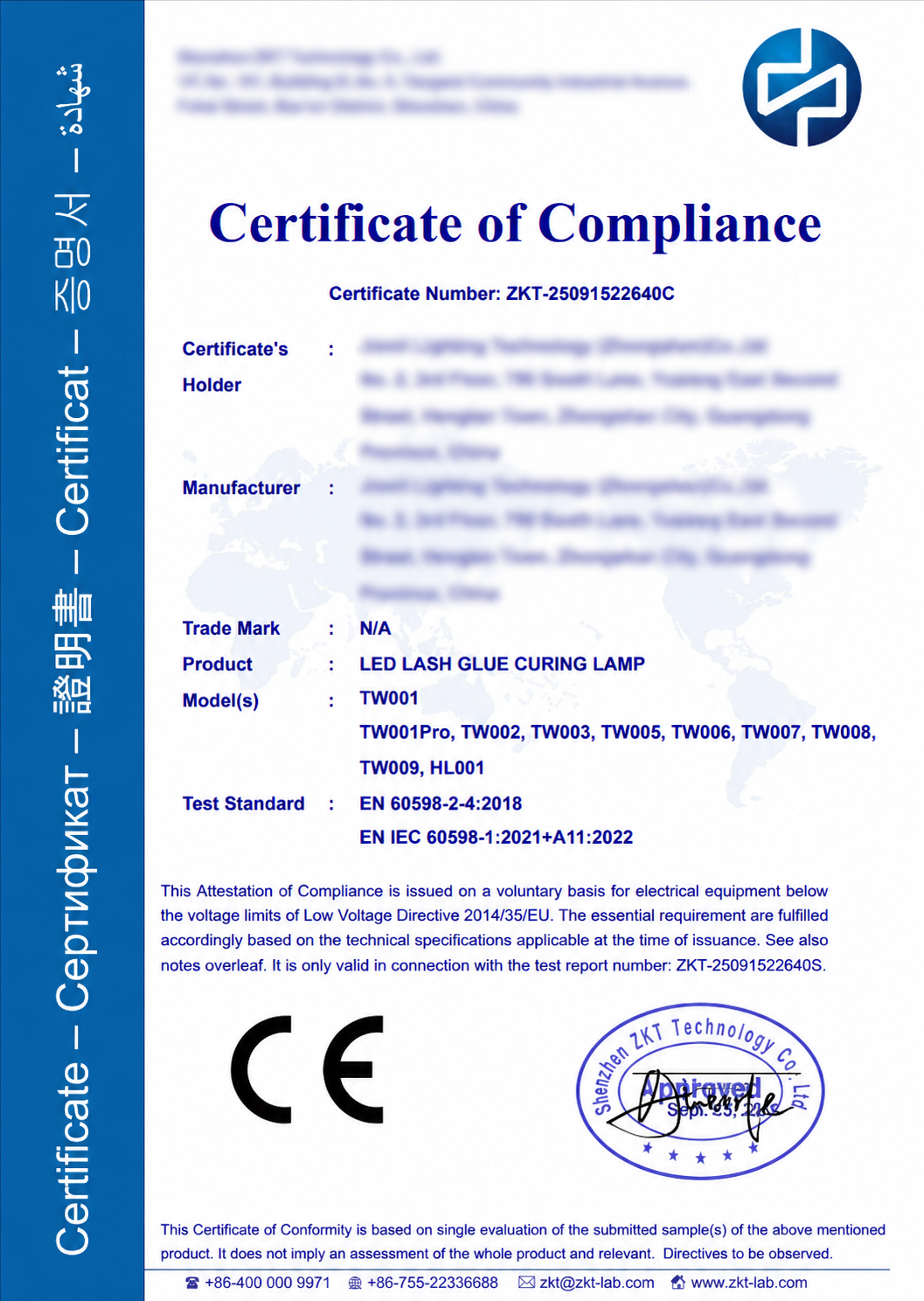
Compliance documents should also match the product being ordered. UBEMAY lists CE (LVD) and CE (EMC) certifications for its LED Lash Glue Curing Lamp, with the European Union identified as the applicable market. Request documents relevant to the exact lamp model and configuration in the order. Compliance paperwork supports regulatory documentation, but it does not substitute for a separate contractual output guarantee.
Contract Clauses at a Glance
| Contract Term | Why It Matters | Details to Record |
|---|---|---|
| Output specification | Establishes a measurable performance standard | Output value, tolerance, model, and configuration |
| Testing and acceptance | Aligns the parties on how performance is assessed | Test method and position, operating conditions, inspection records, and acceptance period |
| Nonconformance process | Provides a consistent way to address a failed result | Notice deadline, supporting evidence, retest procedure, and cost responsibility |
| Remedy | Defines the buyer's options if the lamp falls short | Repair, replacement, refund, or another agreed corrective action |
| Compliance documents | Connects regulatory records to the purchased product | Applicable CE LVD and EMC documents for the specified model |
Product Sourcing Context
UBEMAY has described supplying a complete range of lash products for salon work, training, and retail, including UV/LED lash equipment alongside extensions, adhesives, and accessories. That background may be relevant when sourcing related products, but the purchase contract remains the controlling record for the output requirement of a particular lamp.
Frequently Asked Questions
What output information should the purchase agreement include?
Identify the required output and tolerance, the lamp model and head configuration, operating conditions, test position, measurement method, and the records required as evidence. Agree on a specific output target before signing.
Does CE certification guarantee the lamp will meet my output requirement?
No. CE LVD and EMC documents can support compliance documentation for the applicable product, but they do not establish the commercial performance level you require. Set output, testing, acceptance, and remedies out separately in the contract.
How should conflicting test results be resolved?
Agree in advance on how to give notice, what evidence to submit, and whether a repeat or independent inspection will determine the result. The contract should also assign inspection costs and state which remedy applies if the retest confirms output below specification.
Recommendations
Before placing an order, make the lamp configuration, output target, test conditions, inspection window, and nonconformance remedy explicit in the contract. UBEMAY lists OEM/ODM customization, wholesale supply, private-label service, bulk orders, and flexible small-batch orders. Put any custom lamp requirements into the order documents rather than relying on a general product description. For technical assistance or product enquiries, contact sales@ubemay.com.
About UBEMAY
Guangzhou Ruiju E-Commerce Co., Ltd., operating as UBEMAY, supplies eyelash extensions, adhesives, lash accessories, and UV/LED lash equipment to professional beauty markets. Its customers include wholesalers, distributors, salons, training academies, lash artists, retailers, and private-label brands. Established in 2014, the company reports a 5,000 sqm factory area and production and supply capacity for adhesives, extensions, accessories, and UV/LED lash lamps. Listed credentials include CE (LVD) and CE (EMC) certifications for an LED Lash Glue Curing Lamp, and the company reports serving clients across multiple industries.

REPORT