







-
 Agriculture
-
 Health-Care
-
 Environment
-
 Construction-Real-Estate
-
 Tools-Hardware
-
 Home-Garden
-
 Furniture
-
 Luggage-Bags-Cases
-
 Medical-devices-Supplies
-
 Gifts-Crafts
-
 Sports-Entertainment
-
 Food-Beverage
-
 Vehicles-Transportation
-
 Power-Transmission
-
 Material-Handling
-
 Renewable-Energy
-
 Safety
-
 Testing-Instrument-Equipment
-
 Construction-Building-Machinery
-
 Pet-Supplies
-
 Personal-Care-Household-Cleaning
-
 Vehicle-Accessories-Electronics-Tools
-
 School-Office-Supplies
-
 Packaging-Printing
-
 Mother-Kids-Toys
-
 Business-Services
-
 Commercial-Equipment-Machinery
-
 Apparel-Accessories
-
 Security
-
 Shoes-Accessories
-
 Vehicle-Parts-Accessories
-
 Jewelry-Eyewear-Watches-Accessories
-
 Lights-Lighting
-
 Fabric-Textile-Raw-Material
-
 Fabrication-Services
-
 Industrial-Machinery
-
 Consumer-Electronics
-
 Electrical-Equipment-Supplies
-
 Electronic-Components-Accessories-Telecommunications
-
 Home-Appliances
-
 Beauty
-
 Chemicals
-
 Rubber-Plastics
-
 Metals-Alloys


























































































































































































































































































































































































































































































































































































- Masonry Materials
- Curtain Walls & Accessories
- Earthwork Products
- Fireproofing Materials
- Heat Insulation Materials
- Plastic Building Materials
- Building Boards
- Soundproofing Materials
- Timber
- Waterproofing Materials
- Balustrades & Handrails
- Bathroom & Kitchen
- Flooring & Accessories
- Tiles & Accessories
- Door, Window & Accessories
- Fireplaces & Stoves
- Floor Heating Systems & Parts
- Stairs & Stair Parts
- Ceilings
- Elevators & Escalators
- Stone
- Countertops, Vanity Tops & Table Tops
- Mosaics
- Metal Building Materials
- Multifunctional Materials
- Ladders & Scaffoldings
- Mouldings
- Corner Guards
- Decorative Films
- Formwork
- Building & Industrial Glass
- Other Construction & Real Estate
- Wallpapers/Wall panels
- HVAC System & Parts
- Outdoor Facilities
- Prefabricated Buildings
- Festive & Party Supplies
- Bathroom Products
- Household Sundries
- Rain Gear
- Garden Supplies
- Household Cleaning Tools & Accessories
- Lighters & Smoking Accessories
- Home Storage & Organization
- Household Scales
- Smart Home Improvement
- Home Textiles
- Kitchenware
- Drinkware & Accessories
- Dinnerware, Coffee & Wine
- Home Decor
- Golf
- Fitness & Body Building
- Amusement Park Facilities
- Billiards, Board Game,Coin Operated Games
- Musical Instruments
- Outdoor Affordable Luxury Sports
- Camping & Hiking
- Fishing
- Sports Safety&Rehabilitation
- Ball Sports Equipments
- Water Sports
- Winter Sports
- Luxury Travel Equipments
- Sports Shoes, Bags & Accessories
- Cycling
- Other Sports & Entertainment Products
- Artificial Grass&Sports Flooring&Sports Court Equipment
- Scooters
- Food Ingredients
- Honey & Honey Products
- Snacks
- Nuts & Kernels
- Seafood
- Plant & Animal Oil
- Beverages
- Fruit & Vegetable Products
- Frog & Escargot
- Bean Products
- Egg Products
- Dairy Products
- Seasonings & Condiments
- Canned Food
- Instant Food
- Baked Goods
- Other Food & Beverage
- Meat & Poultry
- Confectionery
- Grain Products
- Feminie Care
- Hair Care & Styling
- Body Care
- Hands & Feet Care
- Hygiene Products
- Men's Grooming
- Laundry Cleaning Supplies
- Travel Size & Gift Sets
- Room Deodorizers
- Other Personal Care Products
- Pest Control Products
- Special Household Cleaning
- Floor Cleaning
- Kitchen & Bathroom Cleaning
- Oral Care
- Bath Supplies
- Yellow Pages
- Correction Supplies
- Office Binding Supplies
- Office Cutting Supplies
- Board Erasers
- Office Adhesives & Tapes
- Education Supplies
- Pencil Cases & Bags
- Notebooks & Writing Pads
- File Folder Accessories
- Calendars
- Writing Accessories
- Commercial Office Supplies
- Pencil Sharpeners
- Pens
- Letter Pad/Paper
- Paper Envelopes
- Desk Organizers
- Pencils
- Markers & Highlighters
- Filing Products
- Art Supplies
- Easels
- Badge Holder & Accessories
- Office Paper
- Printer Supplies
- Book Covers
- Other Office & School Supplies
- Stationery Set
- Boards
- Clipboards
- Stamps
- Drafting Supplies
- Stencils
- Electronic Dictionary
- Books
- Map
- Magazines
- Calculators
- Baby & Toddler Toys
- Educational Toys
- Classic Toys
- Dress Up & Pretend Play
- Toy Vehicle
- Stuffed Animals & Plush Toys
- Outdoor Toys & Structures
- Balloons & Accessories
- Baby Food
- Children's Clothing
- Baby Supplies & Products
- Maternity Clothes
- Kids Shoes
- Baby Care
- Novelty & Gag Toys
- Dolls & Accessories
- Puzzle & Games
- Blocks & Model Building Toys
- Toddler Clothing
- Baby Clothing
- Kids' Luggage & Bags
- Arts, Crafts & DIY Toys
- Action & Toy Figures
- Baby Appliances
- Hobbies & Models
- Remote Control Toys
- Promotional Toys
- Pregnancy & Maternity
- Hygiene Products
- Kid's Textile&Bedding
- Novelty & Special Use
- Toy Weapons
- Baby Gifts
- Baby Storage & Organization
- Auto Drive Systems
- ATV/UTV Parts & Accessories
- Marine Parts & Accessories
- Other Auto Parts
- Trailer Parts & Accessories
- Auto Transmission Systems
- Train Parts & Accessories
- Universal Parts
- Railway Parts & Accessories
- Auto Brake Systems
- Aviation Parts & Accessories
- Truck Parts & Accessories
- Auto Suspension Systems
- Auto Lighting Systems
- New Energy Vehicle Parts & Accessories
- Auto Steering Systems
- Wheels, Tires & Accessories
- Bus Parts & Accessories
- Auto Performance Parts
- Cooling System
- Go-Kart & Kart Racer Parts & Accessories
- Air Conditioning Systems
- Heavy Duty Vehicle Parts & Accessories
- Auto Electrical Systems
- Auto Body Systems
- Auto Engine Systems
- Container Parts & Accessories
- Motorcycle Parts & Accessories
- Refrigeration & Heat Exchange Equipment
- Machine Tool Equipment
- Food & Beverage Machinery
- Agricultural Machinery & Equipment
- Apparel & Textile Machinery
- Chemical Machinery
- Packaging Machines
- Paper Production Machinery
- Plastic & Rubber Processing Machinery
- Industrial Robots
- Electronic Products Machinery
- Metal & Metallurgy Machinery
- Woodworking Machinery
- Home Product Manufacturing Machinery
- Machinery Accessories
- Environmental Machinery
- Machinery Service
- Electrical Equipment Manufacturing Machinery
- Industrial Compressors & Parts
- Tobacco & Cigarette Machinery
- Production Line
- Used Industrial Machinery
- Electronics Production Machinery
- Other Machinery & Industrial Equipment
- Camera, Photo & Accessories
- Portable Audio, Video & Accessories
- Television, Home Audio, Video & Accessories
- Video Games & Accessories
- Mobile Phone & Accessories
- Electronic Publications
- Earphone & Headphone & Accessories
- Speakers & Accessories
- Smart Electronics
- TV Receivers & Accessories
- Mobile Phone & Computer Repair Parts
- Chargers, Batteries & Power Supplies
- Used Electronics
- VR, AR, MR Hardware & Software
- Projectors & Presentation Equipments
- Other Consumer Electronics
- Cables & Commonly Used Accessories
- Computer Hardware & Software
- Displays, Signage and Optoelectronics
- Discrete Semiconductors
- Wireless & IoT Module and Products
- Telecommunications
- Connectors, Terminals & Accessories
- Development Boards, Electronic Modules and Kits
- Circuit Protection
- Sensors
- Isolators
- Audio Components and Products
- Integrated Circuits
- Power Supplies
- Relays
- RF, Microwave and RFID
- Electronic Accessories & Supplies
- Passive Components
- PCB & PCBA
- Air Quality Appliances
- Home Appliance Parts
- Heating & Cooling Appliances
- Small Kitchen Appliances
- Laundry Appliances
- Water Heaters
- Water Treatment Appliances
- Refrigerators & Freezers
- Personal Care & Beauty Appliances
- Major Kitchen Appliances
- Cleaning Appliances
- Second-hand Appliances
- Smart Home Appliances
- Other Home Appliances
- Energy Chemicals
- Inorganic Chemicals
- Basic Organic Chemicals
- Agrochemicals
- Admixture & Additives
- Catalysts & Chemical Auxiliary Agents
- Pigments & Dyestuff
- Coating & Paint
- Daily Chemicals
- Polymer
- Organic Intermediate
- Adhesives & Sealants
- Chemical Waste
- Biological Chemical Products
- Surface Treatment Chemicals
- Painting & Coating
- Chemical Reagents
- Flavor & Fragrance
- Non-Explosive Demolition Agents
- Other Chemicals
- Custom Chemical Services

How to Test Coffee Flavor Repeatability with a Single Machine Sample
A single coffee machine sample can be used to examine brew-to-brew flavor repeatability when every important input is held constant. Use the same capsule, water source, cup, water-volume setting, temperature setting, and preparation method, then compare aroma, flavor, strength, balance, and aftertaste across repeated brews.
Practical Testing Method
Begin by selecting one DG or DG plus capsule type and one consistent water source. Choose a single water-volume key and temperature key, and use the same cup size for the entire test series. Allow the machine to complete its stated 25-second preheating cycle before each brew so that heating preparation remains consistent.
Prepare several consecutive samples under these fixed conditions. Use a clean cup for every brew and record the capsule condition, water source, selected settings, preheating status, and sensory results. The evaluator should use the same written criteria each time, covering aroma intensity, perceived strength, taste balance, flavor clarity, mouthfeel, and aftertaste.
What the Machine Can Demonstrate
Repeated testing with one unit can reveal whether that machine delivers similar results when operating conditions do not change. It cannot confirm consistency across multiple machines, production lots, or future batches. For batch-level reliability, additional units and a larger sampling plan are required.
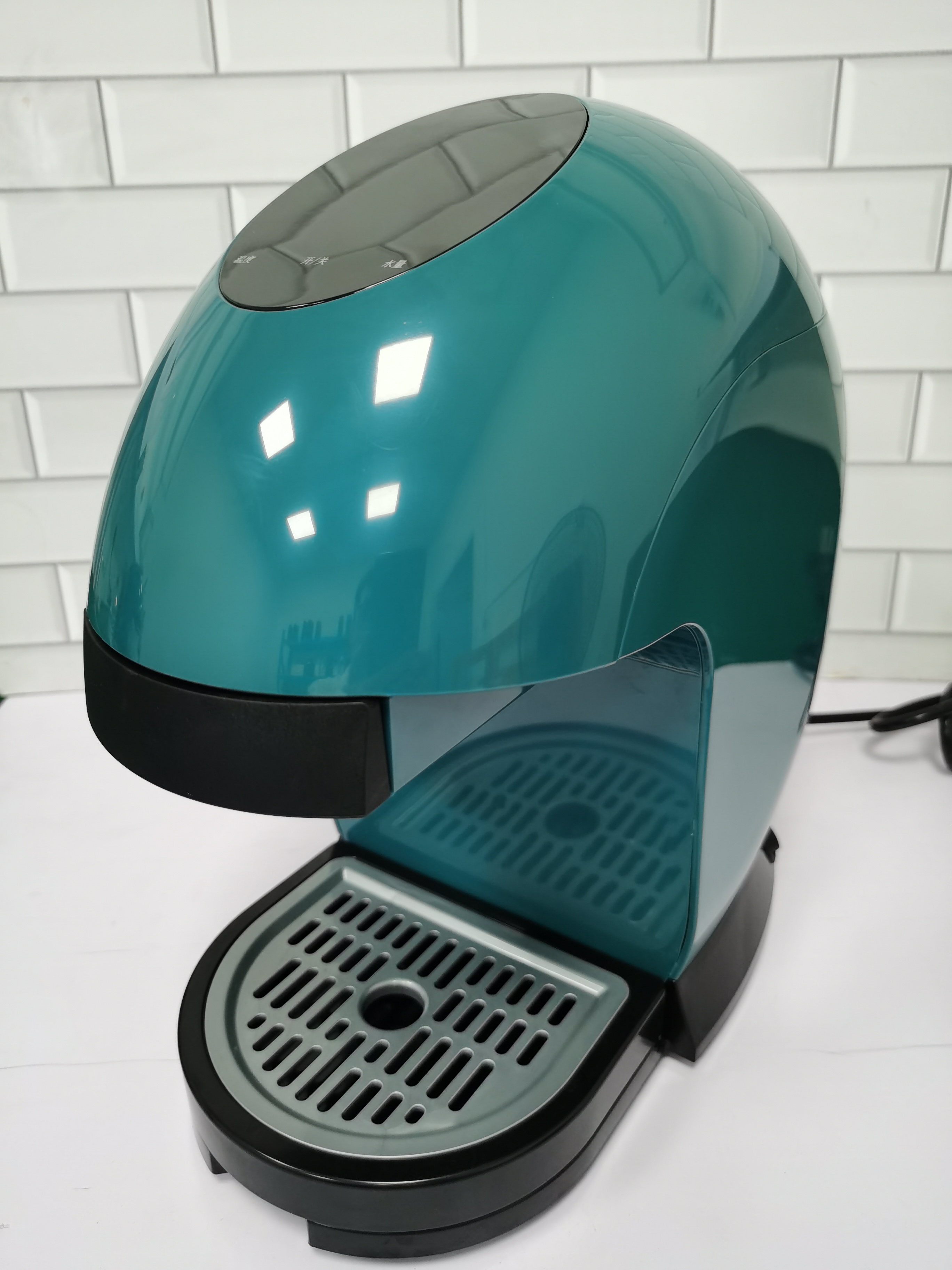
The machine is designed for 220V-50/60Hz operation and has a rated power of 1450W. It supports DG and DG plus capsules, includes an 800mL removable water tank and removable water tray, and uses touch-sensitive function keys. Seven water-volume selections and seven temperature selections make it possible to establish controlled test settings. When paired with a suitable water system, the tank can also connect directly to bottled water.
Keep Residual-Water Handling Consistent
The machine includes an air-blowing function that can help dry residual water inside the capsule. Decide before testing whether this function will be used. Apply the same choice after every brew, because changing the drying procedure may affect the next sample and reduce the value of the comparison.
Testing Records and Procurement Communication
Separate objective machine settings from sensory judgments in the evaluation record. Record the selected volume, temperature, capsule type, water arrangement, heating preparation, and air-blowing status as controlled variables. Then document sensory observations using a repeatable scoring scale or the same descriptive vocabulary for every sample.
For cross-border procurement, a complete test record helps buyers, suppliers, and technical teams communicate requirements through international import and export, supply-chain coordination, installation, and after-sales support processes. Any deviation from the planned method should be listed separately instead of being treated as part of the same controlled comparison.
Evaluation Factors at a Glance
| Test Factor | Recommended Control | Product Capability |
|---|---|---|
| Capsule | Use the same capsule type throughout one test series | Compatible with DG and DG plus capsules |
| Water volume | Select and retain one volume key for every brew | Seven selectable water-volume keys |
| Temperature | Use one temperature key without changing it between samples | Seven selectable temperature keys |
| Preheating | Follow the same preparation cycle before each brew | Instant heating with a stated 25-second preheating time |
| Water supply | Keep the tank or bottled-water connection arrangement unchanged | 800mL removable tank and supported direct bottled-water connection with a water system |
| Capsule drying | Use the air-blowing function consistently, or omit it consistently | Air blowing can dry residual water in the capsule |
Frequently Asked Questions
Can one machine prove flavor consistency across an entire production batch?
No. A single sample can measure repeatability from that individual unit under controlled conditions. It cannot establish the degree of variation among separate machines or manufacturing batches.
Which variables should remain fixed?
Keep the capsule, water source, cup type, water-volume selection, temperature selection, preheating routine, and residual-water handling method unchanged within the same test series.
What should a flavor evaluation form include?
Record the machine settings and procedural conditions first. Then assess aroma, perceived strength, flavor balance, taste clarity, mouthfeel, and aftertaste with the same scale or terminology for every brew. Note equipment or process changes in a separate field.
Service Background and Certification Notes
Guangdong BFC Technology Co,.Ltd has cooperation experience involving Ecuadorian construction wood cutting machines and wastewater treatment equipment. These projects reference on-site commissioning, remote technical assistance, installation debugging, and after-sales maintenance, which may be relevant when a coffee machine sample requires documented setup or evaluation support.
The company lists a CERTIFICATE OF QUALITY MANAGEMENT SYSTEM CERTIFICATION for OEM production of refrigerated freezers and an EU TEST ATTESTATION OF CONFORMITY for WASTED WATER TREATMENT EQUIPMENT. These credentials apply to the specified product categories and should not be interpreted as coffee machine-specific certification.
Conclusion
To assess flavor repeatability with one coffee machine sample, standardize the capsule, water, cup, volume, temperature, preheating, and capsule-drying procedure. Repeat the brew several times and document sensory differences using consistent criteria. The machine's seven volume keys, seven temperature keys, DG and DG plus compatibility, instant heating, and 800mL removable tank support structured sample evaluation. BFC provides overseas cooperation, global expansion, resource integration, and industrial output, with minimum order quantity, delivery time, and monthly capacity determined by the product. For technical solutions or support, contact karl.liu@buyfromchina.cn.
About Us
Guangdong BFC Technology Co,.Ltd operates the BUY FACTORY FROM CHINA brand as an industrial internet platform company, equipment manufacturing exporter, and comprehensive solution provider. Founded in 2012, it is developing a cross-border production-capacity cooperation platform to support factory development and equipment-manufacturing exports. Its foreign-trade team handles inquiries, order progress, logistics, customs-clearance coordination, and after-sales communication through cooperation with domestic manufacturers and technical partners. South America is its main market, and its stated export ratio is 100%.
The company lists CERTIFICATE OF QUALITY MANAGEMENT SYSTEM CERTIFICATION and CERTIFICATE OF ENVIRONMENT MANAGEMENT SYSTEM CERTIFICATION among its credentials. It also reports cooperation cases serving customers in several industrial sectors.

REPORT