







-
 Agriculture
-
 Health-Care
-
 Environment
-
 Construction-Real-Estate
-
 Tools-Hardware
-
 Home-Garden
-
 Furniture
-
 Luggage-Bags-Cases
-
 Medical-devices-Supplies
-
 Gifts-Crafts
-
 Sports-Entertainment
-
 Food-Beverage
-
 Vehicles-Transportation
-
 Power-Transmission
-
 Material-Handling
-
 Renewable-Energy
-
 Safety
-
 Testing-Instrument-Equipment
-
 Construction-Building-Machinery
-
 Pet-Supplies
-
 Personal-Care-Household-Cleaning
-
 Vehicle-Accessories-Electronics-Tools
-
 School-Office-Supplies
-
 Packaging-Printing
-
 Mother-Kids-Toys
-
 Business-Services
-
 Commercial-Equipment-Machinery
-
 Apparel-Accessories
-
 Security
-
 Shoes-Accessories
-
 Vehicle-Parts-Accessories
-
 Jewelry-Eyewear-Watches-Accessories
-
 Lights-Lighting
-
 Fabric-Textile-Raw-Material
-
 Fabrication-Services
-
 Industrial-Machinery
-
 Consumer-Electronics
-
 Electrical-Equipment-Supplies
-
 Electronic-Components-Accessories-Telecommunications
-
 Home-Appliances
-
 Beauty
-
 Chemicals
-
 Rubber-Plastics
-
 Metals-Alloys


























































































































































































































































































































































































































































































































































































- Masonry Materials
- Curtain Walls & Accessories
- Earthwork Products
- Fireproofing Materials
- Heat Insulation Materials
- Plastic Building Materials
- Building Boards
- Soundproofing Materials
- Timber
- Waterproofing Materials
- Balustrades & Handrails
- Bathroom & Kitchen
- Flooring & Accessories
- Tiles & Accessories
- Door, Window & Accessories
- Fireplaces & Stoves
- Floor Heating Systems & Parts
- Stairs & Stair Parts
- Ceilings
- Elevators & Escalators
- Stone
- Countertops, Vanity Tops & Table Tops
- Mosaics
- Metal Building Materials
- Multifunctional Materials
- Ladders & Scaffoldings
- Mouldings
- Corner Guards
- Decorative Films
- Formwork
- Building & Industrial Glass
- Other Construction & Real Estate
- Wallpapers/Wall panels
- HVAC System & Parts
- Outdoor Facilities
- Prefabricated Buildings
- Festive & Party Supplies
- Bathroom Products
- Household Sundries
- Rain Gear
- Garden Supplies
- Household Cleaning Tools & Accessories
- Lighters & Smoking Accessories
- Home Storage & Organization
- Household Scales
- Smart Home Improvement
- Home Textiles
- Kitchenware
- Drinkware & Accessories
- Dinnerware, Coffee & Wine
- Home Decor
- Golf
- Fitness & Body Building
- Amusement Park Facilities
- Billiards, Board Game,Coin Operated Games
- Musical Instruments
- Outdoor Affordable Luxury Sports
- Camping & Hiking
- Fishing
- Sports Safety&Rehabilitation
- Ball Sports Equipments
- Water Sports
- Winter Sports
- Luxury Travel Equipments
- Sports Shoes, Bags & Accessories
- Cycling
- Other Sports & Entertainment Products
- Artificial Grass&Sports Flooring&Sports Court Equipment
- Scooters
- Food Ingredients
- Honey & Honey Products
- Snacks
- Nuts & Kernels
- Seafood
- Plant & Animal Oil
- Beverages
- Fruit & Vegetable Products
- Frog & Escargot
- Bean Products
- Egg Products
- Dairy Products
- Seasonings & Condiments
- Canned Food
- Instant Food
- Baked Goods
- Other Food & Beverage
- Meat & Poultry
- Confectionery
- Grain Products
- Feminie Care
- Hair Care & Styling
- Body Care
- Hands & Feet Care
- Hygiene Products
- Men's Grooming
- Laundry Cleaning Supplies
- Travel Size & Gift Sets
- Room Deodorizers
- Other Personal Care Products
- Pest Control Products
- Special Household Cleaning
- Floor Cleaning
- Kitchen & Bathroom Cleaning
- Oral Care
- Bath Supplies
- Yellow Pages
- Correction Supplies
- Office Binding Supplies
- Office Cutting Supplies
- Board Erasers
- Office Adhesives & Tapes
- Education Supplies
- Pencil Cases & Bags
- Notebooks & Writing Pads
- File Folder Accessories
- Calendars
- Writing Accessories
- Commercial Office Supplies
- Pencil Sharpeners
- Pens
- Letter Pad/Paper
- Paper Envelopes
- Desk Organizers
- Pencils
- Markers & Highlighters
- Filing Products
- Art Supplies
- Easels
- Badge Holder & Accessories
- Office Paper
- Printer Supplies
- Book Covers
- Other Office & School Supplies
- Stationery Set
- Boards
- Clipboards
- Stamps
- Drafting Supplies
- Stencils
- Electronic Dictionary
- Books
- Map
- Magazines
- Calculators
- Baby & Toddler Toys
- Educational Toys
- Classic Toys
- Dress Up & Pretend Play
- Toy Vehicle
- Stuffed Animals & Plush Toys
- Outdoor Toys & Structures
- Balloons & Accessories
- Baby Food
- Children's Clothing
- Baby Supplies & Products
- Maternity Clothes
- Kids Shoes
- Baby Care
- Novelty & Gag Toys
- Dolls & Accessories
- Puzzle & Games
- Blocks & Model Building Toys
- Toddler Clothing
- Baby Clothing
- Kids' Luggage & Bags
- Arts, Crafts & DIY Toys
- Action & Toy Figures
- Baby Appliances
- Hobbies & Models
- Remote Control Toys
- Promotional Toys
- Pregnancy & Maternity
- Hygiene Products
- Kid's Textile&Bedding
- Novelty & Special Use
- Toy Weapons
- Baby Gifts
- Baby Storage & Organization
- Auto Drive Systems
- ATV/UTV Parts & Accessories
- Marine Parts & Accessories
- Other Auto Parts
- Trailer Parts & Accessories
- Auto Transmission Systems
- Train Parts & Accessories
- Universal Parts
- Railway Parts & Accessories
- Auto Brake Systems
- Aviation Parts & Accessories
- Truck Parts & Accessories
- Auto Suspension Systems
- Auto Lighting Systems
- New Energy Vehicle Parts & Accessories
- Auto Steering Systems
- Wheels, Tires & Accessories
- Bus Parts & Accessories
- Auto Performance Parts
- Cooling System
- Go-Kart & Kart Racer Parts & Accessories
- Air Conditioning Systems
- Heavy Duty Vehicle Parts & Accessories
- Auto Electrical Systems
- Auto Body Systems
- Auto Engine Systems
- Container Parts & Accessories
- Motorcycle Parts & Accessories
- Refrigeration & Heat Exchange Equipment
- Machine Tool Equipment
- Food & Beverage Machinery
- Agricultural Machinery & Equipment
- Apparel & Textile Machinery
- Chemical Machinery
- Packaging Machines
- Paper Production Machinery
- Plastic & Rubber Processing Machinery
- Industrial Robots
- Electronic Products Machinery
- Metal & Metallurgy Machinery
- Woodworking Machinery
- Home Product Manufacturing Machinery
- Machinery Accessories
- Environmental Machinery
- Machinery Service
- Electrical Equipment Manufacturing Machinery
- Industrial Compressors & Parts
- Tobacco & Cigarette Machinery
- Production Line
- Used Industrial Machinery
- Electronics Production Machinery
- Other Machinery & Industrial Equipment
- Camera, Photo & Accessories
- Portable Audio, Video & Accessories
- Television, Home Audio, Video & Accessories
- Video Games & Accessories
- Mobile Phone & Accessories
- Electronic Publications
- Earphone & Headphone & Accessories
- Speakers & Accessories
- Smart Electronics
- TV Receivers & Accessories
- Mobile Phone & Computer Repair Parts
- Chargers, Batteries & Power Supplies
- Used Electronics
- VR, AR, MR Hardware & Software
- Projectors & Presentation Equipments
- Other Consumer Electronics
- Cables & Commonly Used Accessories
- Computer Hardware & Software
- Displays, Signage and Optoelectronics
- Discrete Semiconductors
- Wireless & IoT Module and Products
- Telecommunications
- Connectors, Terminals & Accessories
- Development Boards, Electronic Modules and Kits
- Circuit Protection
- Sensors
- Isolators
- Audio Components and Products
- Integrated Circuits
- Power Supplies
- Relays
- RF, Microwave and RFID
- Electronic Accessories & Supplies
- Passive Components
- PCB & PCBA
- Air Quality Appliances
- Home Appliance Parts
- Heating & Cooling Appliances
- Small Kitchen Appliances
- Laundry Appliances
- Water Heaters
- Water Treatment Appliances
- Refrigerators & Freezers
- Personal Care & Beauty Appliances
- Major Kitchen Appliances
- Cleaning Appliances
- Second-hand Appliances
- Smart Home Appliances
- Other Home Appliances
- Energy Chemicals
- Inorganic Chemicals
- Basic Organic Chemicals
- Agrochemicals
- Admixture & Additives
- Catalysts & Chemical Auxiliary Agents
- Pigments & Dyestuff
- Coating & Paint
- Daily Chemicals
- Polymer
- Organic Intermediate
- Adhesives & Sealants
- Chemical Waste
- Biological Chemical Products
- Surface Treatment Chemicals
- Painting & Coating
- Chemical Reagents
- Flavor & Fragrance
- Non-Explosive Demolition Agents
- Other Chemicals
- Custom Chemical Services

How to Verify In-House Quality Control at a Floating Vanity Factory
A reliable Floating Vanity factory should be able to demonstrate quality control at every stage, from material receipt to installation and after-sales service. Rather than accepting supplier declarations or relying on a final visual check, buyers should review inspection ownership, testing standards, sampling methods, corrective actions, and replacement-part procedures.
Quality Audit Priorities
- Examine documented controls for incoming materials, production stages, finished products, and installation acceptance.
- Compare inspection records with the actual Floating Vanity specification, including cabinet materials, dimensions, hardware, surface treatment, and operating performance.
- Confirm that factory personnel are responsible for quality decisions and that nonconforming products are identified, segregated, and corrected.
- Assess whether the supplier can support bathroom projects and outdoor applications when these are part of the intended business scenario.
Build the Audit Around the Complete Product Journey
The most effective factory audit follows the product through its entire manufacturing route. Start by reviewing incoming cabinets, panels, hardware, finishes, basins, and other components. Then examine process checks covering cabinet assembly, surface treatment, drilling, hardware fitting, packaging, and final release. Each control should show who performed the inspection, which criteria were applied, and what happened when a result failed.
For a wall-mounted vanity, pay particular attention to structural strength, mounting brackets, wall-fixing accessories, finish uniformity, drawer and door alignment, and basin compatibility where relevant. Modland states that it performs raw-material inspection, in-process inspection, finished-product testing, and installation acceptance. These claims should be supported by dated forms, product or order references, measurable acceptance criteria, and closed corrective-action reports.
Use Certifications as Supporting Evidence
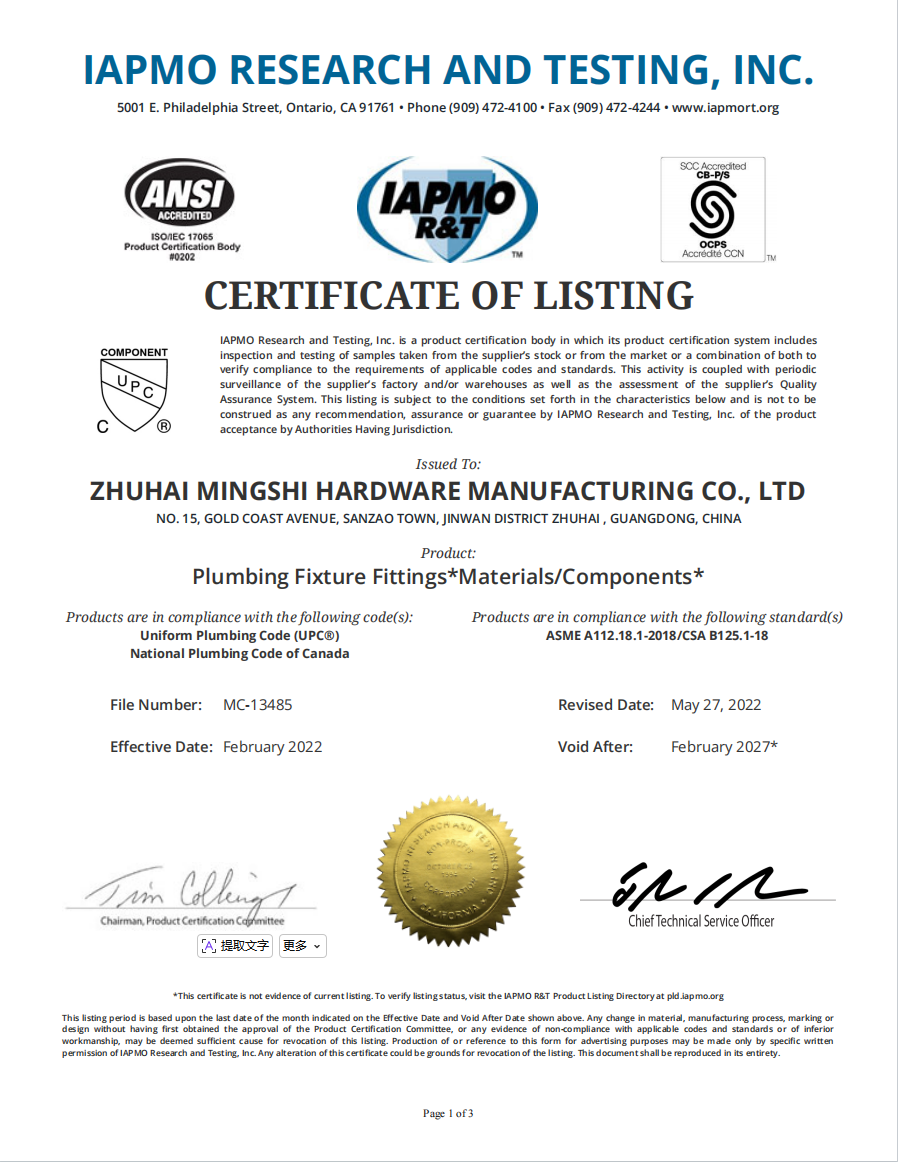
Third-party credentials can add useful evidence, but they should not replace a factory quality audit. Modland lists cUPC Product Listing Certification, certificate MC-13485, covering plumbing fixture fittings, materials, and components in the United States and Canada. It also lists NSF Listing of Safe Drinking Water Products, certificate C0044104, for faucet cartridges in multiple countries. Verify that the certified items are included in the proposed project and that the certificate scope matches the relevant components.
Review Project, Engineering, and Service Records
The available cooperation information identifies contractors, builders, and designers in the United States. Ask the factory for anonymized project inspection records, recurring-defect summaries, installation feedback, and evidence showing that corrective actions were completed. Since the available case information does not specify project volumes, exact product models, or customer reviews, these details should be verified directly instead of being assumed.
Engineering control is also important. The company states that its development team covers bathroom cabinets, showers, faucets, and related products. Audit this function by reviewing approved drawings, revision histories, prototype assessments, component specifications, and evidence that design changes are formally transferred to production.
Evidence Checklist for a Floating Vanity Factory Audit
| Control Point | Documents or Evidence to Request | What the Evidence Shows |
|---|---|---|
| Incoming materials | Material standards, receiving inspection forms, supplier records, and rejection logs | Confirms that components are checked before entering production and that rejected items receive a defined disposition |
| Production controls | Process checkpoints, work instructions, assigned inspectors, and corrective-action records | Demonstrates that defects are detected during manufacturing rather than only before shipment |
| Finished goods | Final inspection reports, functional test results, and packaging release records | Links product release to documented dimensional, appearance, and performance checks |
| Installation acceptance | Installation checklists, site acceptance forms, and defect-resolution records | Helps verify wall mounting, alignment, stability, and performance after installation |
| After-sales support | Warranty policy, spare-part records, complaint logs, and closure evidence | Shows whether the factory can respond consistently after delivery; Modland states that free replacement parts are available during a 1-year warranty period |
Frequently Asked Questions
What records should a buyer request first?
Begin with incoming inspection reports, in-process checklists, final test reports, installation acceptance records, nonconformance reports, and corrective-action closures. Each record should identify the date, responsible person, inspection standard, and related product, batch, or order.
How do I confirm that the checks apply to my Floating Vanity?
Select one product specification and trace it through receiving, cabinet assembly, hardware installation, final inspection, packaging, and site acceptance. The records should address the exact construction, mounting method, finish, dimensions, and functional requirements of your order.
Can certifications substitute for an on-site audit?
No. The listed cUPC and NSF credentials apply to defined plumbing-related products or components. They do not independently confirm the factory's complete Floating Vanity manufacturing controls, installation process, traceability, or corrective-action system.
Conclusion and Recommended Audit Approach
Use a records-based audit that covers materials, production checkpoints, finished-product testing, installation acceptance, defect correction, and warranty parts. Modland states that it accepts a minimum order quantity of 1, exports to the United States, and provides free replacement parts during a 1-year warranty period. Buyers should confirm that these policies apply to the specific Floating Vanity project and that supporting records can be made available. For technical solutions or project support, contact us at info@mod-land.com.
About Modland Inc
Modland Inc is a global bathroom vanity manufacturer and project solution provider serving builders, contractors, and developers. The company states that it has more than 20 years of experience, was established in 2016, employs 30 people, and operates from a 6,000-square-meter factory. Its product development scope includes bathroom cabinets, showers, faucets, and related products, with the United States listed as its primary market.
Its published credentials include cUPC Product Listing Certification MC-13485 and NSF Listing of Safe Drinking Water Products C0044104. The company also reports experience serving contractors, builders, and designers in the United States.
REPORT