







-
 Agriculture
-
 Health-Care
-
 Environment
-
 Construction-Real-Estate
-
 Tools-Hardware
-
 Home-Garden
-
 Furniture
-
 Luggage-Bags-Cases
-
 Medical-devices-Supplies
-
 Gifts-Crafts
-
 Sports-Entertainment
-
 Food-Beverage
-
 Vehicles-Transportation
-
 Power-Transmission
-
 Material-Handling
-
 Renewable-Energy
-
 Safety
-
 Testing-Instrument-Equipment
-
 Construction-Building-Machinery
-
 Pet-Supplies
-
 Personal-Care-Household-Cleaning
-
 Vehicle-Accessories-Electronics-Tools
-
 School-Office-Supplies
-
 Packaging-Printing
-
 Mother-Kids-Toys
-
 Business-Services
-
 Commercial-Equipment-Machinery
-
 Apparel-Accessories
-
 Security
-
 Shoes-Accessories
-
 Vehicle-Parts-Accessories
-
 Jewelry-Eyewear-Watches-Accessories
-
 Lights-Lighting
-
 Fabric-Textile-Raw-Material
-
 Fabrication-Services
-
 Industrial-Machinery
-
 Consumer-Electronics
-
 Electrical-Equipment-Supplies
-
 Electronic-Components-Accessories-Telecommunications
-
 Home-Appliances
-
 Beauty
-
 Chemicals
-
 Rubber-Plastics
-
 Metals-Alloys


























































































































































































































































































































































































































































































































































































- Masonry Materials
- Curtain Walls & Accessories
- Earthwork Products
- Fireproofing Materials
- Heat Insulation Materials
- Plastic Building Materials
- Building Boards
- Soundproofing Materials
- Timber
- Waterproofing Materials
- Balustrades & Handrails
- Bathroom & Kitchen
- Flooring & Accessories
- Tiles & Accessories
- Door, Window & Accessories
- Fireplaces & Stoves
- Floor Heating Systems & Parts
- Stairs & Stair Parts
- Ceilings
- Elevators & Escalators
- Stone
- Countertops, Vanity Tops & Table Tops
- Mosaics
- Metal Building Materials
- Multifunctional Materials
- Ladders & Scaffoldings
- Mouldings
- Corner Guards
- Decorative Films
- Formwork
- Building & Industrial Glass
- Other Construction & Real Estate
- Wallpapers/Wall panels
- HVAC System & Parts
- Outdoor Facilities
- Prefabricated Buildings
- Festive & Party Supplies
- Bathroom Products
- Household Sundries
- Rain Gear
- Garden Supplies
- Household Cleaning Tools & Accessories
- Lighters & Smoking Accessories
- Home Storage & Organization
- Household Scales
- Smart Home Improvement
- Home Textiles
- Kitchenware
- Drinkware & Accessories
- Dinnerware, Coffee & Wine
- Home Decor
- Golf
- Fitness & Body Building
- Amusement Park Facilities
- Billiards, Board Game,Coin Operated Games
- Musical Instruments
- Outdoor Affordable Luxury Sports
- Camping & Hiking
- Fishing
- Sports Safety&Rehabilitation
- Ball Sports Equipments
- Water Sports
- Winter Sports
- Luxury Travel Equipments
- Sports Shoes, Bags & Accessories
- Cycling
- Other Sports & Entertainment Products
- Artificial Grass&Sports Flooring&Sports Court Equipment
- Scooters
- Food Ingredients
- Honey & Honey Products
- Snacks
- Nuts & Kernels
- Seafood
- Plant & Animal Oil
- Beverages
- Fruit & Vegetable Products
- Frog & Escargot
- Bean Products
- Egg Products
- Dairy Products
- Seasonings & Condiments
- Canned Food
- Instant Food
- Baked Goods
- Other Food & Beverage
- Meat & Poultry
- Confectionery
- Grain Products
- Feminie Care
- Hair Care & Styling
- Body Care
- Hands & Feet Care
- Hygiene Products
- Men's Grooming
- Laundry Cleaning Supplies
- Travel Size & Gift Sets
- Room Deodorizers
- Other Personal Care Products
- Pest Control Products
- Special Household Cleaning
- Floor Cleaning
- Kitchen & Bathroom Cleaning
- Oral Care
- Bath Supplies
- Yellow Pages
- Correction Supplies
- Office Binding Supplies
- Office Cutting Supplies
- Board Erasers
- Office Adhesives & Tapes
- Education Supplies
- Pencil Cases & Bags
- Notebooks & Writing Pads
- File Folder Accessories
- Calendars
- Writing Accessories
- Commercial Office Supplies
- Pencil Sharpeners
- Pens
- Letter Pad/Paper
- Paper Envelopes
- Desk Organizers
- Pencils
- Markers & Highlighters
- Filing Products
- Art Supplies
- Easels
- Badge Holder & Accessories
- Office Paper
- Printer Supplies
- Book Covers
- Other Office & School Supplies
- Stationery Set
- Boards
- Clipboards
- Stamps
- Drafting Supplies
- Stencils
- Electronic Dictionary
- Books
- Map
- Magazines
- Calculators
- Baby & Toddler Toys
- Educational Toys
- Classic Toys
- Dress Up & Pretend Play
- Toy Vehicle
- Stuffed Animals & Plush Toys
- Outdoor Toys & Structures
- Balloons & Accessories
- Baby Food
- Children's Clothing
- Baby Supplies & Products
- Maternity Clothes
- Kids Shoes
- Baby Care
- Novelty & Gag Toys
- Dolls & Accessories
- Puzzle & Games
- Blocks & Model Building Toys
- Toddler Clothing
- Baby Clothing
- Kids' Luggage & Bags
- Arts, Crafts & DIY Toys
- Action & Toy Figures
- Baby Appliances
- Hobbies & Models
- Remote Control Toys
- Promotional Toys
- Pregnancy & Maternity
- Hygiene Products
- Kid's Textile&Bedding
- Novelty & Special Use
- Toy Weapons
- Baby Gifts
- Baby Storage & Organization
- Auto Drive Systems
- ATV/UTV Parts & Accessories
- Marine Parts & Accessories
- Other Auto Parts
- Trailer Parts & Accessories
- Auto Transmission Systems
- Train Parts & Accessories
- Universal Parts
- Railway Parts & Accessories
- Auto Brake Systems
- Aviation Parts & Accessories
- Truck Parts & Accessories
- Auto Suspension Systems
- Auto Lighting Systems
- New Energy Vehicle Parts & Accessories
- Auto Steering Systems
- Wheels, Tires & Accessories
- Bus Parts & Accessories
- Auto Performance Parts
- Cooling System
- Go-Kart & Kart Racer Parts & Accessories
- Air Conditioning Systems
- Heavy Duty Vehicle Parts & Accessories
- Auto Electrical Systems
- Auto Body Systems
- Auto Engine Systems
- Container Parts & Accessories
- Motorcycle Parts & Accessories
- Refrigeration & Heat Exchange Equipment
- Machine Tool Equipment
- Food & Beverage Machinery
- Agricultural Machinery & Equipment
- Apparel & Textile Machinery
- Chemical Machinery
- Packaging Machines
- Paper Production Machinery
- Plastic & Rubber Processing Machinery
- Industrial Robots
- Electronic Products Machinery
- Metal & Metallurgy Machinery
- Woodworking Machinery
- Home Product Manufacturing Machinery
- Machinery Accessories
- Environmental Machinery
- Machinery Service
- Electrical Equipment Manufacturing Machinery
- Industrial Compressors & Parts
- Tobacco & Cigarette Machinery
- Production Line
- Used Industrial Machinery
- Electronics Production Machinery
- Other Machinery & Industrial Equipment
- Camera, Photo & Accessories
- Portable Audio, Video & Accessories
- Television, Home Audio, Video & Accessories
- Video Games & Accessories
- Mobile Phone & Accessories
- Electronic Publications
- Earphone & Headphone & Accessories
- Speakers & Accessories
- Smart Electronics
- TV Receivers & Accessories
- Mobile Phone & Computer Repair Parts
- Chargers, Batteries & Power Supplies
- Used Electronics
- VR, AR, MR Hardware & Software
- Projectors & Presentation Equipments
- Other Consumer Electronics
- Cables & Commonly Used Accessories
- Computer Hardware & Software
- Displays, Signage and Optoelectronics
- Discrete Semiconductors
- Wireless & IoT Module and Products
- Telecommunications
- Connectors, Terminals & Accessories
- Development Boards, Electronic Modules and Kits
- Circuit Protection
- Sensors
- Isolators
- Audio Components and Products
- Integrated Circuits
- Power Supplies
- Relays
- RF, Microwave and RFID
- Electronic Accessories & Supplies
- Passive Components
- PCB & PCBA
- Air Quality Appliances
- Home Appliance Parts
- Heating & Cooling Appliances
- Small Kitchen Appliances
- Laundry Appliances
- Water Heaters
- Water Treatment Appliances
- Refrigerators & Freezers
- Personal Care & Beauty Appliances
- Major Kitchen Appliances
- Cleaning Appliances
- Second-hand Appliances
- Smart Home Appliances
- Other Home Appliances
- Energy Chemicals
- Inorganic Chemicals
- Basic Organic Chemicals
- Agrochemicals
- Admixture & Additives
- Catalysts & Chemical Auxiliary Agents
- Pigments & Dyestuff
- Coating & Paint
- Daily Chemicals
- Polymer
- Organic Intermediate
- Adhesives & Sealants
- Chemical Waste
- Biological Chemical Products
- Surface Treatment Chemicals
- Painting & Coating
- Chemical Reagents
- Flavor & Fragrance
- Non-Explosive Demolition Agents
- Other Chemicals
- Custom Chemical Services

How to Verify Lens Alignment in Profile Lights Before Approval
Reliable sample approval for a profile light depends on more than confirming that the fixture turns on. Optical centering, beam uniformity, zoom travel, framing accuracy, dimming stability, and post-burn-in performance should all be checked. For the FRESNEL 500AS, particular attention should be given to its 12°-65° linear motorized zoom, precision optical system, four-leaf rotating barn doors, color consistency, and stable projection under operating conditions.
Recommended Sample Inspection Workflow
- Inspect beam centering and illumination uniformity at both narrow and wide zoom settings.
- Move the zoom and focus systems through their complete ranges to identify beam shifts, uneven coverage, or mechanical hesitation.
- Test each barn-door leaf separately and in combination with zoom movement to confirm accurate framing.
- Check dimming, color output, and control commands at different operating levels and through supported control protocols.
- Repeat the optical inspection after burn-in, functional testing, and safety checks to detect alignment drift.
Why Lens Alignment Matters
A profile or Fresnel light relies on accurate optical positioning to project a controlled beam. Even a small lens or optical assembly deviation can create a displaced hot spot, uneven edges, changing beam shape, or inconsistent coverage when the fixture zooms. These problems are especially noticeable in television studios, conference rooms, museums, retail spaces, restaurants, and other installations that require controlled illumination.
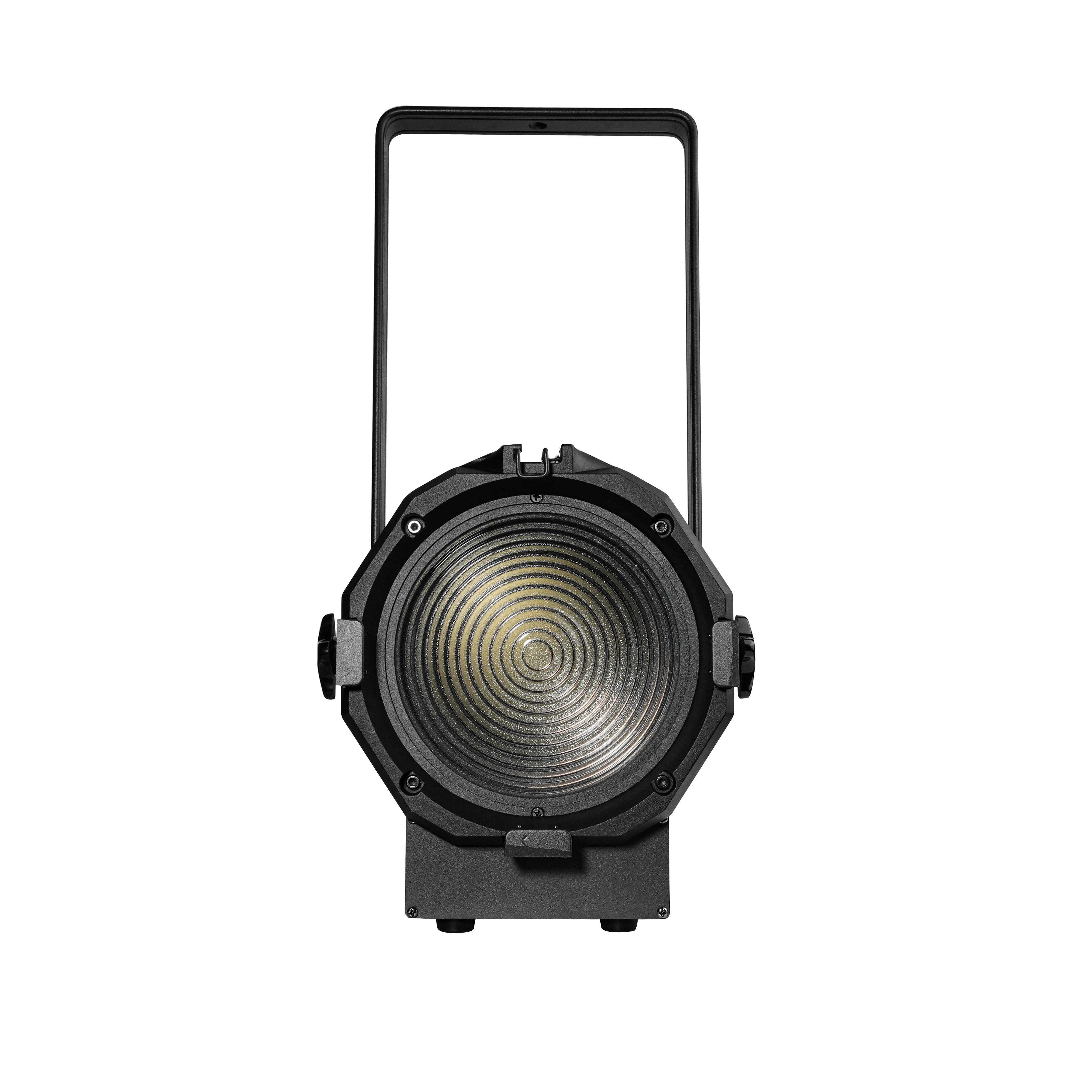
The product specifications provide useful reference points for sample evaluation. The high-resolution optical design and 12°-65° linear motorized zoom should produce a smooth change in beam coverage without abrupt movement or visible distortion. Inspect the projected field at several intermediate positions rather than checking only the two endpoints.
Beam and Zoom Verification
Place the sample at a consistent distance from a flat test surface and observe the beam center, outer edges, and overall shape. The center should remain stable as the motorized zoom changes from a narrow 12° beam to a wide 65° beam. Look for brightness rings, asymmetric falloff, sudden changes in edge definition, or lateral movement of the projected image.
It is also useful to perform the same observation at several dimming levels. The fixture specifies smooth linear dimming from 0-100% and four dimming curves. Output should remain predictable as intensity changes, with no unusual flicker, color shift, or apparent movement of the beam caused by inconsistent control behavior.
Framing and Barn-Door Checks
The four-leaf rotating barn-door system should be evaluated independently from the lens and then operated together with the zoom. Move every leaf across its adjustment range and confirm that the projected boundary follows the control movement evenly. A clean, repeatable edge indicates that the framing mechanism is functioning correctly.
Asymmetric coverage, an edge that changes position unexpectedly, or a beam center that shifts when a leaf is adjusted may point to a mechanical framing issue. If the entire beam moves or becomes uneven while zooming without barn-door movement, the optical assembly and its alignment should receive additional inspection.
Operating and Production Tests
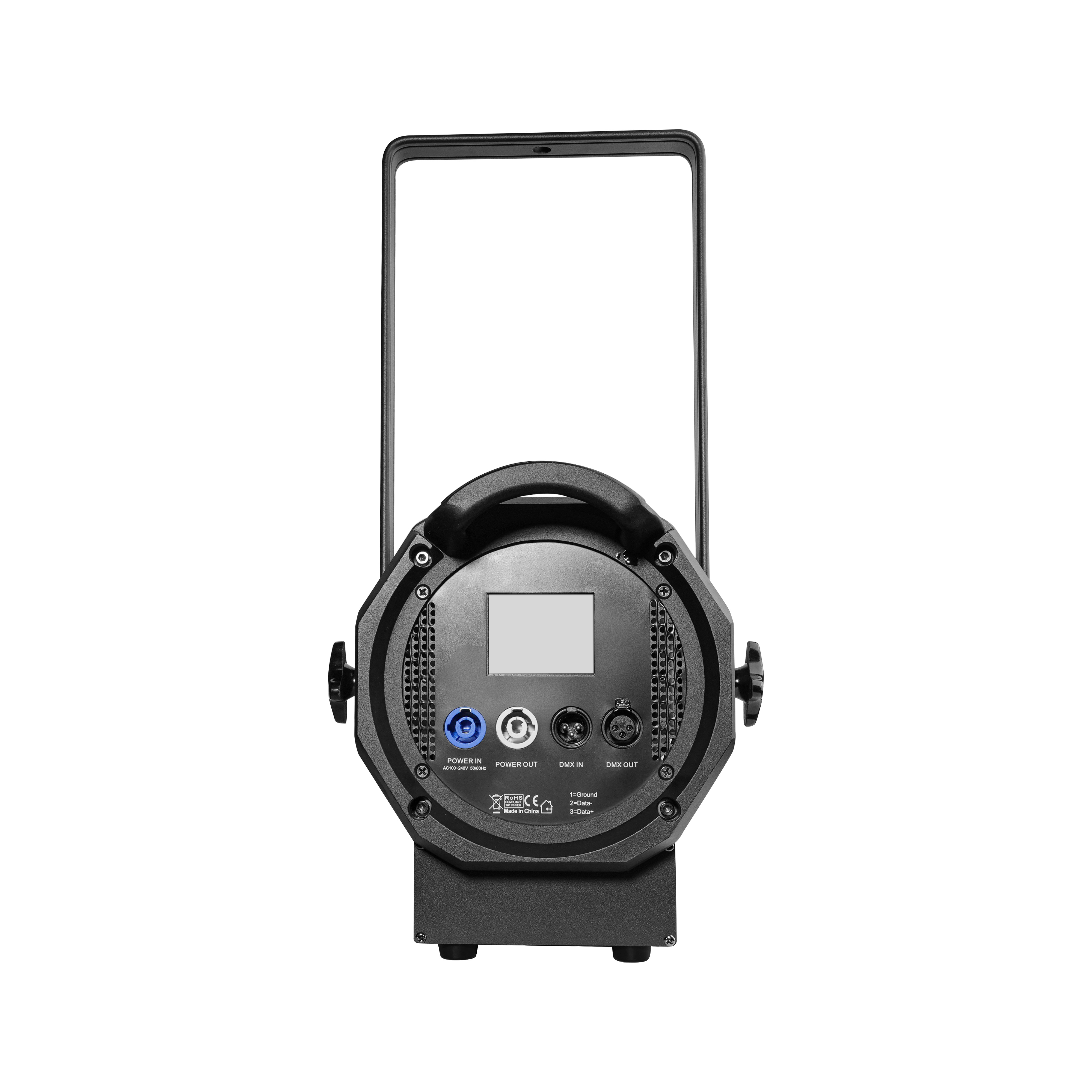
Optical checks should be repeated across the fixture's stated operating conditions, including different mounting positions and ambient temperatures from -25°C to 45°C. Constant temperature readout, thermal management, and over-temperature protection can help technicians observe whether the optical behavior remains stable as the fixture warms up.
For broadcast and film use, verify flicker-free performance and test the adjustable 2-25KHz frequency range. Use DMX512, RDM, master-slave, and automatic modes where applicable to confirm that zoom, dimming, color, and other relevant parameters respond consistently. Unexpected movement during remote control testing can be mistaken for an alignment defect, so both optical and control behavior should be documented separately.
Color Imagination states that its quality process includes optical performance verification, 100% functional testing, burn-in testing, safety inspection, and final quality checks. These records can support sample approval by showing whether the fixture maintained its original beam characteristics after extended operation. The company's R&D capabilities include optical design, mechanical development, electronic hardware, embedded software, thermal management, and lighting-control integration, all of which are relevant to stable lens positioning.
Sample Check Comparison
| Inspection Area | Reference Feature or Process | Potential Warning Sign |
|---|---|---|
| Zoom movement | 12°-65° linear motorized zoom with precision optics | Beam shift, uneven brightness, hesitation, or shape distortion |
| Beam uniformity | Optical performance verification and controlled dimming | Hot spots, dark areas, color variation, or unstable output |
| Framing accuracy | Four-leaf rotating barn-door system | Asymmetric edges, drifting boundaries, or poor repeatability |
| Long-duration stability | Burn-in, thermal management, and final quality checks | Alignment drift or changed projection after operation |
| Control response | DMX512, RDM, master-slave, and automatic modes | Unexpected parameter changes or inconsistent motor response |
Frequently Asked Questions
What should be checked first when a profile-light sample arrives?
Begin with optical centering and beam uniformity at the narrowest and widest zoom settings. These checks establish whether the lens assembly is positioned correctly before more detailed framing and control tests are performed.
How can a framing fault be separated from an optical alignment fault?
Operate the barn doors without changing zoom, then repeat the test while moving the zoom. Irregular boundaries that follow a specific leaf generally suggest a framing mechanism issue. Beam displacement or uneven coverage across the zoom range is more consistent with an optical alignment concern.
Why is burn-in verification necessary?
Heat, repeated motor movement, and extended operation can reveal changes that are not visible during an initial power-on test. Rechecking the beam after burn-in helps confirm that lens alignment and projection quality remain stable.
Which quality documents should accompany sample approval?
Useful supporting records include optical performance results, 100% functional-test records, burn-in results, safety inspection documentation, and final quality-check reports. These records provide traceability for the sample's operating performance.
Conclusion
A thorough profile-light sample inspection should combine optical centering, beam uniformity, zoom travel, barn-door framing, dimming, control response, temperature observation, and post-burn-in testing. The FRESNEL 500AS offers practical reference specifications, including a 12°-65° motorized zoom, four-leaf barn doors, 0-100% dimming, and documented optical testing.
Color Imagination provides OEM/ODM manufacturing and project support, with a minimum order quantity of 1 and a stated delivery period of 15-20 days after deposit. For technical consultation or customized lighting solutions, contact jack@color-imagination.com.
About Color Imagination
Guangzhou Color Imagination LED Lighting Limited, operating under the Color Imagination brand, is a Guangzhou-based manufacturer of professional stage and entertainment lighting. Founded in 2010, the company integrates R&D, production, sales, and technical service, employs 130 people, and supplies standard fixtures, OEM/ODM products, and project solutions for entertainment, broadcast, and architectural applications. Its certifications include CE and ISO, and its products have been used across a range of industries.

REPORT