







-
 Agriculture
-
 Health-Care
-
 Environment
-
 Construction-Real-Estate
-
 Tools-Hardware
-
 Home-Garden
-
 Furniture
-
 Luggage-Bags-Cases
-
 Medical-devices-Supplies
-
 Gifts-Crafts
-
 Sports-Entertainment
-
 Food-Beverage
-
 Vehicles-Transportation
-
 Power-Transmission
-
 Material-Handling
-
 Renewable-Energy
-
 Safety
-
 Testing-Instrument-Equipment
-
 Construction-Building-Machinery
-
 Pet-Supplies
-
 Personal-Care-Household-Cleaning
-
 Vehicle-Accessories-Electronics-Tools
-
 School-Office-Supplies
-
 Packaging-Printing
-
 Mother-Kids-Toys
-
 Business-Services
-
 Commercial-Equipment-Machinery
-
 Apparel-Accessories
-
 Security
-
 Shoes-Accessories
-
 Vehicle-Parts-Accessories
-
 Jewelry-Eyewear-Watches-Accessories
-
 Lights-Lighting
-
 Fabric-Textile-Raw-Material
-
 Fabrication-Services
-
 Industrial-Machinery
-
 Consumer-Electronics
-
 Electrical-Equipment-Supplies
-
 Electronic-Components-Accessories-Telecommunications
-
 Home-Appliances
-
 Beauty
-
 Chemicals
-
 Rubber-Plastics
-
 Metals-Alloys


























































































































































































































































































































































































































































































































































































- Masonry Materials
- Curtain Walls & Accessories
- Earthwork Products
- Fireproofing Materials
- Heat Insulation Materials
- Plastic Building Materials
- Building Boards
- Soundproofing Materials
- Timber
- Waterproofing Materials
- Balustrades & Handrails
- Bathroom & Kitchen
- Flooring & Accessories
- Tiles & Accessories
- Door, Window & Accessories
- Fireplaces & Stoves
- Floor Heating Systems & Parts
- Stairs & Stair Parts
- Ceilings
- Elevators & Escalators
- Stone
- Countertops, Vanity Tops & Table Tops
- Mosaics
- Metal Building Materials
- Multifunctional Materials
- Ladders & Scaffoldings
- Mouldings
- Corner Guards
- Decorative Films
- Formwork
- Building & Industrial Glass
- Other Construction & Real Estate
- Wallpapers/Wall panels
- HVAC System & Parts
- Outdoor Facilities
- Prefabricated Buildings
- Festive & Party Supplies
- Bathroom Products
- Household Sundries
- Rain Gear
- Garden Supplies
- Household Cleaning Tools & Accessories
- Lighters & Smoking Accessories
- Home Storage & Organization
- Household Scales
- Smart Home Improvement
- Home Textiles
- Kitchenware
- Drinkware & Accessories
- Dinnerware, Coffee & Wine
- Home Decor
- Golf
- Fitness & Body Building
- Amusement Park Facilities
- Billiards, Board Game,Coin Operated Games
- Musical Instruments
- Outdoor Affordable Luxury Sports
- Camping & Hiking
- Fishing
- Sports Safety&Rehabilitation
- Ball Sports Equipments
- Water Sports
- Winter Sports
- Luxury Travel Equipments
- Sports Shoes, Bags & Accessories
- Cycling
- Other Sports & Entertainment Products
- Artificial Grass&Sports Flooring&Sports Court Equipment
- Scooters
- Food Ingredients
- Honey & Honey Products
- Snacks
- Nuts & Kernels
- Seafood
- Plant & Animal Oil
- Beverages
- Fruit & Vegetable Products
- Frog & Escargot
- Bean Products
- Egg Products
- Dairy Products
- Seasonings & Condiments
- Canned Food
- Instant Food
- Baked Goods
- Other Food & Beverage
- Meat & Poultry
- Confectionery
- Grain Products
- Feminie Care
- Hair Care & Styling
- Body Care
- Hands & Feet Care
- Hygiene Products
- Men's Grooming
- Laundry Cleaning Supplies
- Travel Size & Gift Sets
- Room Deodorizers
- Other Personal Care Products
- Pest Control Products
- Special Household Cleaning
- Floor Cleaning
- Kitchen & Bathroom Cleaning
- Oral Care
- Bath Supplies
- Yellow Pages
- Correction Supplies
- Office Binding Supplies
- Office Cutting Supplies
- Board Erasers
- Office Adhesives & Tapes
- Education Supplies
- Pencil Cases & Bags
- Notebooks & Writing Pads
- File Folder Accessories
- Calendars
- Writing Accessories
- Commercial Office Supplies
- Pencil Sharpeners
- Pens
- Letter Pad/Paper
- Paper Envelopes
- Desk Organizers
- Pencils
- Markers & Highlighters
- Filing Products
- Art Supplies
- Easels
- Badge Holder & Accessories
- Office Paper
- Printer Supplies
- Book Covers
- Other Office & School Supplies
- Stationery Set
- Boards
- Clipboards
- Stamps
- Drafting Supplies
- Stencils
- Electronic Dictionary
- Books
- Map
- Magazines
- Calculators
- Baby & Toddler Toys
- Educational Toys
- Classic Toys
- Dress Up & Pretend Play
- Toy Vehicle
- Stuffed Animals & Plush Toys
- Outdoor Toys & Structures
- Balloons & Accessories
- Baby Food
- Children's Clothing
- Baby Supplies & Products
- Maternity Clothes
- Kids Shoes
- Baby Care
- Novelty & Gag Toys
- Dolls & Accessories
- Puzzle & Games
- Blocks & Model Building Toys
- Toddler Clothing
- Baby Clothing
- Kids' Luggage & Bags
- Arts, Crafts & DIY Toys
- Action & Toy Figures
- Baby Appliances
- Hobbies & Models
- Remote Control Toys
- Promotional Toys
- Pregnancy & Maternity
- Hygiene Products
- Kid's Textile&Bedding
- Novelty & Special Use
- Toy Weapons
- Baby Gifts
- Baby Storage & Organization
- Auto Drive Systems
- ATV/UTV Parts & Accessories
- Marine Parts & Accessories
- Other Auto Parts
- Trailer Parts & Accessories
- Auto Transmission Systems
- Train Parts & Accessories
- Universal Parts
- Railway Parts & Accessories
- Auto Brake Systems
- Aviation Parts & Accessories
- Truck Parts & Accessories
- Auto Suspension Systems
- Auto Lighting Systems
- New Energy Vehicle Parts & Accessories
- Auto Steering Systems
- Wheels, Tires & Accessories
- Bus Parts & Accessories
- Auto Performance Parts
- Cooling System
- Go-Kart & Kart Racer Parts & Accessories
- Air Conditioning Systems
- Heavy Duty Vehicle Parts & Accessories
- Auto Electrical Systems
- Auto Body Systems
- Auto Engine Systems
- Container Parts & Accessories
- Motorcycle Parts & Accessories
- Refrigeration & Heat Exchange Equipment
- Machine Tool Equipment
- Food & Beverage Machinery
- Agricultural Machinery & Equipment
- Apparel & Textile Machinery
- Chemical Machinery
- Packaging Machines
- Paper Production Machinery
- Plastic & Rubber Processing Machinery
- Industrial Robots
- Electronic Products Machinery
- Metal & Metallurgy Machinery
- Woodworking Machinery
- Home Product Manufacturing Machinery
- Machinery Accessories
- Environmental Machinery
- Machinery Service
- Electrical Equipment Manufacturing Machinery
- Industrial Compressors & Parts
- Tobacco & Cigarette Machinery
- Production Line
- Used Industrial Machinery
- Electronics Production Machinery
- Other Machinery & Industrial Equipment
- Camera, Photo & Accessories
- Portable Audio, Video & Accessories
- Television, Home Audio, Video & Accessories
- Video Games & Accessories
- Mobile Phone & Accessories
- Electronic Publications
- Earphone & Headphone & Accessories
- Speakers & Accessories
- Smart Electronics
- TV Receivers & Accessories
- Mobile Phone & Computer Repair Parts
- Chargers, Batteries & Power Supplies
- Used Electronics
- VR, AR, MR Hardware & Software
- Projectors & Presentation Equipments
- Other Consumer Electronics
- Cables & Commonly Used Accessories
- Computer Hardware & Software
- Displays, Signage and Optoelectronics
- Discrete Semiconductors
- Wireless & IoT Module and Products
- Telecommunications
- Connectors, Terminals & Accessories
- Development Boards, Electronic Modules and Kits
- Circuit Protection
- Sensors
- Isolators
- Audio Components and Products
- Integrated Circuits
- Power Supplies
- Relays
- RF, Microwave and RFID
- Electronic Accessories & Supplies
- Passive Components
- PCB & PCBA
- Air Quality Appliances
- Home Appliance Parts
- Heating & Cooling Appliances
- Small Kitchen Appliances
- Laundry Appliances
- Water Heaters
- Water Treatment Appliances
- Refrigerators & Freezers
- Personal Care & Beauty Appliances
- Major Kitchen Appliances
- Cleaning Appliances
- Second-hand Appliances
- Smart Home Appliances
- Other Home Appliances
- Energy Chemicals
- Inorganic Chemicals
- Basic Organic Chemicals
- Agrochemicals
- Admixture & Additives
- Catalysts & Chemical Auxiliary Agents
- Pigments & Dyestuff
- Coating & Paint
- Daily Chemicals
- Polymer
- Organic Intermediate
- Adhesives & Sealants
- Chemical Waste
- Biological Chemical Products
- Surface Treatment Chemicals
- Painting & Coating
- Chemical Reagents
- Flavor & Fragrance
- Non-Explosive Demolition Agents
- Other Chemicals
- Custom Chemical Services

Key Trends Defining the Next Generation of Insulated Lunch Bags
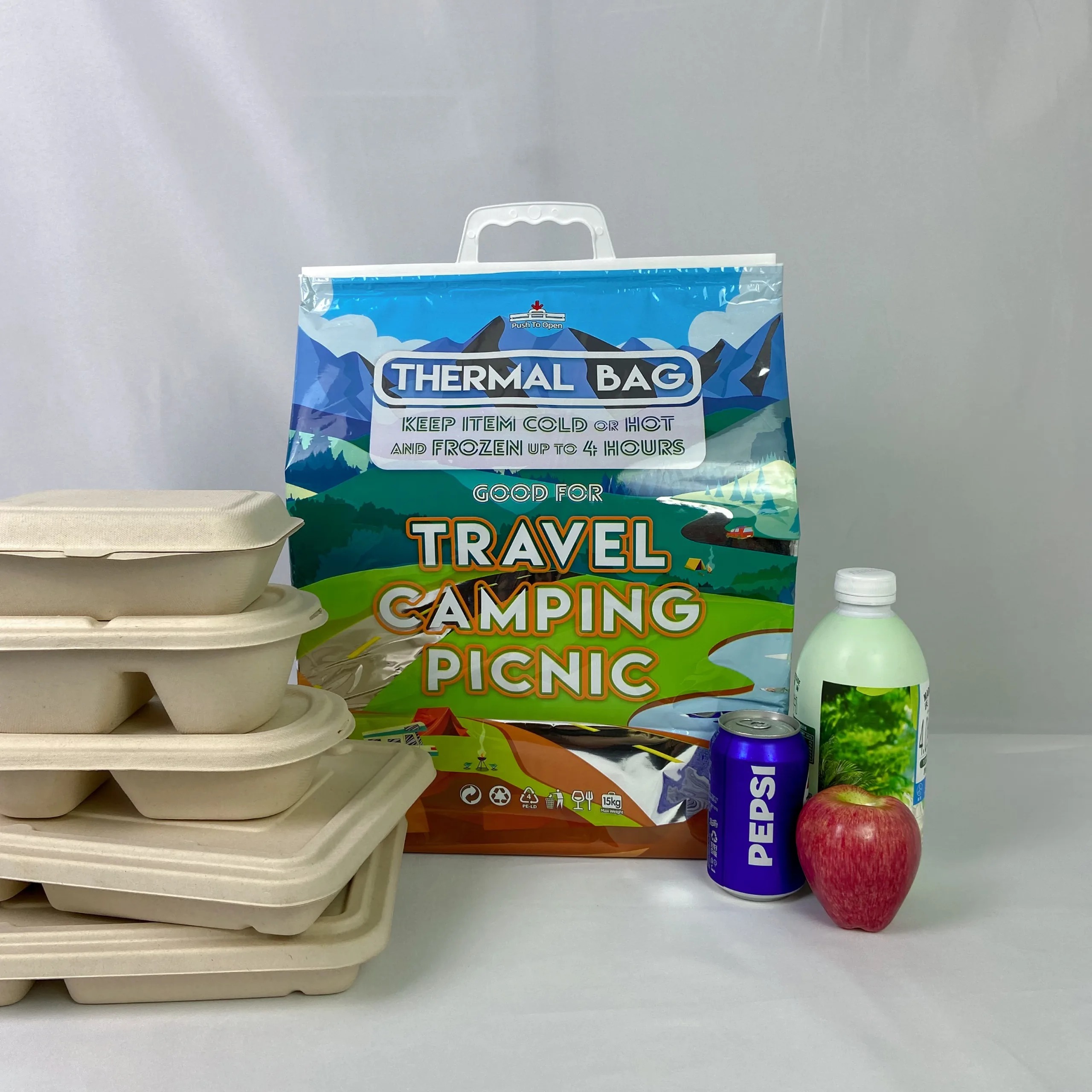
Insulated lunch bags are evolving from simple thermal carriers into configurable packaging solutions for food delivery, grocery distribution, cold-chain logistics, temperature-sensitive goods, and branded daily use. The latest designs combine reflective aluminium foil laminates, closed-cell EPE foam, food-safe sealing layers, reinforced square bottoms, adjustable gussets, practical closures, moulded handles, and expanded printing coverage.
Key Developments in Insulated Lunch Bag Design
- Square-bottom construction with side gussets and a folded base panel improves stability and supports different packing volumes.
- Aluminium foil laminate, closed-cell EPE foam, and food-grade PE sealant form a flexible thermal packaging structure.
- Customisation now includes dimensions, core materials, closures, handles, print coverage, colours, and structural details.
- Insulated formats are being adapted for hot meal delivery, grocery transport, pharmacy logistics, meal kits, and temperature-sensitive online orders.
How the Structure Supports Different Applications
A square-bottom insulated bag is built with a folded base panel and gussets on both sides. The base depth can be specified at 10, 12, or 15 cm, either matching the gusset size or being selected independently. Standard dimensions range from 30 x 35 x 10 cm to 45 x 50 x 15 cm, enabling the bag to accommodate different food containers, grocery products, and shipment volumes.
The thermal layer generally consists of an aluminium foil outer laminate combined with a 2-5 mm closed-cell EPE foam core. An air-bubble insulation core can also be requested for selected applications. On the inside, a food-grade PE sealant provides the product-contact surface, while the foil layer contributes reflective performance and a metallic exterior. Unprinted silver foil is available when a plain reflective appearance is preferred to full-colour graphics.
Closures, Handles, and Print Coverage
Closure options are another important part of current insulated bag development. The standard design uses a flat seal, while a slider zip or tear notch can be added according to the intended use. A moulded handle is sealed into the upper band to make carrying easier and to support takeaway, retail, grocery, meal-kit, and personal lunch applications.
Branding can extend over the front, back, and both side gussets rather than being limited to one panel. Custom Pantone colours help maintain brand consistency across the complete visible surface. For restaurants and delivery businesses, printing can continue up to the top edge, creating a larger branded area during transport, handover, and customer use.
Application-Specific Thermal Packaging
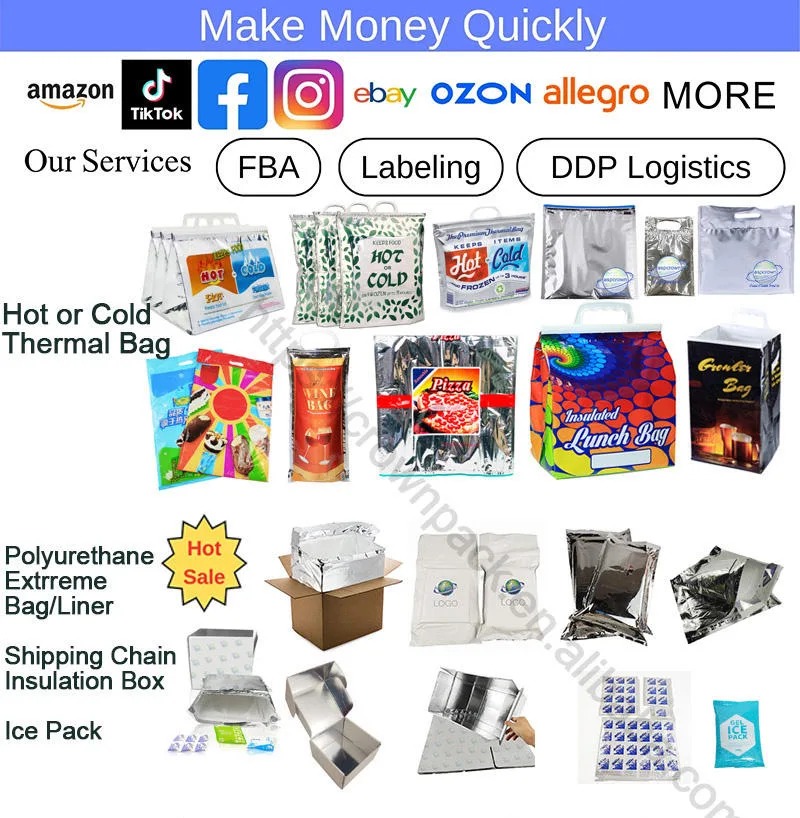
Different temperature-control requirements are influencing the way insulated packaging is specified. Hot food delivery bags often use a foil-lined body and a firm flat base to keep takeaway containers level during movement. Grocery and cold-chain versions may incorporate a separate gel-pack sleeve and a waterproof inner membrane to manage condensation and thaw water.
Pharmacy and healthcare applications generally require more controlled temperature management. These formats can be designed around phase-change gel packs and may include an unprinted panel for temperature indicators, batch information, or monitoring labels. The same adaptable structure can therefore be configured for both everyday food transport and more demanding logistics environments.
Materials, Manufacturing, and Quality Control
The expansion of insulated lunch bags is part of a wider development in flexible packaging. Ecopack Packaging produces insulated mailers, thermal packaging, coffee bags, pet food bags, stand-up pouches, spout pouches, kraft and compostable bags, and ESD bags. This broader capability allows material combinations such as foil, kraft, compostable, and other barrier structures to be selected according to the product and distribution conditions.
Manufacturing control also contributes to reliable bag performance. Huizhou Ecopack Packaging Products Co., Ltd. manages structural design and tooling internally, provides a 3D structural drawing before printing plates are produced, and validates new designs on a physical sample bag. Its integrated workflow covers research and development, printing, lamination, bag making, and inspection. The company reports using twelve-colour rotogravure and eight-colour flexographic presses, together with matte and gloss lamination, spot UV, metallic ink, and holographic finishing options.
Quality procedures include incoming material checks, in-process controls, and pre-shipment inspection under an ISO 9001:2015 quality system. Finished bags undergo AQL sampling for appearance, dimensions, print registration, seal strength, and lamination bond. The company also holds FSC Chain of Custody certification for specified FSC Mix and FSC Recycled paper packaging products.
A documented US distributor project involves approximately 10 million insulated mailers per year for cold shipping. The reported solution was intended to reduce heat transfer while also lowering storage requirements, shipping volume, and waste compared with rigid foam packaging.
Configuration Comparison
| Design element | Configuration options | Suitable applications |
|---|---|---|
| Insulation core | 2-5 mm closed-cell EPE foam, with air bubble available by request | Lunch bags, food delivery, and temperature-sensitive transport |
| Outer layer | Aluminium foil laminate with full-colour printing or plain silver foil | Branded delivery bags and higher-barrier thermal packaging |
| Base and gussets | Square bottom, two side gussets, folded base panel, and 10/12/15 cm base depths | Stable packing for takeaway containers and grocery products |
| Closure system | Flat seal, slider zip, or tear notch on request | Single-use sealed formats and reusable or reclosable designs |
| Print area | Front, back, and both side gussets with custom Pantone colours | Restaurants, delivery fleets, retailers, and e-commerce brands |
Frequently Asked Questions
Which materials are used in a square-bottom insulated bag?
The standard construction includes an aluminium foil laminate outer layer, a 2-5 mm closed-cell EPE foam core, and a food-grade PE sealant layer for product contact. An air-bubble core may be specified for certain requirements.
Can the bag be adjusted for different products and packing formats?
Yes. Buyers can customise the dimensions, base depth, insulation core, printing, colour, closure, handle, and overall structure. Typical sizes range from 30 x 35 x 10 cm to 45 x 50 x 15 cm.
How long do sampling and production usually take?
Samples generally require 3 to 5 working days. Standard production is usually completed within 15 to 25 days after artwork approval. Custom orders commonly begin at 5,000 to 10,000 pieces, with the final MOQ determined by the specification.
Conclusion and Purchasing Considerations
The next generation of insulated lunch bags is defined by modular construction, selectable thermal materials, improved stability, practical closure choices, and larger branding surfaces. Before approving a design, buyers should confirm the required dimensions, base depth, foam or air-bubble core, food-contact layer, closure, print coverage, and operating temperature conditions.
Ecopack Packaging supports these requirements through in-house R&D, printing, lamination, bag making, inspection, and export services. For technical specifications or project support, please contact manager@ecoppack.com.
About Us
Huizhou Ecopack Packaging Products Co., Ltd. is a flexible packaging manufacturer based in Guangdong, China, and established in 2011. The company supplies custom composite pouches and bags, including insulated mailers and thermal packaging, coffee bags, pet food packaging, spout pouches, kraft and compostable formats, and ESD bags. It exports to more than 40 countries and has a production capacity of over 500,000 pouches per day, with R&D, printing, lamination, bag making, and inspection managed in-house.
The company maintains ISO 9001:2015 Quality Management System certification and FSC Chain of Custody certification. Its customers operate across several industries, including a US distributor using insulated mailers for cold-shipping applications.

REPORT