







-
 Agriculture
-
 Health-Care
-
 Environment
-
 Construction-Real-Estate
-
 Tools-Hardware
-
 Home-Garden
-
 Furniture
-
 Luggage-Bags-Cases
-
 Medical-devices-Supplies
-
 Gifts-Crafts
-
 Sports-Entertainment
-
 Food-Beverage
-
 Vehicles-Transportation
-
 Power-Transmission
-
 Material-Handling
-
 Renewable-Energy
-
 Safety
-
 Testing-Instrument-Equipment
-
 Construction-Building-Machinery
-
 Pet-Supplies
-
 Personal-Care-Household-Cleaning
-
 Vehicle-Accessories-Electronics-Tools
-
 School-Office-Supplies
-
 Packaging-Printing
-
 Mother-Kids-Toys
-
 Business-Services
-
 Commercial-Equipment-Machinery
-
 Apparel-Accessories
-
 Security
-
 Shoes-Accessories
-
 Vehicle-Parts-Accessories
-
 Jewelry-Eyewear-Watches-Accessories
-
 Lights-Lighting
-
 Fabric-Textile-Raw-Material
-
 Fabrication-Services
-
 Industrial-Machinery
-
 Consumer-Electronics
-
 Electrical-Equipment-Supplies
-
 Electronic-Components-Accessories-Telecommunications
-
 Home-Appliances
-
 Beauty
-
 Chemicals
-
 Rubber-Plastics
-
 Metals-Alloys


























































































































































































































































































































































































































































































































































































- Masonry Materials
- Curtain Walls & Accessories
- Earthwork Products
- Fireproofing Materials
- Heat Insulation Materials
- Plastic Building Materials
- Building Boards
- Soundproofing Materials
- Timber
- Waterproofing Materials
- Balustrades & Handrails
- Bathroom & Kitchen
- Flooring & Accessories
- Tiles & Accessories
- Door, Window & Accessories
- Fireplaces & Stoves
- Floor Heating Systems & Parts
- Stairs & Stair Parts
- Ceilings
- Elevators & Escalators
- Stone
- Countertops, Vanity Tops & Table Tops
- Mosaics
- Metal Building Materials
- Multifunctional Materials
- Ladders & Scaffoldings
- Mouldings
- Corner Guards
- Decorative Films
- Formwork
- Building & Industrial Glass
- Other Construction & Real Estate
- Wallpapers/Wall panels
- HVAC System & Parts
- Outdoor Facilities
- Prefabricated Buildings
- Festive & Party Supplies
- Bathroom Products
- Household Sundries
- Rain Gear
- Garden Supplies
- Household Cleaning Tools & Accessories
- Lighters & Smoking Accessories
- Home Storage & Organization
- Household Scales
- Smart Home Improvement
- Home Textiles
- Kitchenware
- Drinkware & Accessories
- Dinnerware, Coffee & Wine
- Home Decor
- Golf
- Fitness & Body Building
- Amusement Park Facilities
- Billiards, Board Game,Coin Operated Games
- Musical Instruments
- Outdoor Affordable Luxury Sports
- Camping & Hiking
- Fishing
- Sports Safety&Rehabilitation
- Ball Sports Equipments
- Water Sports
- Winter Sports
- Luxury Travel Equipments
- Sports Shoes, Bags & Accessories
- Cycling
- Other Sports & Entertainment Products
- Artificial Grass&Sports Flooring&Sports Court Equipment
- Scooters
- Food Ingredients
- Honey & Honey Products
- Snacks
- Nuts & Kernels
- Seafood
- Plant & Animal Oil
- Beverages
- Fruit & Vegetable Products
- Frog & Escargot
- Bean Products
- Egg Products
- Dairy Products
- Seasonings & Condiments
- Canned Food
- Instant Food
- Baked Goods
- Other Food & Beverage
- Meat & Poultry
- Confectionery
- Grain Products
- Feminie Care
- Hair Care & Styling
- Body Care
- Hands & Feet Care
- Hygiene Products
- Men's Grooming
- Laundry Cleaning Supplies
- Travel Size & Gift Sets
- Room Deodorizers
- Other Personal Care Products
- Pest Control Products
- Special Household Cleaning
- Floor Cleaning
- Kitchen & Bathroom Cleaning
- Oral Care
- Bath Supplies
- Yellow Pages
- Correction Supplies
- Office Binding Supplies
- Office Cutting Supplies
- Board Erasers
- Office Adhesives & Tapes
- Education Supplies
- Pencil Cases & Bags
- Notebooks & Writing Pads
- File Folder Accessories
- Calendars
- Writing Accessories
- Commercial Office Supplies
- Pencil Sharpeners
- Pens
- Letter Pad/Paper
- Paper Envelopes
- Desk Organizers
- Pencils
- Markers & Highlighters
- Filing Products
- Art Supplies
- Easels
- Badge Holder & Accessories
- Office Paper
- Printer Supplies
- Book Covers
- Other Office & School Supplies
- Stationery Set
- Boards
- Clipboards
- Stamps
- Drafting Supplies
- Stencils
- Electronic Dictionary
- Books
- Map
- Magazines
- Calculators
- Baby & Toddler Toys
- Educational Toys
- Classic Toys
- Dress Up & Pretend Play
- Toy Vehicle
- Stuffed Animals & Plush Toys
- Outdoor Toys & Structures
- Balloons & Accessories
- Baby Food
- Children's Clothing
- Baby Supplies & Products
- Maternity Clothes
- Kids Shoes
- Baby Care
- Novelty & Gag Toys
- Dolls & Accessories
- Puzzle & Games
- Blocks & Model Building Toys
- Toddler Clothing
- Baby Clothing
- Kids' Luggage & Bags
- Arts, Crafts & DIY Toys
- Action & Toy Figures
- Baby Appliances
- Hobbies & Models
- Remote Control Toys
- Promotional Toys
- Pregnancy & Maternity
- Hygiene Products
- Kid's Textile&Bedding
- Novelty & Special Use
- Toy Weapons
- Baby Gifts
- Baby Storage & Organization
- Auto Drive Systems
- ATV/UTV Parts & Accessories
- Marine Parts & Accessories
- Other Auto Parts
- Trailer Parts & Accessories
- Auto Transmission Systems
- Train Parts & Accessories
- Universal Parts
- Railway Parts & Accessories
- Auto Brake Systems
- Aviation Parts & Accessories
- Truck Parts & Accessories
- Auto Suspension Systems
- Auto Lighting Systems
- New Energy Vehicle Parts & Accessories
- Auto Steering Systems
- Wheels, Tires & Accessories
- Bus Parts & Accessories
- Auto Performance Parts
- Cooling System
- Go-Kart & Kart Racer Parts & Accessories
- Air Conditioning Systems
- Heavy Duty Vehicle Parts & Accessories
- Auto Electrical Systems
- Auto Body Systems
- Auto Engine Systems
- Container Parts & Accessories
- Motorcycle Parts & Accessories
- Refrigeration & Heat Exchange Equipment
- Machine Tool Equipment
- Food & Beverage Machinery
- Agricultural Machinery & Equipment
- Apparel & Textile Machinery
- Chemical Machinery
- Packaging Machines
- Paper Production Machinery
- Plastic & Rubber Processing Machinery
- Industrial Robots
- Electronic Products Machinery
- Metal & Metallurgy Machinery
- Woodworking Machinery
- Home Product Manufacturing Machinery
- Machinery Accessories
- Environmental Machinery
- Machinery Service
- Electrical Equipment Manufacturing Machinery
- Industrial Compressors & Parts
- Tobacco & Cigarette Machinery
- Production Line
- Used Industrial Machinery
- Electronics Production Machinery
- Other Machinery & Industrial Equipment
- Camera, Photo & Accessories
- Portable Audio, Video & Accessories
- Television, Home Audio, Video & Accessories
- Video Games & Accessories
- Mobile Phone & Accessories
- Electronic Publications
- Earphone & Headphone & Accessories
- Speakers & Accessories
- Smart Electronics
- TV Receivers & Accessories
- Mobile Phone & Computer Repair Parts
- Chargers, Batteries & Power Supplies
- Used Electronics
- VR, AR, MR Hardware & Software
- Projectors & Presentation Equipments
- Other Consumer Electronics
- Cables & Commonly Used Accessories
- Computer Hardware & Software
- Displays, Signage and Optoelectronics
- Discrete Semiconductors
- Wireless & IoT Module and Products
- Telecommunications
- Connectors, Terminals & Accessories
- Development Boards, Electronic Modules and Kits
- Circuit Protection
- Sensors
- Isolators
- Audio Components and Products
- Integrated Circuits
- Power Supplies
- Relays
- RF, Microwave and RFID
- Electronic Accessories & Supplies
- Passive Components
- PCB & PCBA
- Air Quality Appliances
- Home Appliance Parts
- Heating & Cooling Appliances
- Small Kitchen Appliances
- Laundry Appliances
- Water Heaters
- Water Treatment Appliances
- Refrigerators & Freezers
- Personal Care & Beauty Appliances
- Major Kitchen Appliances
- Cleaning Appliances
- Second-hand Appliances
- Smart Home Appliances
- Other Home Appliances
- Energy Chemicals
- Inorganic Chemicals
- Basic Organic Chemicals
- Agrochemicals
- Admixture & Additives
- Catalysts & Chemical Auxiliary Agents
- Pigments & Dyestuff
- Coating & Paint
- Daily Chemicals
- Polymer
- Organic Intermediate
- Adhesives & Sealants
- Chemical Waste
- Biological Chemical Products
- Surface Treatment Chemicals
- Painting & Coating
- Chemical Reagents
- Flavor & Fragrance
- Non-Explosive Demolition Agents
- Other Chemicals
- Custom Chemical Services

Navigating Customs Compliance for Electrostatic Flocking Fabric: How Proper Documentation Prevents Import Delays
Improper documentation, missing chemical test reports, or unverified sustainability credentials can lead to severe border delays and rejections for electrostatic flocking fabric imports. Customs agencies across North America and Europe rigorously audit technical textile shipments to verify hazardous substance levels, recycled material traceabilities, and tariff classifications before granting market entry.
Understanding Regulatory Frameworks for Import Clearance
Customs inspection protocols evaluate electrostatic flocking textiles—where short fibers are aligned under high electrical voltage (30 to 50 kV)—against strict environmental and health standard frameworks. Material variants such as Pearl Velvet and Claimond Veins Velvet incorporate distinct 0.3 to 1.0 mm bead-like textures onto spunlace or silk backing materials. Without verified lab certifications attached to the shipment, customs authorities frequently detain goods for independent chemical testing.

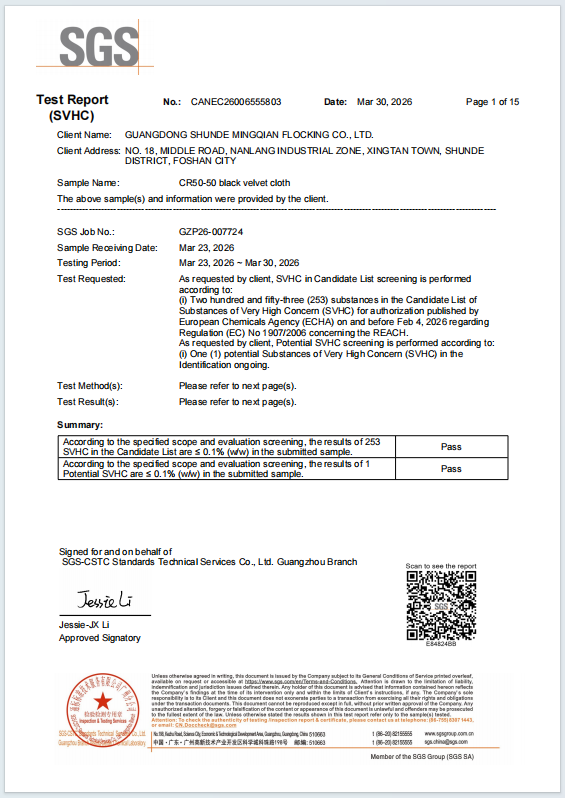
For entry into the European Union, adherence to REACH standards and the Packaging and Packaging Waste Regulation (PPWR) is compulsory. Certified shipments, validated under test report CANEC26006555803, confirm non-detection across 253 Substances of Very High Concern (SVHC). Additionally, report CANEC26006555801 certifies full compliance with RoHS 2.0 Directive 2015/863 covering ten restricted compounds. In the United States, flocking imports must meet TPCH/CONEG standards capping total heavy metals (lead, cadmium, mercury, and hexavalent chromium) under 100 ppm, alongside compliance with California Proposition 65 directives.
Technical Integrity & Anti-Tarnish Standards for Packaging Applications
High-end packaging uses, such as linings for fine jewelry, watches, and luxury items, demand strict physical and chemical controls. Premium flocking formulations rely on eco-friendly water-based acrylic adhesives, completely eliminating phthalates, organotin agents, and solvent residues. Quality assurance benchmarks mandate formaldehyde levels under 75 ppm and azo dyes below 30 ppm.
To prevent tarnish on enclosed precious metals, specialized jewelry flocking fabrics require precise chemical control. Free reactive sulfur must remain under 5 ppm, and aqueous extract pH values are stabilized between 5.5 and 7.5. Every batch undergoes accelerated silver coupon testing to verify that no tarnish or oxidation will occur inside sealed luxury boxes.
Essential Strategies for Seamless Border Clearance
- Mandate Comprehensive Chemical Declarations: Ensure test reports for REACH 253 SVHC screening and RoHS 2.0 directives are included in every shipping package to avoid port detentions.
- Maintain Chain-of-Custody Tracking for Recycled Goods: Shipments of eco-friendly recycled polyester or nylon flocking must feature GRS 4.0 Transaction Certificates (TC) linked to commercial invoices.
- Clarify Tariff Classifications: State whether the flocking fabric is destined for industrial packaging, luxury display boxes, or apparel to ensure accurate duty assessment.
- Adopt Clean Adhesive Chemistries: Utilize zero-PFAS, low-VOC (< 10 mg/m³) water-based formulations that leave zero organotin trace.
Product Grade & Technical Specifications Overview
| Flocking Category | Base Fabric Support | Compliance Credentials | Key Performance Indicators | MOQ & Lead Time |
|---|---|---|---|---|
| Standard Packaging Flocking | Spunlace, Nonwoven, Knitted | ISO 9001:2015, REACH SVHC Compliant | Delta E ≤ 2.0, Formaldehyde ≤ 75 ppm, Passed 10-cycle 3M Tape Test | 1,000 yards / 14 days |
| GRS Recycled Flocking | Recycled PET, Recycled Nylon | GRS 4.0 (Scope Cert SGC-GRC01308-GRS-2026-05R3) | Verified recycled content, Azo dyes ≤ 30 ppm, Low VOC emissions | 1,000 yards / 14 days |
| Anti-Tarnish Jewelry Flocking | Spunlace, Silk, Cotton-Rayon | EU PPWR, US TPCH, CA Prop 65 | Reactive Sulfur < 5 ppm, pH 5.5–7.5, Non-sulfur dye system, Silver coupon pass | 1,000 yards / 14 days |
| Industrial & Automotive Flocking | Nonwoven, Knitted, PVC | UL94 V-0 Flame Retardant, RoHS 2.0 | 100,000 abrasion cycles, Temp range -30°C to 80°C, Anti-static 10&sup6;–10&sup9; Ω | 1,000 yards / 14 days |
Frequently Asked Questions
Q1: What paperwork is required to pass EU customs inspection for flocking textiles?
Importers should present third-party compliance reports covering REACH 253 SVHC screening, RoHS 2.0 results, GRS 4.0 Transaction Certificates for recycled lines, along with standard commercial invoices detailing specific material compositions and intended usage.
Q2: Why is sulfur control vital for jewelry packaging fabric?
Excessive reactive sulfur (above 5 ppm) reacts with silver and precious metals, causing tarnish and discoloration. By enforcing sulfur levels under 5 ppm and maintaining an extract pH between 5.5 and 7.5, packaged luxury items remain protected against oxidation.
Q3: How are global exports handled efficiently?
Bulk shipments depart through key South China shipping ports such as Shenzhen and Guangzhou. Full export packages include origin certificates, packing lists, commercial invoices, bill of lading, and verified SGS test documentation.
Summary & Buyer Advice
Securing smooth international transit for electrostatic flocking fabric requires complete, verifiable batch testing and chemical safety compliance. Partnering with suppliers providing audited REACH, RoHS, GRS, and TPCH documentation safeguards your supply chain against expensive customs delays. For custom technical advice and certified samples, email us at 005@mingqianflocking.com.
About the Manufacturer
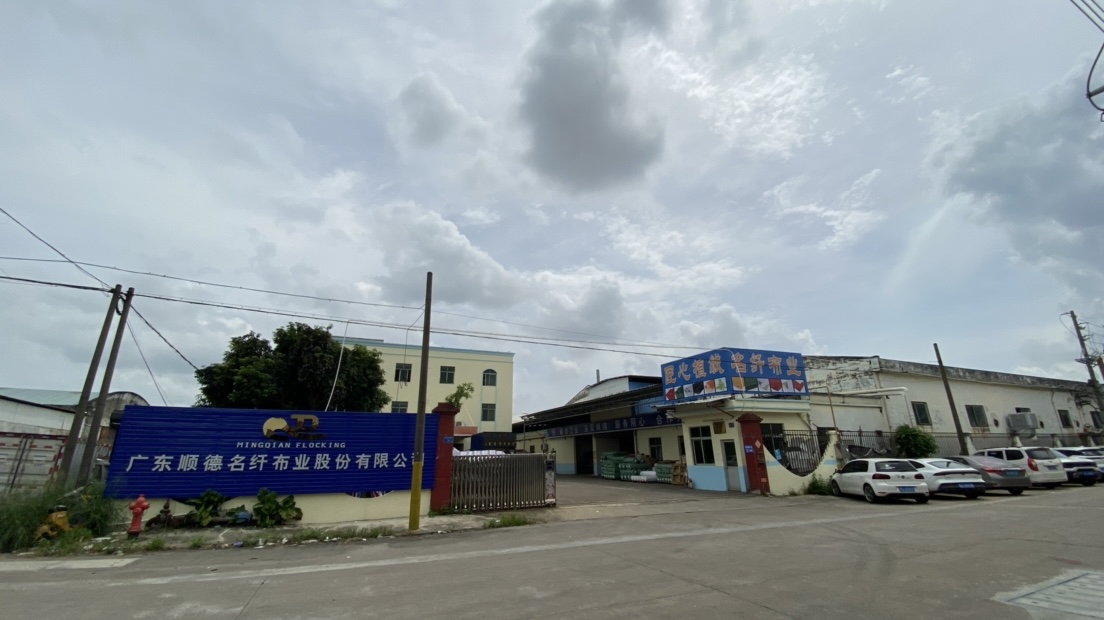
Guangdong Shunde Mingqian Flocking Co., Ltd. was founded in 2008 in Foshan City, Guangdong Province, China. Operating a 12,000 m² modern manufacturing plant equipped with 5 automated electrostatic flocking lines and a team of 100+ professionals, the company yields over 3,000,000 yards monthly. Certified under ISO 9001:2015 and GRS 4.0, Mingqian supplies premium flocking fabrics for global luxury packaging, automotive, electronic, and industrial markets.

REPORT