







-
 Agriculture
-
 Health-Care
-
 Environment
-
 Construction-Real-Estate
-
 Tools-Hardware
-
 Home-Garden
-
 Furniture
-
 Luggage-Bags-Cases
-
 Medical-devices-Supplies
-
 Gifts-Crafts
-
 Sports-Entertainment
-
 Food-Beverage
-
 Vehicles-Transportation
-
 Power-Transmission
-
 Material-Handling
-
 Renewable-Energy
-
 Safety
-
 Testing-Instrument-Equipment
-
 Construction-Building-Machinery
-
 Pet-Supplies
-
 Personal-Care-Household-Cleaning
-
 Vehicle-Accessories-Electronics-Tools
-
 School-Office-Supplies
-
 Packaging-Printing
-
 Mother-Kids-Toys
-
 Business-Services
-
 Commercial-Equipment-Machinery
-
 Apparel-Accessories
-
 Security
-
 Shoes-Accessories
-
 Vehicle-Parts-Accessories
-
 Jewelry-Eyewear-Watches-Accessories
-
 Lights-Lighting
-
 Fabric-Textile-Raw-Material
-
 Fabrication-Services
-
 Industrial-Machinery
-
 Consumer-Electronics
-
 Electrical-Equipment-Supplies
-
 Electronic-Components-Accessories-Telecommunications
-
 Home-Appliances
-
 Beauty
-
 Chemicals
-
 Rubber-Plastics
-
 Metals-Alloys


























































































































































































































































































































































































































































































































































































- Masonry Materials
- Curtain Walls & Accessories
- Earthwork Products
- Fireproofing Materials
- Heat Insulation Materials
- Plastic Building Materials
- Building Boards
- Soundproofing Materials
- Timber
- Waterproofing Materials
- Balustrades & Handrails
- Bathroom & Kitchen
- Flooring & Accessories
- Tiles & Accessories
- Door, Window & Accessories
- Fireplaces & Stoves
- Floor Heating Systems & Parts
- Stairs & Stair Parts
- Ceilings
- Elevators & Escalators
- Stone
- Countertops, Vanity Tops & Table Tops
- Mosaics
- Metal Building Materials
- Multifunctional Materials
- Ladders & Scaffoldings
- Mouldings
- Corner Guards
- Decorative Films
- Formwork
- Building & Industrial Glass
- Other Construction & Real Estate
- Wallpapers/Wall panels
- HVAC System & Parts
- Outdoor Facilities
- Prefabricated Buildings
- Festive & Party Supplies
- Bathroom Products
- Household Sundries
- Rain Gear
- Garden Supplies
- Household Cleaning Tools & Accessories
- Lighters & Smoking Accessories
- Home Storage & Organization
- Household Scales
- Smart Home Improvement
- Home Textiles
- Kitchenware
- Drinkware & Accessories
- Dinnerware, Coffee & Wine
- Home Decor
- Golf
- Fitness & Body Building
- Amusement Park Facilities
- Billiards, Board Game,Coin Operated Games
- Musical Instruments
- Outdoor Affordable Luxury Sports
- Camping & Hiking
- Fishing
- Sports Safety&Rehabilitation
- Ball Sports Equipments
- Water Sports
- Winter Sports
- Luxury Travel Equipments
- Sports Shoes, Bags & Accessories
- Cycling
- Other Sports & Entertainment Products
- Artificial Grass&Sports Flooring&Sports Court Equipment
- Scooters
- Food Ingredients
- Honey & Honey Products
- Snacks
- Nuts & Kernels
- Seafood
- Plant & Animal Oil
- Beverages
- Fruit & Vegetable Products
- Frog & Escargot
- Bean Products
- Egg Products
- Dairy Products
- Seasonings & Condiments
- Canned Food
- Instant Food
- Baked Goods
- Other Food & Beverage
- Meat & Poultry
- Confectionery
- Grain Products
- Feminie Care
- Hair Care & Styling
- Body Care
- Hands & Feet Care
- Hygiene Products
- Men's Grooming
- Laundry Cleaning Supplies
- Travel Size & Gift Sets
- Room Deodorizers
- Other Personal Care Products
- Pest Control Products
- Special Household Cleaning
- Floor Cleaning
- Kitchen & Bathroom Cleaning
- Oral Care
- Bath Supplies
- Yellow Pages
- Correction Supplies
- Office Binding Supplies
- Office Cutting Supplies
- Board Erasers
- Office Adhesives & Tapes
- Education Supplies
- Pencil Cases & Bags
- Notebooks & Writing Pads
- File Folder Accessories
- Calendars
- Writing Accessories
- Commercial Office Supplies
- Pencil Sharpeners
- Pens
- Letter Pad/Paper
- Paper Envelopes
- Desk Organizers
- Pencils
- Markers & Highlighters
- Filing Products
- Art Supplies
- Easels
- Badge Holder & Accessories
- Office Paper
- Printer Supplies
- Book Covers
- Other Office & School Supplies
- Stationery Set
- Boards
- Clipboards
- Stamps
- Drafting Supplies
- Stencils
- Electronic Dictionary
- Books
- Map
- Magazines
- Calculators
- Baby & Toddler Toys
- Educational Toys
- Classic Toys
- Dress Up & Pretend Play
- Toy Vehicle
- Stuffed Animals & Plush Toys
- Outdoor Toys & Structures
- Balloons & Accessories
- Baby Food
- Children's Clothing
- Baby Supplies & Products
- Maternity Clothes
- Kids Shoes
- Baby Care
- Novelty & Gag Toys
- Dolls & Accessories
- Puzzle & Games
- Blocks & Model Building Toys
- Toddler Clothing
- Baby Clothing
- Kids' Luggage & Bags
- Arts, Crafts & DIY Toys
- Action & Toy Figures
- Baby Appliances
- Hobbies & Models
- Remote Control Toys
- Promotional Toys
- Pregnancy & Maternity
- Hygiene Products
- Kid's Textile&Bedding
- Novelty & Special Use
- Toy Weapons
- Baby Gifts
- Baby Storage & Organization
- Auto Drive Systems
- ATV/UTV Parts & Accessories
- Marine Parts & Accessories
- Other Auto Parts
- Trailer Parts & Accessories
- Auto Transmission Systems
- Train Parts & Accessories
- Universal Parts
- Railway Parts & Accessories
- Auto Brake Systems
- Aviation Parts & Accessories
- Truck Parts & Accessories
- Auto Suspension Systems
- Auto Lighting Systems
- New Energy Vehicle Parts & Accessories
- Auto Steering Systems
- Wheels, Tires & Accessories
- Bus Parts & Accessories
- Auto Performance Parts
- Cooling System
- Go-Kart & Kart Racer Parts & Accessories
- Air Conditioning Systems
- Heavy Duty Vehicle Parts & Accessories
- Auto Electrical Systems
- Auto Body Systems
- Auto Engine Systems
- Container Parts & Accessories
- Motorcycle Parts & Accessories
- Refrigeration & Heat Exchange Equipment
- Machine Tool Equipment
- Food & Beverage Machinery
- Agricultural Machinery & Equipment
- Apparel & Textile Machinery
- Chemical Machinery
- Packaging Machines
- Paper Production Machinery
- Plastic & Rubber Processing Machinery
- Industrial Robots
- Electronic Products Machinery
- Metal & Metallurgy Machinery
- Woodworking Machinery
- Home Product Manufacturing Machinery
- Machinery Accessories
- Environmental Machinery
- Machinery Service
- Electrical Equipment Manufacturing Machinery
- Industrial Compressors & Parts
- Tobacco & Cigarette Machinery
- Production Line
- Used Industrial Machinery
- Electronics Production Machinery
- Other Machinery & Industrial Equipment
- Camera, Photo & Accessories
- Portable Audio, Video & Accessories
- Television, Home Audio, Video & Accessories
- Video Games & Accessories
- Mobile Phone & Accessories
- Electronic Publications
- Earphone & Headphone & Accessories
- Speakers & Accessories
- Smart Electronics
- TV Receivers & Accessories
- Mobile Phone & Computer Repair Parts
- Chargers, Batteries & Power Supplies
- Used Electronics
- VR, AR, MR Hardware & Software
- Projectors & Presentation Equipments
- Other Consumer Electronics
- Cables & Commonly Used Accessories
- Computer Hardware & Software
- Displays, Signage and Optoelectronics
- Discrete Semiconductors
- Wireless & IoT Module and Products
- Telecommunications
- Connectors, Terminals & Accessories
- Development Boards, Electronic Modules and Kits
- Circuit Protection
- Sensors
- Isolators
- Audio Components and Products
- Integrated Circuits
- Power Supplies
- Relays
- RF, Microwave and RFID
- Electronic Accessories & Supplies
- Passive Components
- PCB & PCBA
- Air Quality Appliances
- Home Appliance Parts
- Heating & Cooling Appliances
- Small Kitchen Appliances
- Laundry Appliances
- Water Heaters
- Water Treatment Appliances
- Refrigerators & Freezers
- Personal Care & Beauty Appliances
- Major Kitchen Appliances
- Cleaning Appliances
- Second-hand Appliances
- Smart Home Appliances
- Other Home Appliances
- Energy Chemicals
- Inorganic Chemicals
- Basic Organic Chemicals
- Agrochemicals
- Admixture & Additives
- Catalysts & Chemical Auxiliary Agents
- Pigments & Dyestuff
- Coating & Paint
- Daily Chemicals
- Polymer
- Organic Intermediate
- Adhesives & Sealants
- Chemical Waste
- Biological Chemical Products
- Surface Treatment Chemicals
- Painting & Coating
- Chemical Reagents
- Flavor & Fragrance
- Non-Explosive Demolition Agents
- Other Chemicals
- Custom Chemical Services

What Information Should You Provide for a Custom Insulated Cooler Bag Quote?
To prepare an accurate quotation for a custom insulated cooler bag, a factory needs more than the product name. The quotation brief should include the finished bag size, construction, insulation thickness and density, outer and inner films, closure system, sealing method, printing requirements, intended application, customization details, and expected order quantity. For a metallised foil insulated mailer, buyers should also confirm the sponge specification, film gauge, surface finish, colour treatment, and whether the bag requires a zipper, peel-and-seal strip, or both.
Quotation Information at a Glance
- Confirm the bag style and finished dimensions, including whether it is a flat mailer without a gusset and whether the size is standard or custom.
- Describe every material layer, such as the silver metallised outer film, 20 mm full-face sponge insulation, and wipe-clean PE inner film.
- List all closure and sealing features, including the two-rib zipper, peel-and-seal adhesive strip, and welded edges.
- Explain the end use, whether for medicine, chilled food, perishables, product samples, pharmacy cold-chain shipments, or e-commerce fulfilment.
- Provide the target quantity, artwork requirements, quality expectations, and required delivery schedule.
Key Design Details a Factory Uses for Costing
1. Finished Format and Dimensions
The first step in costing is to establish the finished format. This product is a flat insulated mailer with no gusset, so the factory needs the required width and height, along with the preferred size category from S to XL. These measurements influence the cutting layout, material consumption, finished capacity, and carton packing arrangement.
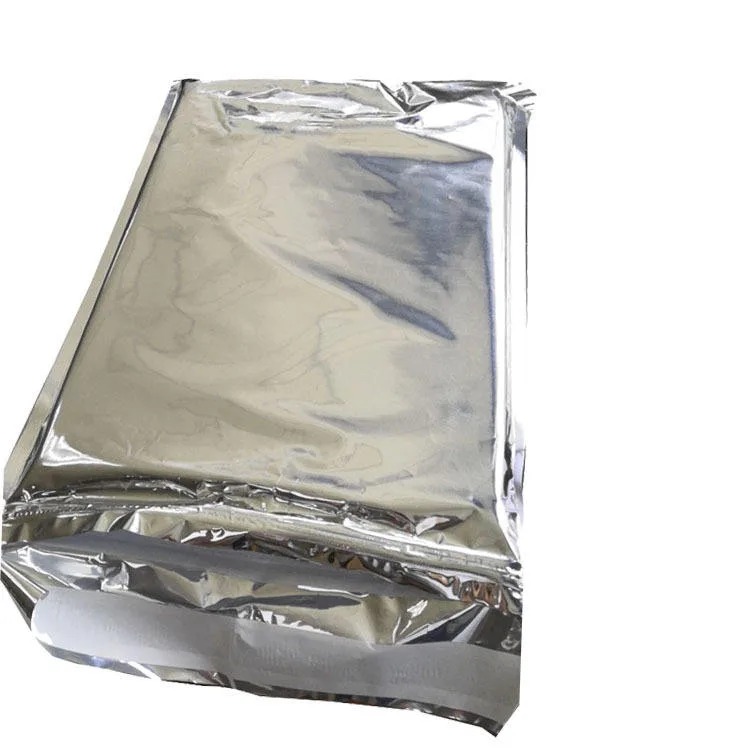
The buyer should state whether the dimensions are fixed or open to the factory's recommendations. Even a small change in width or height can affect the production layout and price. It is also useful to specify whether the quoted size refers to the outside dimensions, inside usable space, or the dimensions measured after sealing.
2. Insulation and Film Construction
Insulation is a major part of the quotation because it determines the product's material cost, thickness, flexibility, and thermal performance. The listed design uses a 20 mm sponge layer covering the full face of the mailer. If the application requires a different sponge density, thickness, or coverage area, this should be identified at the beginning.
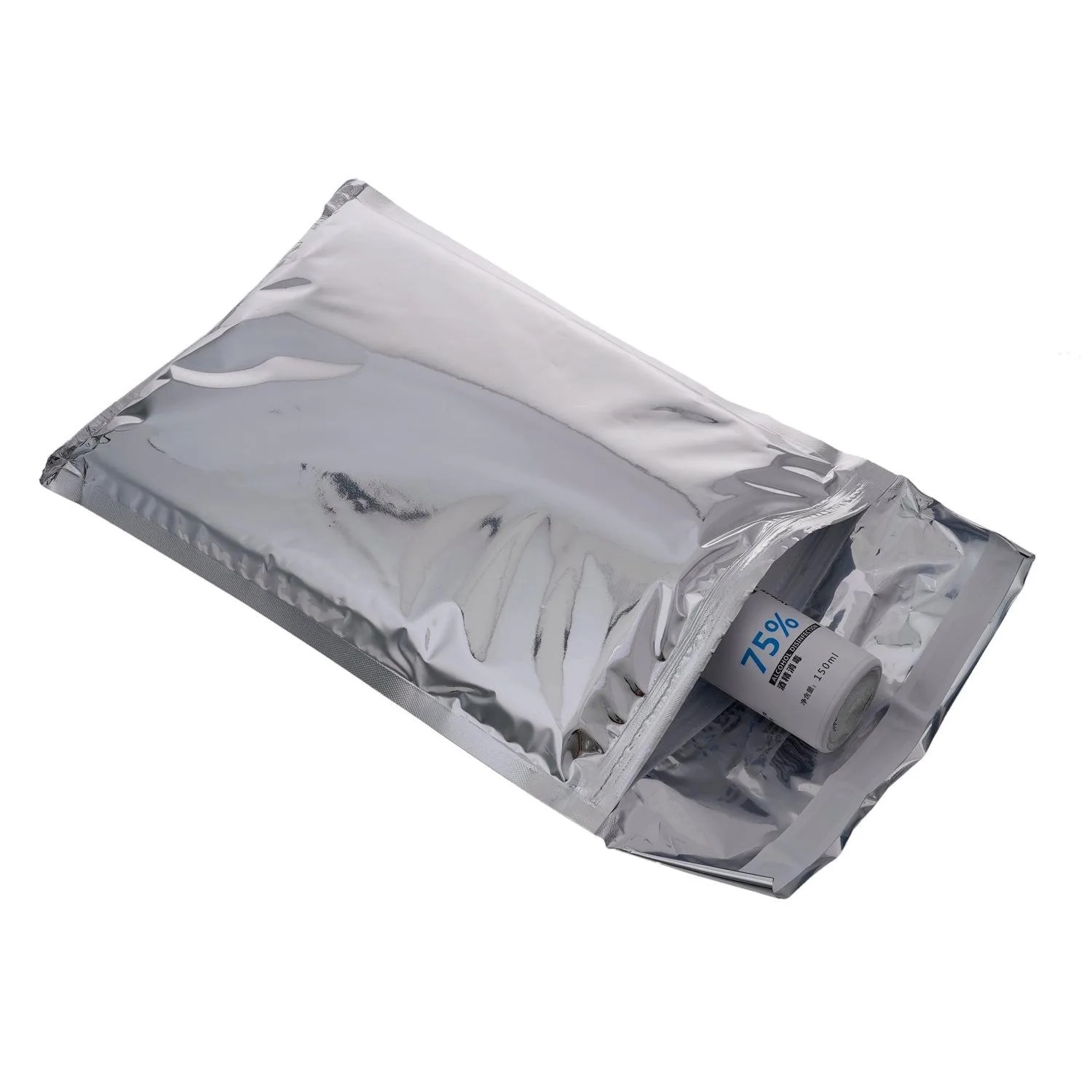
The outside layer is silver metallised film with a reflective surface, while the inside uses PE film with a sealant layer. A complete request should state the required film gauge and whether the finish should remain standard silver or change to matt silver. These choices affect appearance, print compatibility, durability, and the final unit price.
3. Closure, Sealing, and Reuse
Closure components should be described separately from the film structure. This insulated mailer combines a two-rib zipper with a peel-and-seal adhesive strip, while the remaining three sides are welded closed. The factory needs confirmation that both closure features are required and should receive the desired position and usable opening dimensions.
The intended shipping workflow also matters. A zipper supports repeated access and resealing, while a peel-and-seal strip provides a convenient shipping closure. If the mailer must support returns, inspection, or multiple openings during delivery, the design brief should make that requirement explicit.
4. Printing and Surface Appearance
Print instructions should identify the number of colours, the print side, and the exact visible panel. The listed construction supports one to two colours on metallised film, with a white base available when it is needed to improve colour visibility. The artwork package should include the logo position, colour references, print coverage, and any request for a matt silver effect.
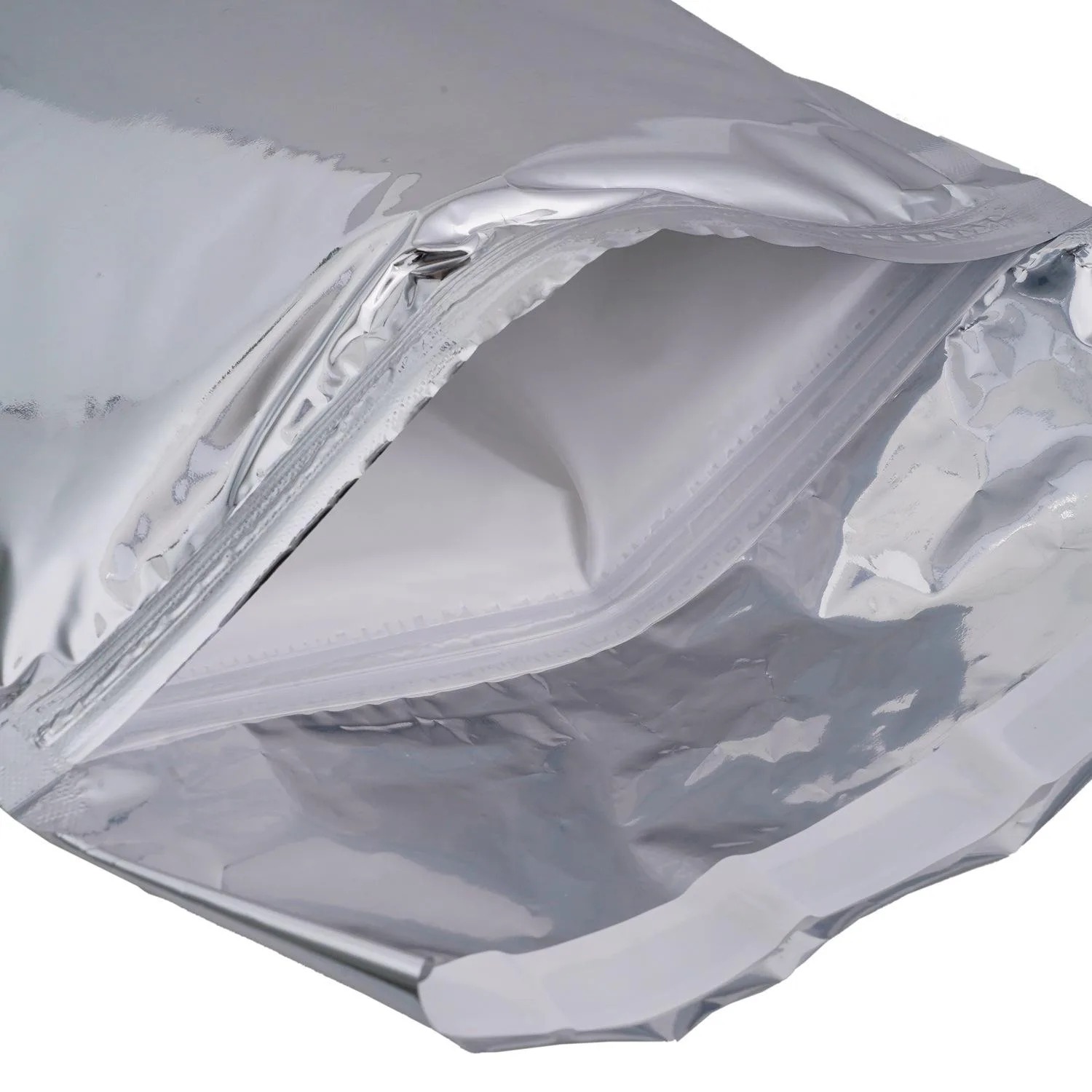
New designs are approved on a physical sample bag. This is important for reflective materials because colours and contrast can appear different on a screen compared with the finished metallised film. Ecopack reviews the design on the actual bag before printing plates are produced.
5. Application and Cold-Chain Requirements
The product may be used for medicine, chilled food, perishables, samples, or e-commerce parcel fulfilment. The application should be included in the request because it can influence the insulation structure, labelling, closure, and packing method.
For pharmacy or 2-8°C cold-chain shipments, the broader packaging system may also need to include a gel-pack sleeve, a front label window, or documents that travel with the shipment. These requirements should be listed separately rather than assumed from the term “insulated.” The quotation can then reflect the complete shipping solution instead of only the empty mailer.
6. Quantity, Sampling, and Inspection
Order volume has a direct effect on material purchasing, printing setup, production planning, and unit pricing. Buyers should provide the expected quantity, initial launch volume, repeat-order expectations, and target delivery date. Custom production generally runs at approximately 5,000 to 10,000 pieces, subject to confirmation according to the final structure and artwork.
Samples normally require 3 to 5 working days, while regular production takes about 15 to 25 days after artwork approval. Quality requirements should be agreed before the quotation is finalized. Ecopack manages incoming material checks, in-process inspections, and pre-shipment inspections under its ISO 9001:2015 system, with AQL sampling for finished products. When independent verification is required, samples can be sent to a laboratory selected by the buyer and shipped against the resulting report.
Quotation Input and Design Impact
| Quotation Category | Details the Buyer Should Supply | Why It Matters |
|---|---|---|
| Format and dimensions | Flat mailer or other style, width, height, internal space, and size category | Controls the cutting plan, material consumption, capacity, and packing dimensions |
| Material structure | Outer film, inner PE film, film gauge, sponge thickness, and sponge density | Defines thermal protection, flexibility, barrier properties, and cost |
| Closure and sealing | Two-rib zipper, peel-and-seal strip, welded edges, and opening requirements | Determines assembly steps, ease of use, and whether the bag can be reopened |
| Printing and finish | One or two colours, white base, print location, logo placement, and matt silver option | Sets the artwork, plate, printing, and surface treatment requirements |
| End use and volume | Medicine, food, perishables, samples, cold-chain conditions, quantity, and timing | Supports material selection, capacity planning, sampling, and price calculation |
Frequently Asked Questions
What details are essential for an initial quotation?
At minimum, provide the finished width and height, mailer format, material layers, insulation specification, closure type, print colours, intended use, and target order quantity. The factory can then recommend or confirm the construction and production method.
Can the metallised foil insulated mailer be modified?
Yes. Available customization may include the bag dimensions, sponge density, film gauge, silver or matt silver finish, and printed design. Each requested change should be stated clearly so the quotation reflects the actual product rather than the standard reference construction.
What are the sample and production lead times?
Samples generally take 3 to 5 working days. Production usually requires 15 to 25 days after the artwork has been approved. The production schedule begins once the approved artwork and final specifications are available.
Conclusion
An accurate custom insulated cooler bag quotation depends on a complete technical brief. Include the finished dimensions, bag format, insulation layers, film gauges, closure and sealing methods, print details, surface finish, application, order quantity, delivery timing, and inspection requirements. Providing these details together allows the manufacturer to evaluate material consumption, production steps, tooling, and quality controls with fewer assumptions.
Huizhou Ecopack Packaging Co., Ltd. is a manufacturer and exporter with in-house R&D, printing, lamination, bag making, and inspection capabilities. Custom projects commonly run from 5,000 to 10,000 pieces, while ISO 9001:2015 quality management and FSC Chain of Custody certification provide documented production credentials. For technical support or a project quotation, contact manager@ecoppack.com.
About Ecopack
Huizhou Ecopack Packaging Products Co., Ltd. is a flexible packaging manufacturer based in Guangdong, China, and established in 2011. The company produces custom composite pouches and bags, including insulated mailers and thermal packaging, with printing and manufacturing completed in house for customers in more than 40 countries.
Ecopack provides in-house tooling and structural development, including 3D structural drawings for customer approval before printing plates are made. R&D, printing, lamination, bag making, and inspection are handled under one roof. Its certifications include ISO 9001:2015 Quality Management System and FSC Chain of Custody (FSC CoC). The company has supplied customers in several industries, including a United States distributor using insulated mailers for cold shipping. The flat format can help reduce storage and shipping space compared with rigid foam packaging.

REPORT