







-
 Agriculture
-
 Health-Care
-
 Environment
-
 Construction-Real-Estate
-
 Tools-Hardware
-
 Home-Garden
-
 Furniture
-
 Luggage-Bags-Cases
-
 Medical-devices-Supplies
-
 Gifts-Crafts
-
 Sports-Entertainment
-
 Food-Beverage
-
 Vehicles-Transportation
-
 Power-Transmission
-
 Material-Handling
-
 Renewable-Energy
-
 Safety
-
 Testing-Instrument-Equipment
-
 Construction-Building-Machinery
-
 Pet-Supplies
-
 Personal-Care-Household-Cleaning
-
 Vehicle-Accessories-Electronics-Tools
-
 School-Office-Supplies
-
 Packaging-Printing
-
 Mother-Kids-Toys
-
 Business-Services
-
 Commercial-Equipment-Machinery
-
 Apparel-Accessories
-
 Security
-
 Shoes-Accessories
-
 Vehicle-Parts-Accessories
-
 Jewelry-Eyewear-Watches-Accessories
-
 Lights-Lighting
-
 Fabric-Textile-Raw-Material
-
 Fabrication-Services
-
 Industrial-Machinery
-
 Consumer-Electronics
-
 Electrical-Equipment-Supplies
-
 Electronic-Components-Accessories-Telecommunications
-
 Home-Appliances
-
 Beauty
-
 Chemicals
-
 Rubber-Plastics
-
 Metals-Alloys


























































































































































































































































































































































































































































































































































































- Masonry Materials
- Curtain Walls & Accessories
- Earthwork Products
- Fireproofing Materials
- Heat Insulation Materials
- Plastic Building Materials
- Building Boards
- Soundproofing Materials
- Timber
- Waterproofing Materials
- Balustrades & Handrails
- Bathroom & Kitchen
- Flooring & Accessories
- Tiles & Accessories
- Door, Window & Accessories
- Fireplaces & Stoves
- Floor Heating Systems & Parts
- Stairs & Stair Parts
- Ceilings
- Elevators & Escalators
- Stone
- Countertops, Vanity Tops & Table Tops
- Mosaics
- Metal Building Materials
- Multifunctional Materials
- Ladders & Scaffoldings
- Mouldings
- Corner Guards
- Decorative Films
- Formwork
- Building & Industrial Glass
- Other Construction & Real Estate
- Wallpapers/Wall panels
- HVAC System & Parts
- Outdoor Facilities
- Prefabricated Buildings
- Festive & Party Supplies
- Bathroom Products
- Household Sundries
- Rain Gear
- Garden Supplies
- Household Cleaning Tools & Accessories
- Lighters & Smoking Accessories
- Home Storage & Organization
- Household Scales
- Smart Home Improvement
- Home Textiles
- Kitchenware
- Drinkware & Accessories
- Dinnerware, Coffee & Wine
- Home Decor
- Golf
- Fitness & Body Building
- Amusement Park Facilities
- Billiards, Board Game,Coin Operated Games
- Musical Instruments
- Outdoor Affordable Luxury Sports
- Camping & Hiking
- Fishing
- Sports Safety&Rehabilitation
- Ball Sports Equipments
- Water Sports
- Winter Sports
- Luxury Travel Equipments
- Sports Shoes, Bags & Accessories
- Cycling
- Other Sports & Entertainment Products
- Artificial Grass&Sports Flooring&Sports Court Equipment
- Scooters
- Food Ingredients
- Honey & Honey Products
- Snacks
- Nuts & Kernels
- Seafood
- Plant & Animal Oil
- Beverages
- Fruit & Vegetable Products
- Frog & Escargot
- Bean Products
- Egg Products
- Dairy Products
- Seasonings & Condiments
- Canned Food
- Instant Food
- Baked Goods
- Other Food & Beverage
- Meat & Poultry
- Confectionery
- Grain Products
- Feminie Care
- Hair Care & Styling
- Body Care
- Hands & Feet Care
- Hygiene Products
- Men's Grooming
- Laundry Cleaning Supplies
- Travel Size & Gift Sets
- Room Deodorizers
- Other Personal Care Products
- Pest Control Products
- Special Household Cleaning
- Floor Cleaning
- Kitchen & Bathroom Cleaning
- Oral Care
- Bath Supplies
- Yellow Pages
- Correction Supplies
- Office Binding Supplies
- Office Cutting Supplies
- Board Erasers
- Office Adhesives & Tapes
- Education Supplies
- Pencil Cases & Bags
- Notebooks & Writing Pads
- File Folder Accessories
- Calendars
- Writing Accessories
- Commercial Office Supplies
- Pencil Sharpeners
- Pens
- Letter Pad/Paper
- Paper Envelopes
- Desk Organizers
- Pencils
- Markers & Highlighters
- Filing Products
- Art Supplies
- Easels
- Badge Holder & Accessories
- Office Paper
- Printer Supplies
- Book Covers
- Other Office & School Supplies
- Stationery Set
- Boards
- Clipboards
- Stamps
- Drafting Supplies
- Stencils
- Electronic Dictionary
- Books
- Map
- Magazines
- Calculators
- Baby & Toddler Toys
- Educational Toys
- Classic Toys
- Dress Up & Pretend Play
- Toy Vehicle
- Stuffed Animals & Plush Toys
- Outdoor Toys & Structures
- Balloons & Accessories
- Baby Food
- Children's Clothing
- Baby Supplies & Products
- Maternity Clothes
- Kids Shoes
- Baby Care
- Novelty & Gag Toys
- Dolls & Accessories
- Puzzle & Games
- Blocks & Model Building Toys
- Toddler Clothing
- Baby Clothing
- Kids' Luggage & Bags
- Arts, Crafts & DIY Toys
- Action & Toy Figures
- Baby Appliances
- Hobbies & Models
- Remote Control Toys
- Promotional Toys
- Pregnancy & Maternity
- Hygiene Products
- Kid's Textile&Bedding
- Novelty & Special Use
- Toy Weapons
- Baby Gifts
- Baby Storage & Organization
- Auto Drive Systems
- ATV/UTV Parts & Accessories
- Marine Parts & Accessories
- Other Auto Parts
- Trailer Parts & Accessories
- Auto Transmission Systems
- Train Parts & Accessories
- Universal Parts
- Railway Parts & Accessories
- Auto Brake Systems
- Aviation Parts & Accessories
- Truck Parts & Accessories
- Auto Suspension Systems
- Auto Lighting Systems
- New Energy Vehicle Parts & Accessories
- Auto Steering Systems
- Wheels, Tires & Accessories
- Bus Parts & Accessories
- Auto Performance Parts
- Cooling System
- Go-Kart & Kart Racer Parts & Accessories
- Air Conditioning Systems
- Heavy Duty Vehicle Parts & Accessories
- Auto Electrical Systems
- Auto Body Systems
- Auto Engine Systems
- Container Parts & Accessories
- Motorcycle Parts & Accessories
- Refrigeration & Heat Exchange Equipment
- Machine Tool Equipment
- Food & Beverage Machinery
- Agricultural Machinery & Equipment
- Apparel & Textile Machinery
- Chemical Machinery
- Packaging Machines
- Paper Production Machinery
- Plastic & Rubber Processing Machinery
- Industrial Robots
- Electronic Products Machinery
- Metal & Metallurgy Machinery
- Woodworking Machinery
- Home Product Manufacturing Machinery
- Machinery Accessories
- Environmental Machinery
- Machinery Service
- Electrical Equipment Manufacturing Machinery
- Industrial Compressors & Parts
- Tobacco & Cigarette Machinery
- Production Line
- Used Industrial Machinery
- Electronics Production Machinery
- Other Machinery & Industrial Equipment
- Camera, Photo & Accessories
- Portable Audio, Video & Accessories
- Television, Home Audio, Video & Accessories
- Video Games & Accessories
- Mobile Phone & Accessories
- Electronic Publications
- Earphone & Headphone & Accessories
- Speakers & Accessories
- Smart Electronics
- TV Receivers & Accessories
- Mobile Phone & Computer Repair Parts
- Chargers, Batteries & Power Supplies
- Used Electronics
- VR, AR, MR Hardware & Software
- Projectors & Presentation Equipments
- Other Consumer Electronics
- Cables & Commonly Used Accessories
- Computer Hardware & Software
- Displays, Signage and Optoelectronics
- Discrete Semiconductors
- Wireless & IoT Module and Products
- Telecommunications
- Connectors, Terminals & Accessories
- Development Boards, Electronic Modules and Kits
- Circuit Protection
- Sensors
- Isolators
- Audio Components and Products
- Integrated Circuits
- Power Supplies
- Relays
- RF, Microwave and RFID
- Electronic Accessories & Supplies
- Passive Components
- PCB & PCBA
- Air Quality Appliances
- Home Appliance Parts
- Heating & Cooling Appliances
- Small Kitchen Appliances
- Laundry Appliances
- Water Heaters
- Water Treatment Appliances
- Refrigerators & Freezers
- Personal Care & Beauty Appliances
- Major Kitchen Appliances
- Cleaning Appliances
- Second-hand Appliances
- Smart Home Appliances
- Other Home Appliances
- Energy Chemicals
- Inorganic Chemicals
- Basic Organic Chemicals
- Agrochemicals
- Admixture & Additives
- Catalysts & Chemical Auxiliary Agents
- Pigments & Dyestuff
- Coating & Paint
- Daily Chemicals
- Polymer
- Organic Intermediate
- Adhesives & Sealants
- Chemical Waste
- Biological Chemical Products
- Surface Treatment Chemicals
- Painting & Coating
- Chemical Reagents
- Flavor & Fragrance
- Non-Explosive Demolition Agents
- Other Chemicals
- Custom Chemical Services

How Film Usage Shapes the Operating Cost of a Patty Packaging Line
Film is a recurring production expense on a patty packaging line, and its impact depends on more than the purchase price of the roll. Pack dimensions, film width, material structure, sealing performance, changeover waste, and rejected packages all affect the cost of each saleable pack. Because the available system information does not include patty film prices or confirmed consumption rates, the most reliable approach is to measure real film usage against accepted output.
How to Control Film-Related Packaging Costs
- Match the film width and bag length to the patty format as closely as production requirements allow. Product width, height, and pack length directly determine film consumption.
- Record packs rejected because of missing products, seal failures, or weight deviations. Every rejected pack has already used film and may also contain wasted product.
- Use stored recipes, servo-driven film control, and photoelectric registration to make film positioning consistent across runs and reduce setup errors.
- Before equipment delivery, test representative patties and the intended packaging film to verify sealing, tracking, throughput, and pack appearance in actual operating conditions.
How a Flow Wrapper Uses Film
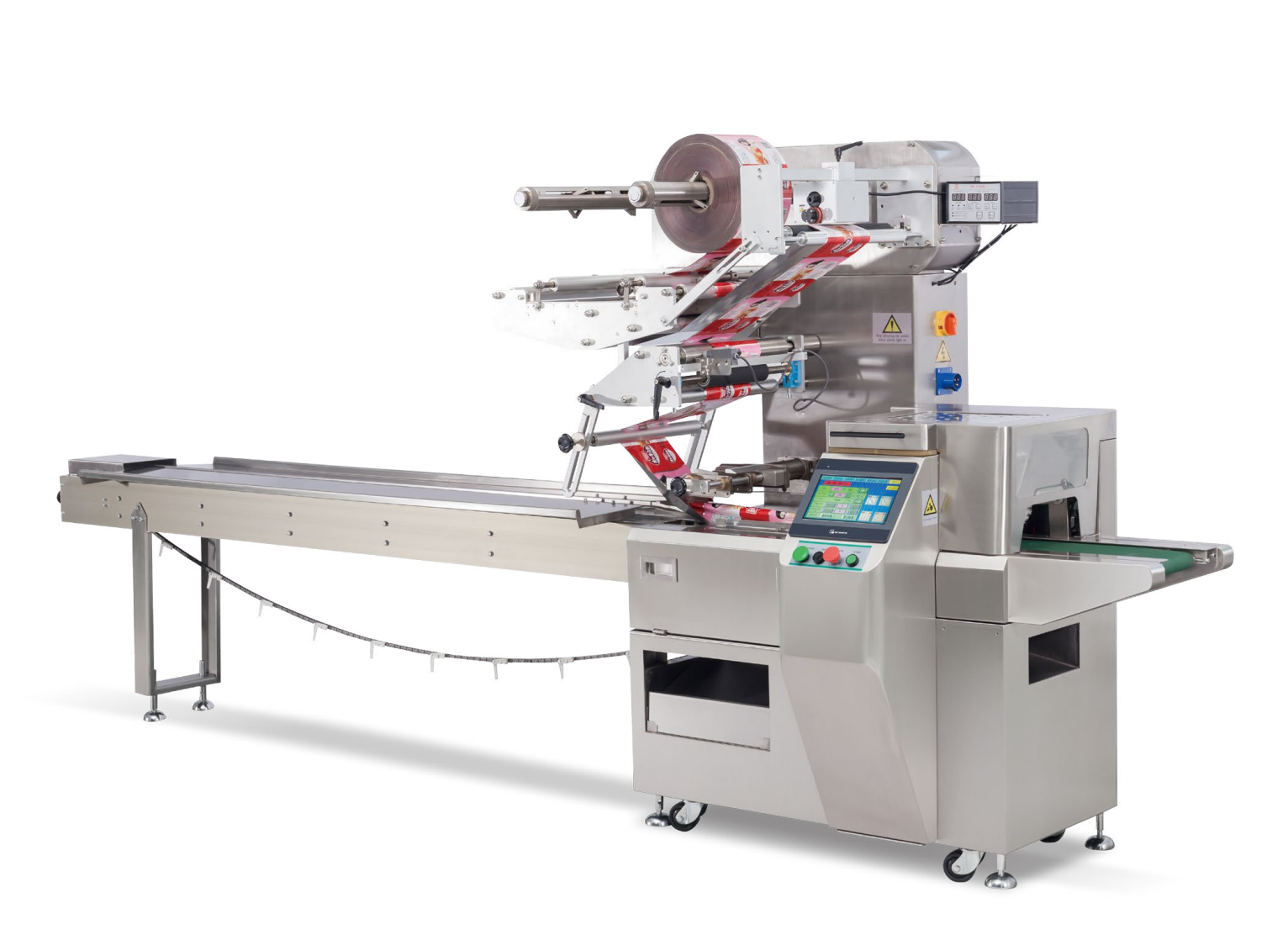
A horizontal flow wrapper draws film around the product, forms a longitudinal fin seal, creates sealed ends, cuts individual packs, and transfers them to the discharge conveyor. Since film is used on every cycle, any unnecessary increase in film width, pack length, material grade, or production waste raises the packaging cost per accepted unit.
Machine Range and Pack Configuration
The supplied wafer automatic packaging system is designed for pillow packs and can handle wafer biscuits, wafer bars, creamed wafers, sandwich wafers, and chocolate-coated wafers. Depending on the model, the stated film-width range is 90 to 900 mm and the adjustable bag-making length is 60 to 400 mm. These specifications demonstrate why film expenditure should be calculated for the selected product format and machine configuration rather than assigned as a single fixed line cost.
Film Handling and Waste Prevention
The available configuration may include a double pneumatic reel holder, a dancer roller with closed-loop servo tension control, and an optional automatic film splicer. Stable tension helps maintain consistent film feeding, while photoelectric tracking supports accurate positioning of printed film. These functions can reduce registration errors, poorly formed packs, and material discarded during adjustments. When specified, an automatic splicer can also support film changes with less interruption to production.
Film waste should be assessed alongside quality rejects. The line can be equipped with automatic rejection for miss-sealed packs, missing products, and weight errors. This protects downstream quality, but each rejected package still consumes film without contributing to saleable output. Cost calculations should therefore include purchased film, startup waste, changeover waste, and film used for rejected packs.
Supporting Equipment and Production Context
Optional downstream modules include a checkweigher, metal detector, labeler, cartoning machine, and robotic palletizer. These additions can increase operating and maintenance requirements, while their inspection and handling functions may reduce the chance of defective packs continuing through the line. The manufacturer lists CE certificate M.2024.206.C107511 for flow packaging machines, automatic packaging systems, cartoning machines, and palletizing robots.
One listed cooperation project involves a chocolate pie cake packaging system supplied for a bakery manufacturer operating across Vietnam, Korea, and China. The project combines forming, baking, filling, enrobing, wrapping, and palletizing. It shows how film consumption should be examined as part of total line performance, using output volume and rejected-pack records rather than evaluating the wrapper in isolation.
Film-Cost Factors at a Glance
| Cost factor | Relevant system capability or parameter | How it affects film cost |
|---|---|---|
| Finished-pack dimensions | Bag-making length: 60 to 400 mm; product width: up to 350 mm; product height: up to 120 mm | A larger product format generally requires more film for each pack. |
| Film specification | Film width: 90 to 900 mm, depending on model; heat-sealable laminate films supported | Film width and material construction determine consumption and purchase cost. |
| Registration and tension | Servo tension control, dancer roller, and photoelectric color-mark tracking with stated accuracy of plus or minus 1 mm | Accurate feeding can reduce misalignment, defective seals, and avoidable film loss. |
| Format changes | Recipe storage for 50 to 200 products; optional automatic splicer | Repeatable recipes and efficient film changes can reduce setup and changeover waste. |
| Quality rejection | Automatic rejection for miss-seal, missing product, or weight-error conditions | Rejects increase the quantity of film used for every accepted finished pack. |
Frequently Asked Questions
Is a specific film price available for this patty packaging line?
No. The supplied information describes equipment capabilities and compatible film types, but it does not state film purchase prices, patty dimensions, consumption per pack, or a patty-specific production rate.
What should be checked when film expenditure increases?
Review the selected film width, bag length, product dimensions, film tension, printed-film registration, rejection percentage, and changeover procedure. These variables are most closely connected to film usage and material waste.
Can the same flow wrapper run multiple pack formats?
The system provides adjustable bag-making lengths and model-dependent film-width ranges, while recipe storage supports repeatable settings for different products. Final suitability depends on the patty dimensions, film structure, sealing requirements, and desired pack style.
Conclusion and Recommendations
To determine the true film cost of a patty packaging line, compare the amount of film purchased with accepted packs and rejected output. Then review film width, pack length, registration accuracy, tension stability, and material discarded during changeovers. Foshan Ruipuhua Machinery Equipment Co. Ltd offers manufacturing and OEM cooperation, a stated minimum order quantity of one, sample testing, and engineer support. Its listed CE credential covers relevant flow packaging and automatic packaging equipment. For technical consultation, contact us at lotuspack@ruipuhua.com.
About Foshan Ruipuhua Machinery Equipment Co. Ltd
Foshan Ruipuhua Machinery Equipment Co. Ltd develops and manufactures intelligent packaging machinery, providing research and development, production, installation, and technical after-sales service. Founded in 2005, the company supplies packaging machines and automated lines for bakery, biscuit, snack, confectionery, noodle, soap, hardware, pharmaceutical, and daily chemical applications. Its portfolio includes horizontal flow wrappers, automatic feeding systems, cartoners, case packers, and palletizing equipment. The machines are sold in more than 100 countries, and the company lists CE certification and experience serving customers in multiple industries.

REPORT